How Negative Press Propagates Through LLM Brand Representations
Negative news embeds in AI models weeks after PR teams move on.
Negative press about a brand doesn't move through a large language model the way it moves through a news cycle. It embeds, lags behind the original event by weeks, and resurfaces on its own schedule, usually after the PR team has already closed the file. That delayed resurfacing is the second crisis, and most brands don't see it coming until they're standing in the middle of it.
The mechanism explains why. LLMs don't hold a live mirror up to the web the way a search index does. They compress patterns from training data into weighted associations, and once those associations set, they harden. Preventing them takes far less effort than reversing them after the fact. Researchers have started calling the gap between a negative event's appearance online and its full arrival in model outputs "LLM sentiment drift." The lag is the whole problem: the crisis a brand thinks it survived is still loading somewhere else, on a timeline nobody in the PR department is watching.
Source weight compounds it further. A negative headline from an outlet like the Financial Times reportedly carries more influence on model outputs than the identical allegation posted to an anonymous forum, even when that forum pulls far more traffic. That inverts how PR teams are trained to think about risk, and it got stranger once licensing deals between major platforms and Reddit took effect in 2024. A moderately active thread can now outweigh a major newspaper's coverage in what a model actually learns. The growing share of synthetic data in training pipelines, estimated at 10% to 30% of modern LLM training sets, amplifies a skewed or manipulated narrative recursively before any communications team knows it exists.
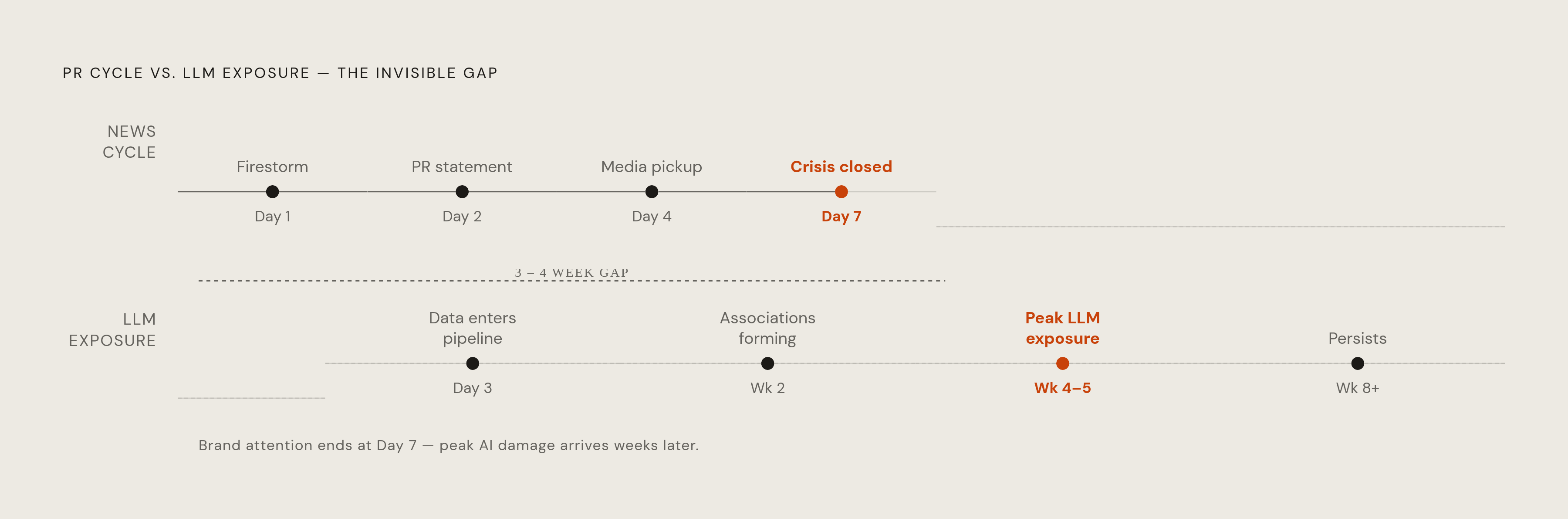
The propagation timeline: how a crisis moves through a model differently than through a news cycle
A pattern recurs across the documented reputation crises affecting European brands analyzed between 2023 and 2025, consistent enough to treat as close to a rule. The event goes viral on social media, Reddit, and X first. Classical PR follows: a statement, an explanation, sometimes an apology. Trade media picks the story up next, search volume for critical brand queries climbs, and SEO rankings start to shift. Then the Google results page normalizes, the PR cycle winds down, and everyone moves on.
The model isn't finished, though. At the exact moment the search results settle, the LLM is only beginning to register the crisis. Peak visibility of the negative event inside model answers typically arrives well past the point where most comms teams have declared the matter closed. Left alone, that exposure doesn't fade on its own. It sits inside model outputs well beyond that window, waiting for someone to ask the right question.
Lining up the timelines makes the mismatch sharper. A social media firestorm burns out in days. Its trace inside model context can persist for weeks or months longer, a significant order-of-magnitude difference. Pairings like "Company X" and "privacy issue" survive retraining cycles because they're statistically dominant in the data the model learned from, even after they stop being accurate. A brand that runs a clean, textbook response and calls it closed at day seven has no idea its worst exposure in AI-generated answers is still three or four weeks out. That gap between when a brand stops paying attention and when the model finally catches up is the entire argument for treating this as a second, separate crisis rather than an aftershock of the first.
The scale of AI-driven discovery and the second crisis
None of this would matter much if AI platforms were a niche channel, but they're the opposite of niche. Google's AI Overviews now appear in nearly half of all monthly searches, reaching a user base north of 900 million people. AI platforms generated roughly 1.13 billion referral visits in June 2025 alone, up 357% year over year, a growth curve that outpaces almost every other channel in digital discovery right now.
The B2B side is where the exposure gets sharpest, and it's where most brands are the least prepared for it. Ninety-four percent of B2B buyers have used generative AI somewhere in their purchase cycle. Fifty-one percent of B2B software buyers now start their research with an AI tool instead of Google, and 73% of senior-level B2B buyers say AI is their first stop when evaluating vendors. For a category defined by long sales cycles and high switching costs, a lingering negative association buried in a model's weights shapes the buyer's first move, because that association is embedded before a sales rep ever gets a chance to correct the record.
Hallucinations compounding the problem: the embedded narrative's inaccuracy
Two failure modes exist here, and treating them as one problem is the mistake most reputation teams make. The first is accurate but damaging: the model correctly recalls a real negative event and keeps replaying it in answers long after the news cycle around it has closed. The second is worse, because it's inaccurate and damaging: the model fabricates or distorts brand information entirely, often while sounding more confident than it does when it happens to be right.
Research published by MIT found that AI models are 34% more likely to use confident language, phrases like "definitely" and "without doubt," when generating incorrect information than when stating something true. A hallucinated answer, in other words, frequently sounds more certain than a correct one. That inverts the instinct most people have about trusting confident-sounding responses, and it's exactly the instinct a buyer relies on when they ask an AI tool to summarize a vendor's track record.
For brands, invented statistics attributed to the company, fake citations pointing to a study or author that doesn't exist, and entity confusion that mixes up a brand's founders, headquarters, or founding date with a competitor's history appear as recurring forms of this problem. Thirty-one percent of citations ChatGPT provided for senior-level B2B queries turned out to be either misattributed or entirely fabricated. Close to a third of the sourcing behind high-stakes buyer research is functionally invented. The second crisis isn't only about an old story resurfacing. Sometimes there's no true story.
The concentration effect: why brands with weak AI presence absorb crisis damage faster
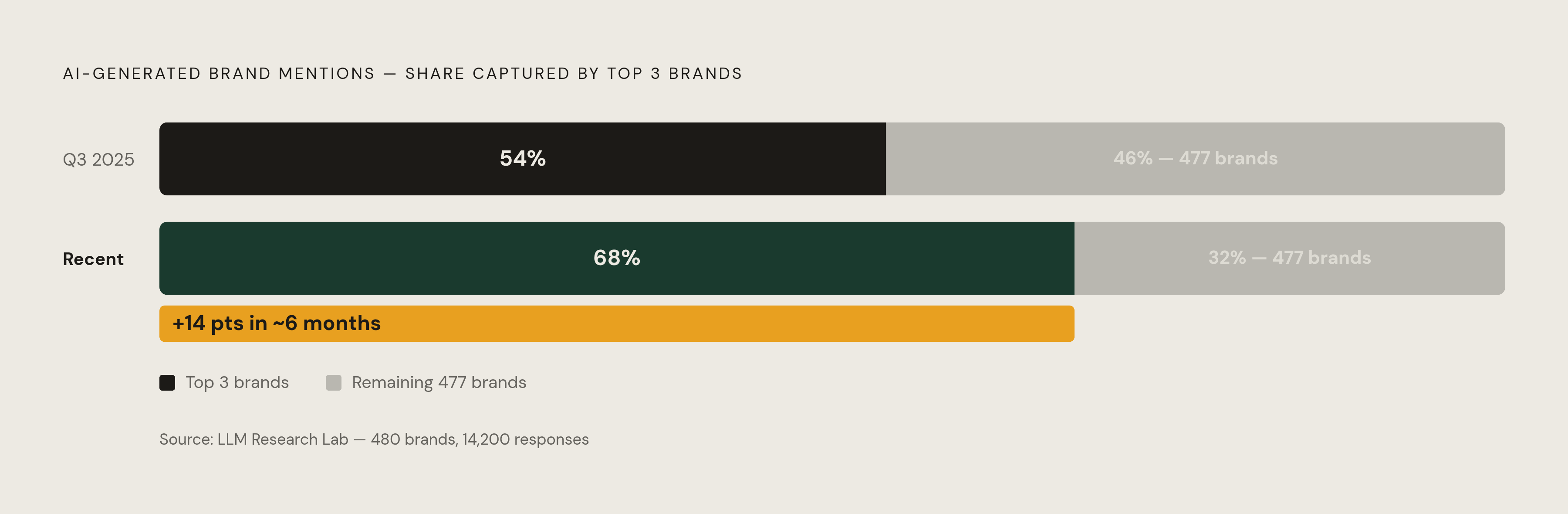
LLM visibility doesn't spread evenly across a category. It concentrates fast, around a small handful of brands the model treats as authoritative, and that concentration is accelerating. Analysis from LLM Research Lab, covering 480 brands across six AI-powered search engines and more than 14,200 responses, found that the top three brands in any given category now capture 68% of all AI-generated mentions, up from 54% in the third quarter of 2025. A 14-point shift in six months is a fast redistribution of visibility for any market to absorb, and it means the gap between the leaders and everyone else is widening rather than closing.
The consequence for everyone outside that top tier is structural. A brand with thin positive signal in the training and retrieval data has nothing to counterbalance a negative event when one hits. The crisis lands in a near-empty signal environment and ends up dominating the model's available associations about that brand, simply because there's nothing else there to compete with it. Scale is the actual variable here, not reputation quality in the abstract. A well-regarded but low-visibility brand still absorbs damage faster than a mediocre brand with heavy AI presence, because the mediocre brand has volume of signal working in its favor even when the sentiment isn't glowing.
This volatility isn't only a crisis phenomenon, either. Tracking of the project management software category has shown real movement in brand standing month over month, some tools surging, others posting notable drops, with no obvious crisis event driving the shift. AI brand perception moves on its own even in calm conditions, and a crisis simply accelerates a redistribution that's already underway.
What brands are monitoring (and the blind spots that leave them exposed)
Most marketing teams have no real visibility into how LLMs represent their brand. Media monitoring, social listening, and SEO rank tracking, the standard toolkit, were never built to capture what a conversational AI tool tells a user who asks about the company directly. That gap persists, and it's the one most reputation teams still haven't closed.
Part of what makes this hard to track is that LLM answers don't hold still the way a search ranking does. Responses vary by platform, by how a prompt is worded, and over time, so a brand can come across favorably in Perplexity and unfavorably in ChatGPT for what is functionally the same question. Dashboards built for the old web don't have a category for that kind of variance, because the old web never required one.
A few metrics matter here and are usually missing. Share of Model, the percentage of times a brand gets mentioned in response to relevant non-branded queries, is emerging as the replacement for Share of Voice. Citation Rate, the percentage of responses that link to a domain the brand actually owns, moves independently of the brand's overall mention count. A model can name a brand as a recommended solution while sourcing its information from a competitor's page or a third-party review site. The model has heard of the brand but doesn't trust its own content enough to cite it directly. Most dashboards skip a third check: whether what the model says about a brand is factually correct and appropriately toned, not just present.
None of this is theoretical. Roughly half of consumers now deliberately seek out AI-powered search tools to guide purchase decisions, so the monitoring gap sits in the middle of live buyer research happening right now, not some hypothetical future state.
Countering negative LLM representation before and after a crisis
Reputation work in 2026 is a technical discipline. It means steering the machine-readable representation of a brand inside model weights, knowledge graphs, and crawler caches, a job with far less room for error than traditional PR ever had.
The strongest position is the one built before a crisis happens. Third-party mentions now correlate with AI visibility substantially more strongly than traditional backlinks do, so a brand that shows up consistently across credible publishers, review platforms, and creator content builds a reserve of positive signal that dilutes a negative association when one lands. A product marketing manager at impact.com described the goal as multiple trusted sources reinforcing the same idea about a brand, rather than relying on the brand's own site to carry all the weight. That's the pattern AI systems learn from, and it's the same pattern that absorbs damage during a crisis. It tracks with a broader shift in the industry: impact.com's Global State of Affiliate Marketing 2025 found that 97% of brands have already integrated AI into their affiliate strategy, and the brands pulling ahead are using those partner networks to feed authority signals into LLMs.
Structured data is the second lever, and it cuts both ways more sharply than most teams realize. Pages carrying valid structured data, particularly FAQ, HowTo, and QAPage markup, appear in AI-generated summaries meaningfully more often than pages without it. A substantial share of Schema.org markup generated by AI tools contains critical validation errors, though, and invalid schema doesn't just fail to help. It confuses the semantic parsers models rely on and introduces new hallucination vectors instead of closing off existing ones. Entity disambiguation through JSON-LD, using sameAs properties to link a brand explicitly to its Wikidata entry, Crunchbase profile, and verified social accounts, anchors identity inside the knowledge graph and cuts down the entity confusion that leads a model to mix up a company's founders or headquarters with a competitor's.
The most effective technical intervention available right now is retrieval-augmented generation, or RAG. Forcing a model to draw from a specific, verified set of documents, instead of pulling loosely from training data, can substantially cut hallucinations. It moves the model from something closer to creative generation into something closer to summary work, drawing from what's actually in front of it instead of reconstructing an answer from compressed, aging patterns. The distinction between a model recalling and a model inventing is the whole battle, and winning it early costs a fraction of what fighting it at day 45 does.