Publisher Partnerships That Influence AI Platform Brand Citations
Brands must court publishers directly to influence how AI platforms cite them in search results.
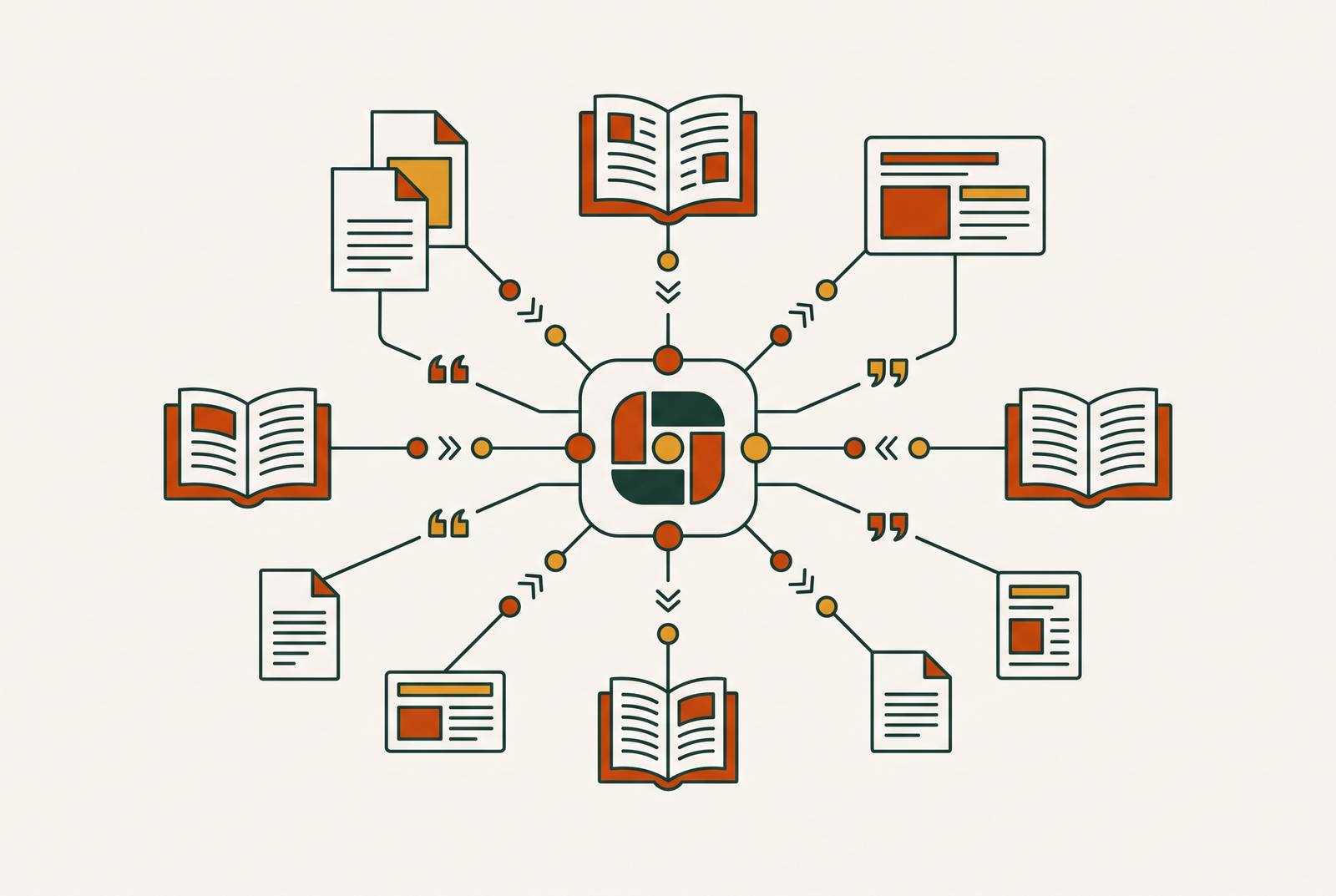
A brand's citation share in AI search comes down to a math problem most marketing teams haven't run yet. McKinsey's research on AI-powered search found that a brand's own websites account for only a small share of the sources AI search tools cite; the great majority comes from publishers, affiliates, and user-generated content the brand doesn't own. That flips the entire discipline on its head: the content a brand controls almost never gets cited, and whether it appears in AI search results is decided by the content written about the brand by someone else.
The stakes are rising because the way people search has changed shape. Consumers now ask a question and act on the answer, rather than searching and browsing a shelf of results the old way. ChatGPT passed a billion monthly users. Google's AI Overviews now appear in nearly 55% of all Google searches. If a brand is missing from the synthesized answer at that scale, it isn't a footnote in the consideration set. It's absent from it.
The growth of the publisher-AI licensing market into a structural layer of the web
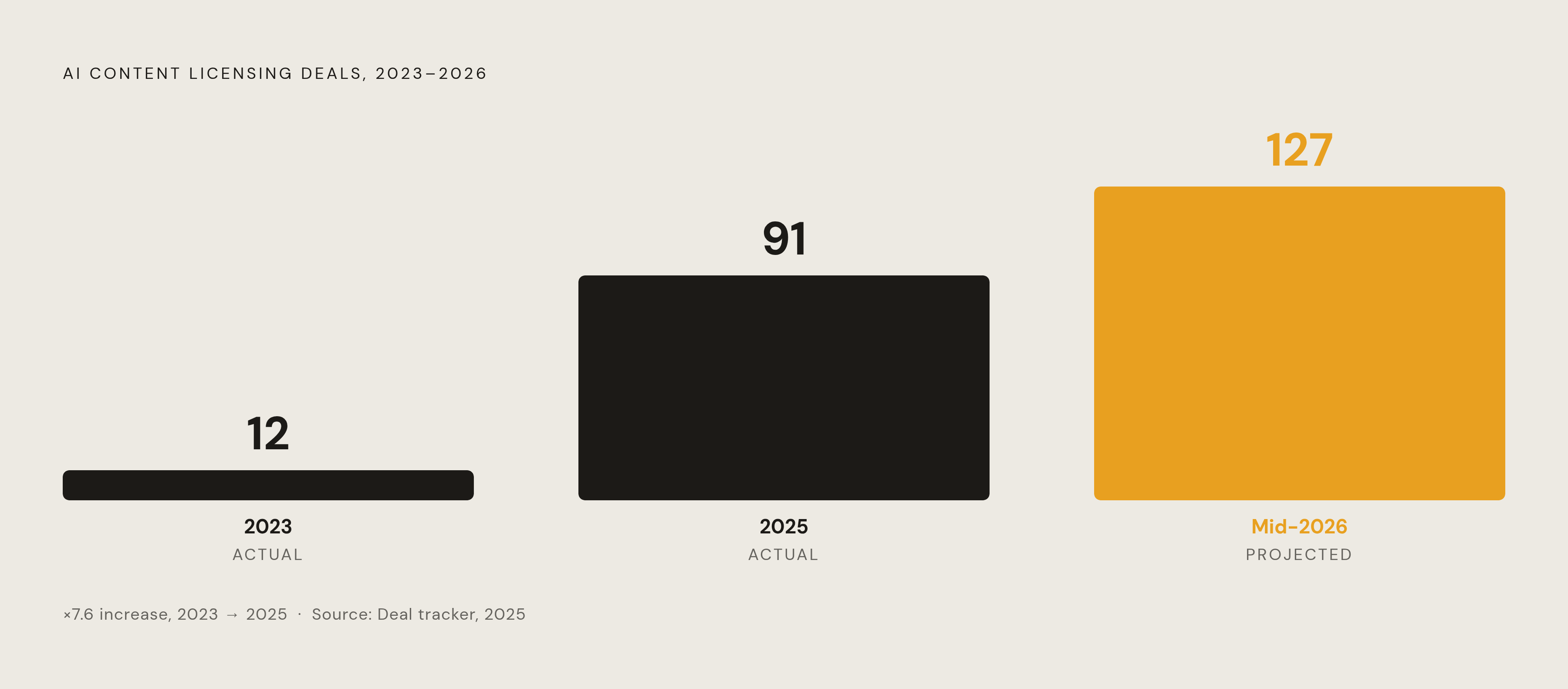
Three years ago, publisher-AI licensing was a curiosity: a dozen deals, mostly experimental, mostly about training data. In 2023, there were 12 publicly announced AI content licensing deals. By the end of 2025, that number hit 91. Projections put it at 127 by mid-2026. Almost all of the recent growth is in live retrieval and attribution deals, not the historical training-data agreements that defined the first wave.
The buyers are the names you'd expect: OpenAI, Google, Amazon, Meta, Microsoft, Mistral, Apple, and Perplexity. On the sell side sit large data platforms like Reddit, Stack Overflow, and Shutterstock, alongside a growing list of news and magazine publishers.
The dollar figures, where they're public, are notable less for their size than for what they signal about where money is flowing. OpenAI's deal with News Corp is reportedly worth $250 million over five years, the largest single reported figure in the market. Meta's News Corp deal is reportedly worth up to $50 million per year, starting March 2026. Amazon's deal with The New York Times covers the Times, NYT Cooking, and The Athletic for use in Alexa and Amazon's own foundation models, reportedly worth a sum in the tens of millions of dollars; this deal does not put Times content inside ChatGPT, Claude, Perplexity, or Google's AI Overviews. Google's deal with Reddit is reportedly worth $60 million. The Financial Times' deal with OpenAI is reportedly worth a much smaller sum than the largest deals in the market. Most deal values are never disclosed at all, which means the public numbers form a floor, not a ceiling, on how much money is actually moving through this market.
What these deals cover, formally, splits into two buckets: rights to train on a publisher's archive (including paywalled material) and rights to surface live content, meaning summaries, quotes, and links with attribution inside the AI product itself. A growing share of recent deals bundle both rights into a single agreement, which tells you the platforms increasingly want ongoing access, not just a one-time archive dump.
Differences in how major AI platforms use licensed publisher content
Each platform has built a different relationship with its licensed content, and treating them as interchangeable is the fastest way to misread a citation audit.
OpenAI runs the largest content licensing portfolio in the industry, roughly two dozen publisher and data deals covering more than 160 outlets across over 20 languages as of June 2026. The roster includes Associated Press, Axel Springer's stable (Politico, Business Insider, Bild, Welt), the Financial Times, News Corp's titles (The Wall Street Journal, New York Post, The Times, The Sun, The Australian), Vox Media (The Verge, New York Magazine, Eater), The Atlantic, TIME, Condé Nast's brands (Vogue, The New Yorker, Wired, GQ, Vanity Fair), Hearst's more than 60 titles (Cosmopolitan, Esquire, ELLE, and a major regional newspaper), Future plc's 200-plus brands (TechRadar, Tom's Guide, PC Gamer), Axios, Schibsted Media Group, The Guardian, The Washington Post, Grupo Folha, and Grupo UOL. Dotdash Meredith's deal, covering People, Investopedia, Food & Wine, and 40-plus other brands, is worth at least $16 million.
None of that guarantees citations, though. A BuzzStream study of top ChatGPT citation sources found little correlation between having a licensing partnership and how often a publisher actually gets cited. ChatGPT's citation habits skew encyclopedic: Wikipedia remains its single most-cited source, licensing deals notwithstanding.
Google's licensed footprint looks entirely different. To the best of BuzzStream's knowledge, Associated Press is the only news publisher confirmed to have an LLM training partnership with Google outside of Reddit, as of early 2026. Google also runs a pilot partnerships program with Der Spiegel, El País, Folha, Infobae, Kompas, The Guardian, The Times of India, The Washington Examiner, and The Washington Post, described as expanded content access paired with testing of new Google News features, with compensation flowing to participating publishers. AP's arrangement with Google specifically feeds real-time news into Gemini. And AI Overviews, in practice, leans heavily on user-generated platforms: YouTube, Reddit, and Quora show up constantly in its citations. Google itself has said many of the so-called "AEO" or "GEO hacks" circulating online aren't effective and don't reflect how Search actually works, which is a useful check against overconfident tactics.
Perplexity signs more publishers than any other platform, and it also gets blocked by publishers more than any other platform, and those two facts are almost certainly related. Its partner list includes Adweek, Blavity, Der Spiegel, DPReview, Entrepreneur, Fortune, Gear Patrol, Lee Enterprises, Los Angeles Times, MediaLab, Mexico News Daily, Minkabu Infonoid, NewsPicks, NTV, Prisa Media, Stern, The Independent, The Texas Tribune, TIME, WordPress.com, and World History Encyclopedia. Its citation behavior is community-driven, with Reddit dominating, and it rewards freshness and topical authority more visibly than the other platforms do.
Microsoft's Copilot deals exist mainly to support the Copilot product itself. The Copilot Daily feature draws on partnerships with the Financial Times, Reuters, Axel Springer, Hearst, and the USA Today Network, and Copilot's broader retrieval runs through the Bing index.
Publisher authority versus publisher volume in citation outcomes
A single placement on a site with a Domain Rating above 70 can out-cite fifty links on lower-tier sites combined. That's the practitioner-level finding driving a lot of the current shift away from volume-based publisher outreach and toward authority-based targeting.
There's research behind why that happens. The GEO study by Aggarwal et al. found that adding quotations from credible sources raised a source's share of an AI-generated answer by roughly 41%. Adding statistics raised it by about 31%. Adding citations raised it by about 28%. These signals compound rather than substitute for each other, so a piece of content with all three tends to outperform a piece with just one.
What counts as "authority" in this context breaks down into a specific, checkable set of traits. Does the publisher hold a formal AI licensing deal with the platform in question? Does it show up consistently in citation data for the brand's actual category queries, not just in general brand mentions? And does its coverage use entity language, meaning brand names, product names, category terms, that matches how the brand describes itself elsewhere?
The Wall Street Journal, The Atlantic, and Dotdash Meredith each hold licensing agreements that cover both training-data rights and live retrieval, which means their content operates at more than one layer of the AI pipeline, a different kind of leverage than simple retrieval traffic, and worth distinguishing when prioritizing partnership targets.
Auditing which publishers are already shaping AI answers in your category
Affiliate performance data and AI citation data measure two different things, and most marketing programs are currently blind to the gap between them.
Click and conversion data tells you what happened after someone saw a link. Citation data reveals which publishers appear inside AI-generated answers for a brand's category queries, before any click occurs at all; which topic areas the brand is invisible in, often in categories nobody flagged as a risk; and which publishers outside the current partner program are already shaping category recommendations without any relationship to the brand whatsoever.
Acceleration Partners ran exactly this kind of audit for a travel brand, checking existing affiliate partners against AI citation data. In a single measurement week, 28% of the brand's active affiliate partners turned up in AI citation data, generating visibility that standard performance reporting had never captured or reported on.
The blind spots can be severe. One retail brand, audited this way, showed 97.6% AI visibility for retail and convenience queries, a strong number by any measure. But for vitamins, visibility dropped to 0.7%. For oral care, 1.9%. For pain relief, zero. The brand sells products in all three categories. It simply has no publisher coverage answering the questions people ask about them, so the AI platforms have nothing of the brand's to cite when those questions come up.
Turning publisher audit findings into a deliberate citation partnership strategy
Once the audit is done, the findings split naturally into three groups of publishers, and each group calls for a different move.
The first group is existing partners with untapped citation authority: publishers already inside an affiliate or PR program who show up in citation data but have never been briefed on where the brand is missing from AI answers. A specific, data-backed brief (here are the six queries in your category where we're absent) beats a generic ask to "mention us more" by a wide margin, because it gives the publisher something concrete to act on.
The second group is high-citation publishers with no formal relationship. These are publishers already appearing in AI-generated answers for the brand's category, without ever having been recruited or paid to do so. That's a strong signal: they've demonstrated citation authority in the category on their own, which makes them a priority recruitment target rather than a cold outreach guess.
The third group is platform-specific authority targets, meaning publishers holding formal AI licensing deals on the platforms where the brand most needs to show up. For Perplexity, that list runs long. For Google's Gemini, the licensed set is narrow: AP, plus the handful of pilot program publishers. For Copilot, the Copilot Daily partners, Financial Times, Reuters, Axel Springer, Hearst, and the USA Today Network, represent a narrow, defined set worth prioritizing.
Briefing content for these partners has its own rules, and they follow directly from the research already cited. The first 200 words of any article should answer the primary query directly and completely, a practice consistent with how GEO research describes effective AI-optimized content structure. Partners should be encouraged to include statistics, named-source quotations, and citations, the exact three signals shown to raise share of AI answer by roughly 41%, 31%, and 28% respectively. Entity language needs to stay consistent across every placement (the same brand name format, the same product names, the same category terms) so the model isn't reconciling three different descriptions of the same thing. And none of it matters if the page isn't accessible to AI crawlers in the first place; page accessibility to AI crawlers is a practical prerequisite worth confirming with whoever manages the publisher's technical setup.
Generative engine optimization, taken as a whole, runs roughly 80% strategic (positioning, ecosystem presence, brand authority) and only 20% technical. Publisher partnership strategy sits squarely inside that strategic 80%, and it's the lever least understood by teams still treating AI visibility as a technical SEO problem rather than a relationship one.