AI Sentiment Bias Against Challenger Brands in Established Categories
Established brands dominate AI search results even when challengers have equal or better products.
AI search now decides which brands people even hear about before they hear a human argue for them, and the decision is not neutral. Large language models systematically favor brands they've seen more of in training, a phenomenon researchers call incumbent advantage, and it appears in model outputs whether or not the underlying product deserves it. AI Overviews triggered on 25.11% of a large sample of queries in 2026, almost double the 13.14% rate from March 2025, and a growing share of those sessions end without a single click to any website. ChatGPT alone fields over 2 billion queries a day, and a growing share of business buyers now say an AI tool is their first stop when researching a vendor. When that much purchase-stage attention happens inside an answer box, which brand gets named and which gets skipped becomes a revenue line rather than a marketing curiosity, because the naming decision directly shapes buyer outcomes.
AI platforms have positioned their answers as free of advertiser influence. That framing may hold in a narrow sense. But it sidesteps a separate problem entirely: the system was never neutral to begin with. It carries a bias baked into the training data itself, a bias that has nothing to do with who bought a placement and everything to do with who got written about the most, for the longest, by the most sources.
What "incumbent advantage" means in LLM behavior
A June 2026 paper, "Incumbent Advantage: Brand Bias and Cognitive Manipulation Dynamics in LLM Recommendation Systems" (arXiv:2606.17443), gives the phenomenon its clearest name so far. The core claim is straightforward: when brand preference stays consistent across queries, large language models recommend well-known brands more often than lesser-known ones, even when the products on offer are functionally identical. That creates an uneven playing field where visibility tracks fame, not capability.
The mechanism isn't some deliberate thumb on the scale. Well-known brands simply show up more in the text the model trained on: more reviews, more articles, more forum threads, more comparison posts. Users then see those brands recommended more, which generates more content about them, which feeds the next training run. It's a feedback loop, not a design choice, and that distinction matters because it makes the bias much harder to spot than an ad unit with a "Sponsored" label on it. A March 2026 paper on brand and cultural bias in LLMs (arXiv:2603.18300, using a framework called ChoiceEval) gives this specific pattern a name: entity-perception bias, defined as a model's tendency to systematically favor certain brands over comparable alternatives, resulting in their over-representation in outputs. The paper treats measuring that bias as step one toward any real conversation about market fairness. Researchers and practitioners are still naming the problem while they study it.
How training data encodes brand history into AI outputs
Every large model is trained on a slice of the internet, and that slice comes loaded with decades of brand coverage, some of it glowing, some of it hostile, most of it wildly uneven in volume. Analysis from Blackbird.ai identifies the consequence: if a brand has faced sustained negative coverage, that sentiment is in the training data and can get replicated, sometimes amplified, when the model generates an answer about that brand later.
There's a geographic layer to this too. Foundational training sets skew toward one dominant language and one dominant cultural region, which compounds the incumbent advantage for brands that already dominate those markets. Research from 2024 found something startling in that same vein: models recommended luxury brands for high-income countries somewhere between 88% and 100% of the time, and non-luxury brands for low-income countries between 84% and 98% of the time. Brand status and geography are tangled together in the same learned pattern to these systems. They're tangled together in the same learned pattern.
None of this is confined to one product category, either. Research has found established brands dominating coffee machine recommendations even against competitors with equal specs. Separate research found U.S.-centric models favoring global shoe and clothing brands over local ones. Further research confirmed that authority-flavored, socially-proven language shifts model rankings across coffee machines, cameras, and books alike. The pattern holds across categories that have nothing to do with each other, which is a strong sign this isn't noise.
The practical result: a challenger brand with a genuinely better product but a thin digital footprint starts the race behind because the model has barely seen it, not because the model evaluated the product and found it wanting. The June 2026 paper examined what happens when that thin footprint meets a determined competitor, and how much a challenger can close that gap with the right content moves.
The experimental evidence: what incumbency buys and where it breaks down
The headline result from arXiv:2606.17443 is stark. In what the paper calls Experiment 1, the "Conditional Monopoly" test, well-known brands got recommended 100% of the time when every product on the table had identical specs. That held across all three models tested (GPT-4o-mini, Claude, and Gemini), across both languages examined, and across every product subcategory. When a model has no other signal to grab onto, brand recognition becomes the tiebreaker by default.
But the monopoly is thin ice, not bedrock. It collapsed the moment a challenger brand carried a rating advantage of less than 0.1 stars, a genuinely tiny signal. Experiment 2 pushed further: authority-style marketing language, including fabricated claims of clinical evidence, broke the incumbent's lock at a measured advantage equivalent to +0.17 rating points, though the three models didn't respond identically to the tactic. Experiment 3 modeled what happens when every brand in a category starts playing the same game, flooding their listings with the same authority language. A social dilemma sets in: the arms race degrades the advantage for everyone once the tactic stops being rare.
Real-world data backs up the fragility. Brandlight's tracking found Ally Bank pulling ahead of much larger, longer-established competitors in AI visibility across ChatGPT, Copilot, and Google's AI Overviews, and found ShipStation outperforming multi-billion dollar logistics giants including UPS and USPS in AI search visibility. The backlink-heavy, decades-of-domain-authority approach that wins in traditional SEO doesn't automatically translate into LLM influence. What counted as authoritative for a search-engine crawler isn't necessarily what an LLM treats as trustworthy. Incumbency, in other words, is a strong default setting. It is not a lock nobody can pick.
Platform fragmentation means the bias does not operate uniformly across AI surfaces
The AI landscape isn't one system, it's several, and they don't treat brands the same way. As of mid-2026, ChatGPT holds 53.9% of worldwide web visits among the seven largest AI chatbots, ahead of Google Gemini at 27.9% and Claude at 9.2%. But ChatGPT's share has fallen sharply from 79.0% a year earlier, which tells you the whole pie is growing and other players are taking a bigger slice of the growth.
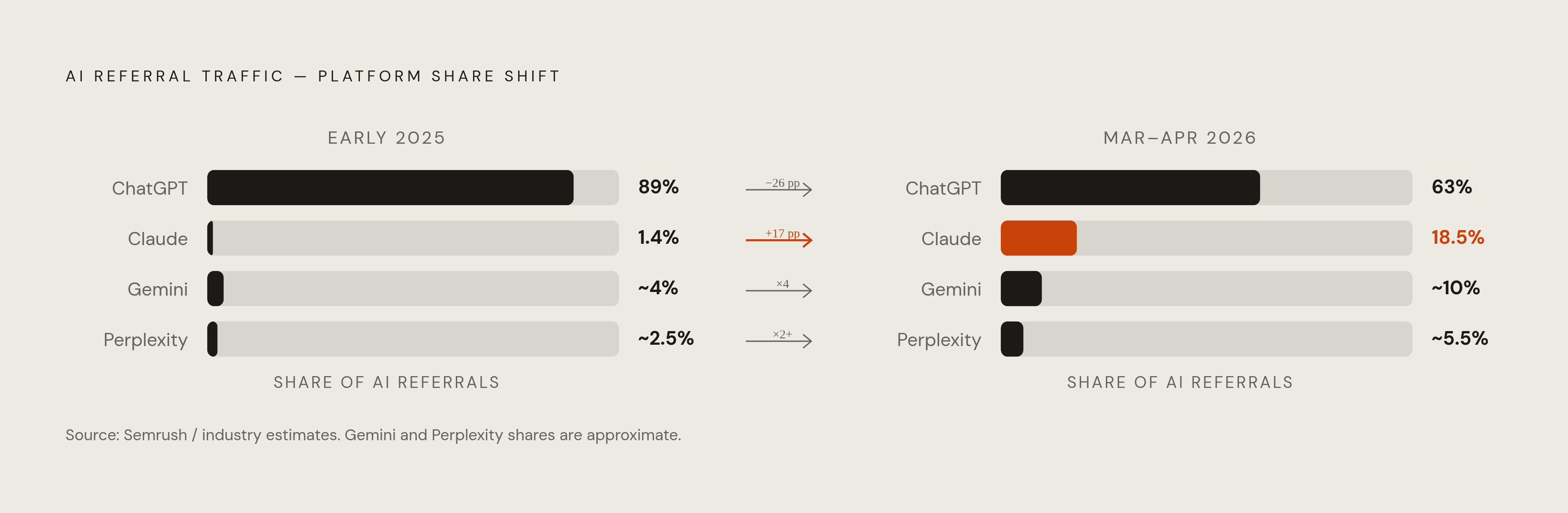
Referral data tells the same story from a different angle. One tracking study found ChatGPT responsible for 89% of AI referral traffic in an early wave, a number that dropped to 63% just a few months later, in March and April of 2026. In that same window, Claude went from 1.4% of referrals to 18.5%, Gemini's share quadrupled, and Perplexity's more than doubled. What was a one-platform story has turned into a four-platform contest. For queries that carry real purchase intent, ChatGPT still leads with 36% share, but Perplexity's 24% share stands out on its own: Perplexity's outsized share of purchase-intent queries points to a user base that is disproportionately research- and buying-focused.
Platforms don't even describe the same brand consistently. The same query, asked of different models, can produce wildly different answers, with measured gaps between platforms sometimes exceeding hundreds of times the magnitude of one another. Some of that traces to how each platform handles citation. ChatGPT tends to paraphrase and skip naming its sources unless a search feature is explicitly triggered, while Perplexity's whole model is built around visible citations. That means the traceability of a brand mention depends entirely on which surface a reader is using, since not every surface shows where an AI got its information. Google's combined AI surfaces, AI Overviews, Gemini, and AI Mode, reach well over 2 billion people a month between them, with AI Overviews alone topping 2 billion monthly users and AI Mode passing 100 million monthly users in the US on its own. Incumbents with deep, longstanding authority inside Google's index carry that advantage straight into these newer surfaces. A challenger winning ground on one platform can still be functionally invisible on another, and no single-platform view tells the full story of where a brand actually stands.
How bias compounds during a brand crisis or negative narrative
Everything above describes how the bias behaves when a brand's story is neutral or positive. It gets worse fast when the story turns negative. Terakeet's Shannon Reedy, writing in Marketing Dive in December 2025, laid out what happened to Campbell's after an alleged executive conversation went viral: negative news sentiment about the company surged to 70%, and the first page of search results filled up with damaging coverage.
Generative AI didn't correct the record, it amplified the mess. Terakeet's analysis found AI systems surfacing fragmented, out-of-context material, including language pulled straight from Campbell's own website referencing "mechanically separated chicken," which only muddied public understanding further rather than clarifying anything. No model stepped in to contextualize or correct the story. Terakeet's analysis found the financial toll was a 7.3% drop in Campbell's stock price, translating to roughly $684 million wiped off market capitalization.
The mechanism here is the same feedback loop that drives the incumbent advantage in ordinary product recommendations, just running in reverse. Sensational, controversial coverage draws outsized attention online. Once a negative narrative gains momentum, AI systems ingest it and reinforce it the same way they'd reinforce a positive one. For an established brand like Campbell's, that's damaging enough. For a challenger brand, it's worse, because a challenger typically has far less pre-existing positive content to act as a counterweight. There's no firewall of years of favorable coverage to dilute the bad story once the bad story starts circulating. Terakeet frames this exact point: brands that had already built out strong owned digital assets have something to lean on when scrutiny hits, a body of content that shortens how long a controversy echoes. Most brands, though, have no systematic way of even tracking how they're being described across ChatGPT, Gemini, and Perplexity in the first place, which means the monitoring gap and the content gap tend to occur together.
Consumer trust dynamics make the bias problem more urgent, not less
Consumer trust in AI search is not rising steadily, it's dropping, and dropping fast. In 2025, 82% of consumers said they found AI more helpful than traditional search. A survey by Fractl and Search Engine Land, covering 1,008 consumers in one major national market. consumers, put that figure at 54%, a 28-point fall in a single year. The share of outright skeptics grew from roughly 3% to 17% over the same period, nearly six times larger than it was.
Yet belief in AI's eventual dominance hasn't moved much at all: 64% of consumers still think AI will replace traditional search within five years, essentially flat against 66% a year earlier. Consumers, in other words, expect the future to arrive even as they grow less satisfied with the present version of it. And when it comes to product recommendations specifically, the Fractl data show Google still beats AI tools roughly 3 to 1 in consumer trust. AI has become an established part of the search landscape without yet becoming a trusted one, at least not at the actual moment of buying something.
Consumers also don't rely on a single source. They check an average of 2.4 platforms before making a purchase decision, and that number holds fairly steady across age groups. A brand that only performs well on one AI surface is losing decisions it never even knows it lost. This is where the incumbent advantage compounds in a way that's easy to miss: a skeptical consumer reading an AI answer is more likely to trust a name they already recognize, so an incumbent that gets named repeatedly benefits from a familiarity effect a challenger simply cannot borrow. The bias isn't just deciding who gets cited, it's shaping how much weight that citation carries once a wary reader sees it.
A real counterweight exists, though. Data cited by Opollo shows AI referral traffic converting at 14.2%, roughly five times the 2.8% conversion rate of Google organic search. The people who do act on AI recommendations are unusually high-intent buyers. So even on a smaller base of trusting users, a citation inside an AI answer is worth disproportionately more than an equivalent mention in a traditional search result. Brands that manage to close the trust gap see a disproportionate payoff.
What the research says challengers can do to shift AI perception
Start with the finding that matters most for anyone running a challenger brand: incumbency is a default setting the model reaches for when it has nothing better to go on, and that default breaks with a genuinely small push, a rating edge under 0.1 stars in the arXiv:2606.17443 experiments, or content that reads as specific and well-supported rather than vague. It's a heuristic, not a wall, and heuristics move when you give the system a reason to move. It's a heuristic, and heuristics move when you give the system a reason to move.
Volume isn't the lever, though. Brandlight's read on Ally Bank's outperformance points to content that's concise, factual, and tightly relevant to the query, beating out the sprawling, decades-deep footprints of much larger competitors. A nimble challenger with a smaller but sharper content library can out-cite an incumbent that's simply published more, more diffusely, over more years. Practitioners describe generative engine optimization as roughly 80% strategic work, positioning, third-party ecosystem presence, and earned authority, rather than raw content output. That means challengers need citation density across credible outside sources, not just a well-tended website.
The arms-race warning from Experiment 3 still applies here. Once every competitor in a category adopts the same authority-signaling language, the collective advantage erodes and the early movers are the only ones who actually profited from it. Timing matters as much as tactics.
Terakeet's Campbell's analysis carries a second lesson that applies before any crisis ever hits: brands with a fortified base of owned digital content have a firewall ready when scrutiny arrives, and that same fortified base narrows the incumbent-advantage gap during ordinary, non-crisis visibility. It's one investment doing two jobs. And because the referral landscape has genuinely split, from ChatGPT carrying 89% of AI referrals in an early tracking wave down to 63% a few months later as Claude, Gemini, and Perplexity all gained ground, a challenger cannot treat any single platform as the whole battlefield. Consumers checking 2.4 platforms before buying means a brand invisible on even one major surface is ceding part of that decision to whichever competitor does show up there.
None of this works without measurement. Knowing whether a rating tweak, a new citation, or a content rewrite actually shifted an AI's answer requires tracking visibility, mention accuracy, and citation share across models over time, the same way a challenger might already track keyword rankings in traditional search. Without that tracking, a brand is making changes and hoping, which is a different discipline than optimizing.
Sources
- How generative AI upends the brand crisis playbook
- Is AI Erasing Your Brand? The 2026 GEO & AEO Survival Guide | by Ewan Mak | Medium
- AI Search Consumer Trust Study: Brand Visibility Strategies for 2026
- How Generative AI Models Create Brand Bias
- Incumbent Advantage: Brand Bias and Cognitive Manipulation Dynamics in LLM Recommendation Systems
- Incumbent Advantage: Brand Bias and Cognitive Manipulation Dynamics in LLM Recommendation Systems
- The New Competitive Frontier: Optimizing Your Brand for LLM Recommendation | by Sparsh Sharma | Medium