Brand Description Accuracy Across ChatGPT, Perplexity, and Gemini
Each AI engine draws from different sources, producing wildly inconsistent brand descriptions.

That is the predictable result of three systems that build brand descriptions out of different materials, using different rules, and arriving at different answers for the same company on the same day.
Why ChatGPT, Perplexity, and Gemini Produce Different Brand Descriptions
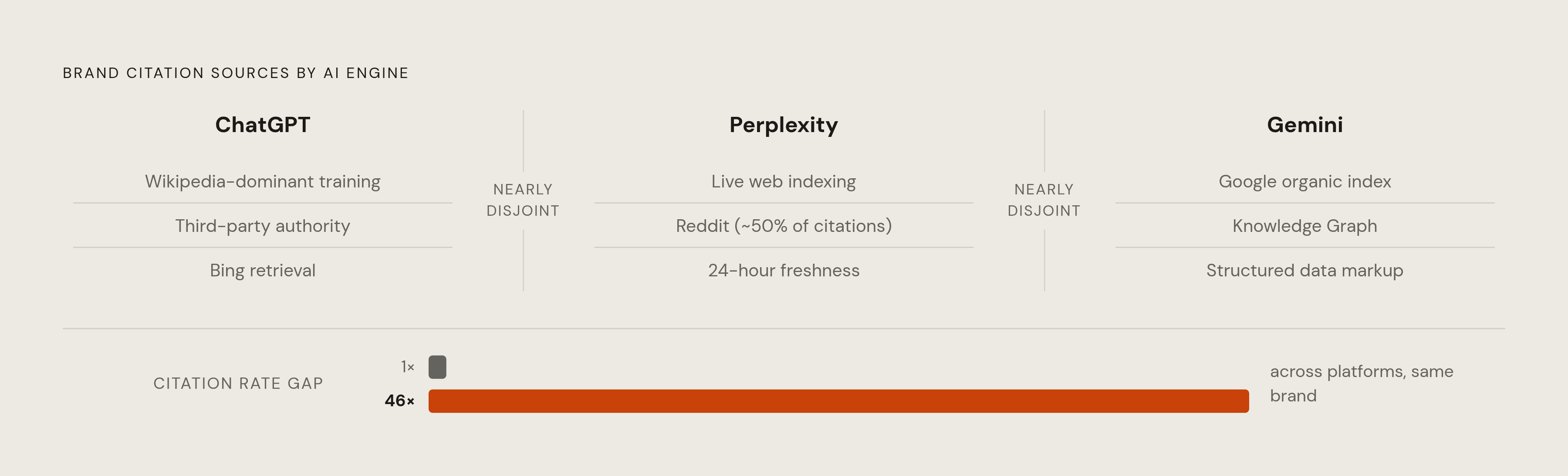
The scenario above is close to the default condition for any brand with a meaningful footprint across the web, because ChatGPT, Perplexity, and Gemini do not draw from a shared pool of knowledge that each one simply queries differently. The domain citation overlap finding, that only a small fraction of domains are cited by both ChatGPT and Perplexity, is the sharpest evidence that these are separate discovery channels with nearly disjoint source graphs. A 2026 study examining 34,234 AI responses found brand citation rates that differed by a factor of 46 between platforms, a gap wide enough that a brand appearing constantly in one engine's answers can be almost entirely absent from another's.
That is the headline fact of this piece, and it carries a practical consequence most brands have not yet absorbed. A brand that checks its description on one engine and assumes it holds across all three is working from a false map. The divergence is a structural fact about how each system decides what counts as a reliable signal about a brand, which sources it trusts, and how recently those sources need to have been touched. Understanding those differences, engine by engine, is the only way to know which fix applies where.
How ChatGPT forms a brand description: training data depth, Bing retrieval, and third-party authority signals
ChatGPT's brand descriptions begin with its training data, and within that training data, Wikipedia plays an outsized role. Common Crawl makes up the bulk of the raw training corpus by volume, but Wikipedia is the single most-cited source in ChatGPT's actual outputs, which tells you something about the kind of content the model has learned to trust when it needs to state a fact about a company. ChatGPT's citation behavior favors material that reads as encyclopedic: neutral in tone, factual in structure, written to describe rather than to sell.
Recency plays a smaller role here than brands often assume. Studies of ChatGPT's citation patterns do find a real skew toward more recently published content, with fresher pages cited more often than older ones. But that recency bias operates inside a system that still weighs accumulated, third-party authority far more heavily than a single recent blog post, however well-written. A brand's Wikipedia page, its presence in long-established review coverage, and its footprint across established industry sources carry more weight collectively than a page published last month.
ChatGPT's retrieval layer, when active, draws on Bing. Off-page signals, not on-page optimization, are what move the needle on ChatGPT brand visibility. Brand mentions that show up across YouTube and the broader web correlate most strongly with how visible a brand becomes in ChatGPT's answers. So the accumulated mass of third-party content referencing a brand, not the brand's own site copy, does most of the work.
The obvious pushback here is that ChatGPT's web browsing feature should flatten this advantage, letting fresh content compete with established authority in real time. That objection does not hold up well under scrutiny. The retrieval layer only activates selectively, triggering more often for commercial queries and less often for informational ones, and even when it does activate, the model still favors content that matches the format and authority signals it learned during training. A freshly published page without structural clarity or third-party backing loses to an older, well-corroborated one more often than brands expect. A brand description problem on ChatGPT is, at its core, a problem of accumulated authority and clear structure, not a problem of how recently the brand last published something. That distinction becomes sharper once Perplexity enters the picture.
How Perplexity forms a brand description: real-time indexing, citation density, and the freshness imperative
Perplexity works from a different foundation. Its brand descriptions come almost entirely from live web retrieval rather than a static training corpus baked in months or years earlier, and because its architecture is citation-first, the accuracy of what it says about a brand depends on what the most recently indexed, well-structured sources say at the exact moment someone asks the question. Content published in the past 24 hours gets prioritized, with the exception of specialized academic focus modes. Freshness functions as a hard requirement rather than a nice-to-have.
The citation behavior itself looks different from ChatGPT's. Perplexity averages roughly double the citations per response that ChatGPT does, and it generates far more website links relative to brand-name mentions, the reverse of how ChatGPT names brands more than it links to sources. That density creates a wrinkle brands need to track separately from simple visibility: a brand can be cited by Perplexity, with a link to its site appearing in the source list, without ever being named in the answer text itself. Marketers have started calling this a "ghost citation," meaning citation volume and brand mention volume are distinct metrics that must be tracked separately.
Reddit plays a role here with no real counterpart on ChatGPT. Depending on the type of query, Reddit can account for anywhere from a meaningful share up to nearly half of Perplexity's citations, a volume of user-generated content citation that dwarfs ChatGPT's minimal use of the same material. That means what people say about a brand in open community discussion on Reddit feeds directly into what Perplexity tells a user about that brand, a channel that simply does not exist in ChatGPT's mechanism.
The density of Perplexity's citations cuts both ways. More citations per response means more source diversity feeding each answer, but it also raises the surface area for something to go wrong: if an outdated or simply incorrect page is still ranking and still getting indexed in real time, Perplexity surfaces it just as readily as it surfaces the accurate version. Where ChatGPT's accuracy problem traces back to accumulated third-party authority, Perplexity's traces back to freshness and community presence, specifically what is live, indexed, and current on Reddit and across the open web right now. That is a fundamentally different repair job, and it sets up a third, separate case in Gemini.
How Gemini forms a brand description: Google's index, structured data, and the penalty for inaccuracy
Gemini draws its brand descriptions from Google's organic search index, the Knowledge Graph, structured data markup, and other signals native to the Google ecosystem, weighting structured data and traditional search signals more heavily than either ChatGPT or Perplexity does. At the same time, Gemini carries the highest error rate of the three platforms, which makes it a strange hybrid: a system that is deeply plugged into a brand's established search presence and still prone to describing that brand incorrectly.
The sourcing pattern reflects Gemini's roots in Google's organic index rather than a training-data hierarchy built around encyclopedic content. Gemini's citations skew toward blogs and a broad mix of source types, a wider net than ChatGPT's preference for Wikipedia-style material. Traditional search strength, meaning organic ranking position, structured data markup, and solid on-page signals, carries real weight in how Gemini forms a brand description, in a way that simply does not apply to Perplexity's live retrieval model. Because Gemini is wired directly into Google's ranking and quality systems, a brand with a strong, conventional SEO footprint starts with a baseline advantage on Gemini that it does not automatically carry over to Perplexity or ChatGPT.
The accuracy numbers temper that advantage considerably. Gemini's error rate is the highest among the three engines covered here, high enough that it becomes a genuinely unreliable surface for brand accuracy, even with the volume of traffic it carries. More than half of Gemini and Grok 3 responses have been found to cite fabricated or broken URLs, so you cannot take the source links Gemini presents at face value for brand monitoring purposes. A company can rank well in Google's organic results, keep clean structured data, and still get a materially wrong description from Gemini, because the mechanisms that drive organic ranking do not fully guard against generative hallucination.
None of that makes Gemini safe to ignore. It still accounts for a meaningful share of AI referral traffic, so brands optimizing across the AI search landscape cannot treat it as optional, even while recognizing it as the least reliable of the three for description accuracy. Fixing a Gemini problem means addressing the search index, Knowledge Graph, structured data, and other ecosystem signals Gemini inherits, while accepting that hallucination risk on this platform runs higher than on the other two and needs more active monitoring rather than a one-time audit.
Why the Same Fix Does Not Work Across All Three Engines
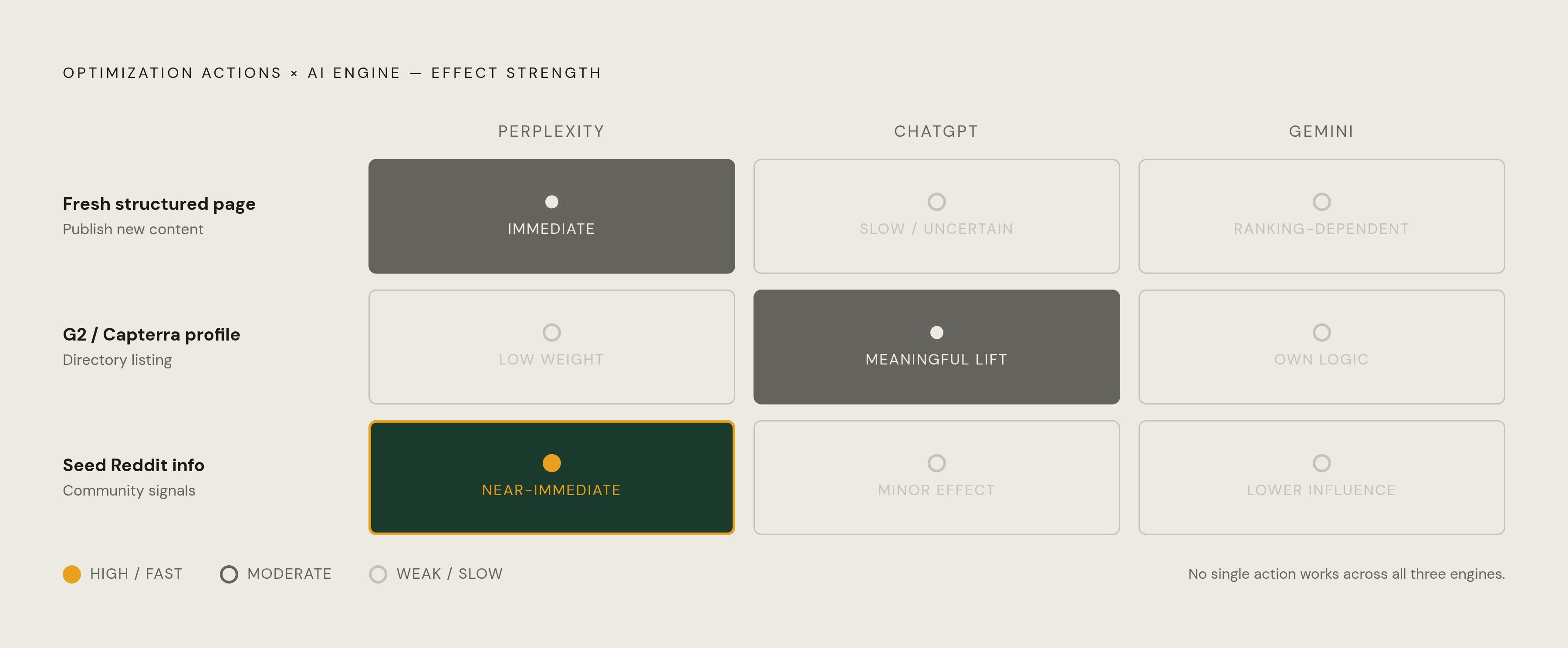
Because ChatGPT, Perplexity, and Gemini each weight different inputs when forming brand descriptions, a content or optimization action that improves accuracy on one platform can have no effect, or a different effect, on the others. ChatGPT runs on accumulated third-party authority. Perplexity runs on what is fresh and indexed right now. Gemini runs on Google's organic ecosystem filtered through a hallucination-prone generation layer. A brand that treats these as one problem with one solution will fix, at best, a third of what needs fixing.
Publishing a freshly updated, well-structured page shows the pattern clearly. It raises the odds of a Perplexity citation almost immediately, because Perplexity's retrieval layer is built to reward exactly that kind of content. ChatGPT may not register the same update for a long time, given how much its brand picture depends on accumulated training data rather than what was published last week. Gemini's response depends on how that page ranks organically, a process with its own timeline that has nothing to do with Perplexity's real-time indexing.
The same unevenness appears with third-party directories. Building out a profile on a platform like G2 or Capterra meaningfully raises the odds of a ChatGPT citation, because those profiles fit the third-party authority pattern ChatGPT was trained to trust. Perplexity's live retrieval does not weight those directory profiles the same way, and Gemini, again, weights them by its own separate logic. Seeding accurate information into Reddit discussions moves Perplexity's brand description almost immediately, given how heavily that engine leans on community content. Wikipedia-style encyclopedic coverage matters far more to ChatGPT than any Reddit thread does, and Reddit's influence inside Gemini's organic index runs lower than its influence inside Perplexity's live results.
Structured data tells a more complicated version of the same story. FAQPage schema markup affects all three engines, but unevenly, carrying real weight for Gemini's structured-data-heavy formation process while mattering less, in different degrees, to ChatGPT and Perplexity. The practical failure mode follows directly from all of this: a brand audits its description on one engine, finds it accurate, and considers the matter closed, while the other two engines keep drawing from entirely separate source pools and may be describing that same brand inaccurately at that very moment. The diagnosis across all three mechanism sections points to one conclusion. Treating ChatGPT, Perplexity, and Gemini as a single channel guarantees that two of the three go unaddressed, no matter how thorough the work looks on the one engine actually being checked.
A Platform-Differentiated Approach to Brand Description Accuracy
Closing the gap across all three engines takes a layered approach: a small set of fundamentals that apply everywhere, plus engine-specific work on top that addresses what each system is uniquely built to reward. The cross-platform layer is necessary groundwork, but it is not where the real differentiation happens, and treating it as the finish line leaves the engine-specific work undone.
Entity disambiguation sits at the base of that cross-platform layer. Entity disambiguation requires that a company's name, address, and other identity signals be identical everywhere, because inconsistencies create ambiguity that no AI engine can resolve cleanly. Get that foundation wrong and every other effort, on any of the three engines, inherits the confusion.
Past that shared foundation, the work splits by platform. For ChatGPT, the priority is building accumulated third-party authority: encyclopedic coverage in the Wikipedia mold, a presence across review directories like G2 or Capterra, and consistent brand mentions across YouTube and the wider web, since those off-page signals correlate most strongly with ChatGPT visibility. For Perplexity, the priority is freshness and community standing: publishing well-structured, recently updated pages that can earn citation inside Perplexity's 24-hour-weighted indexing window, and maintaining an accurate, active presence in Reddit discussions where the brand is likely to come up. For Gemini, the priority is organic search strength paired with active monitoring: solid structured data markup, strong on-page signals, and a healthy organic ranking position, combined with routine checks for fabricated or broken citations given how often Gemini's source attribution turns out to be unreliable.
The engines were built differently, on different source material, with different tolerances for error, and the fix has to match that structure engine by engine rather than treating accuracy as one problem with one answer.