How LLMs Decide Which Brands to Recommend in Competitive Categories
LLMs don't rank brands like search engines—they decide which ones deserve to be named at all.

A chatbot answering a question does not produce a ranked list. It decides which brands belong in its answer, and every brand left out might as well not exist for that query. Traditional search returns a list of links in order, but an LLM synthesizes a single conversational response that often names only a handful of brands. The logic is editorial: the model is effectively asking itself which brands are commonly associated with the topic, which sources explain the topic clearly, and which names appear in expert discussion. A brand absent from that internal pattern never enters the answer.
The most common objection to this framing is that a brand already ranking first on Google should be safe regardless of what AI platforms do. Brandlight's research cuts against that assumption directly: the overlap between top Google links and AI-cited sources has fallen from 70% to below 20%. Google rank has lost its predictive power over whether a brand gets cited by an LLM. That gap between the two systems is the reason a new mental model matters. Treating AI visibility as an inclusion decision rather than a ranking contest is the only frame that matches how these systems actually behave, and it sets up the question the next section answers: by what mechanism does a model decide who is in and who isn't.
The two-pass selection mechanism that determines which brands make the shortlist
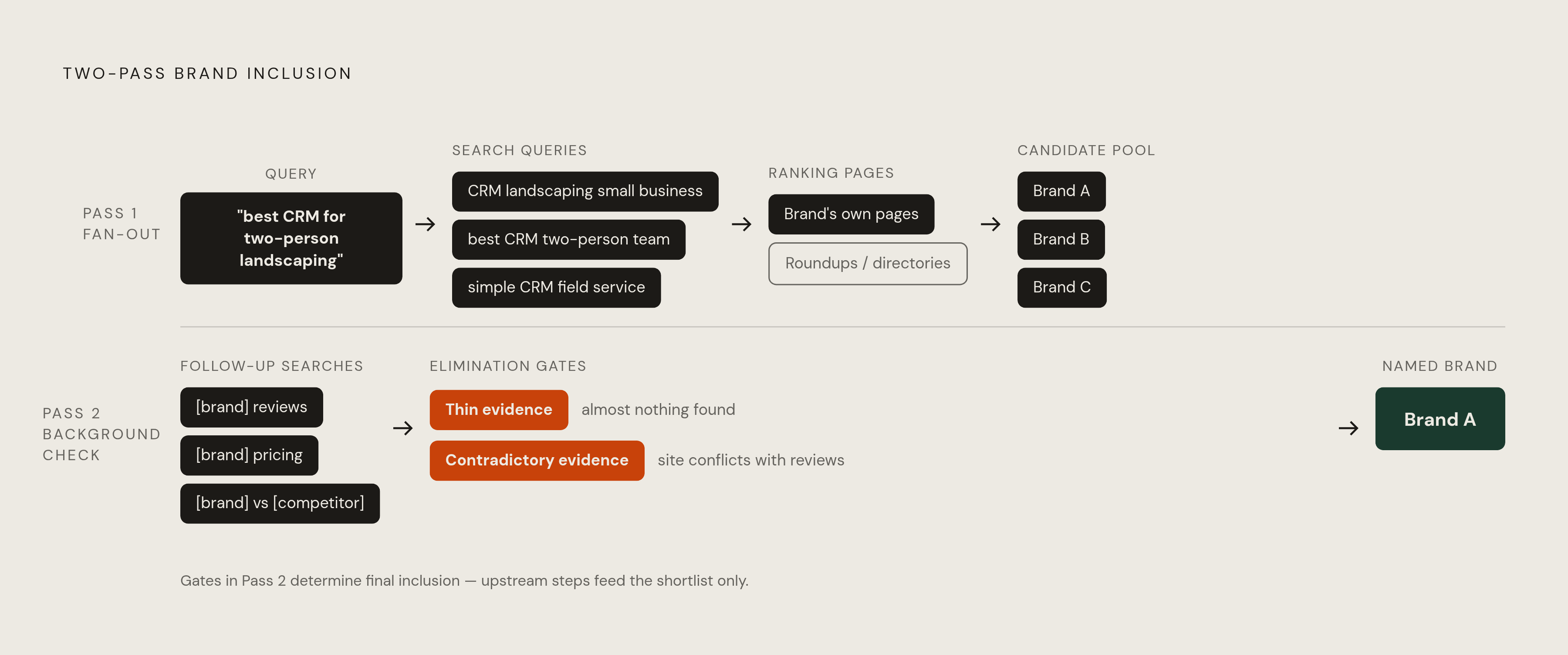
The inclusion decision runs through two distinct passes, and each one has its own purpose and its own failure modes.
The first pass builds the candidate pool. A user's conversational question gets rewritten internally into several short search queries, a process known as fan-out: "What's a good CRM for a two-person landscaping company?" becomes queries like "best CRM small landscaping business" and "CRM for field service small business". Whatever pages rank for those fan-out queries supply the brands that make the shortlist. There are two lanes into that shortlist: a brand's own pages ranking for the fan-out terms, and third-party pages, roundups, directories, and review sites that rank for those same terms and happen to include the brand. The shortlist is built from pages, not from brands directly, so a brand omitted from the top-ranking listicle in its category is effectively invisible in every answer built from that listicle, regardless of how strong its own website performs.
The second pass is the background check. Once the fan-out produces a shortlist, the assistant issues follow-up searches aimed at each candidate specifically: "[brand] reviews," "[brand] pricing," "[brand] vs [competitor]," sometimes restricted to the brand's own domain. These are grounding queries, the model vetting its candidates the way a careful researcher double-checks a source before citing it, trusting corroboration over self-description. Two failure modes eliminate a brand at this stage. Thin evidence happens when the model searches and finds almost nothing, so it defaults to a better-documented competitor instead. Contradictory evidence occurs when the brand's own site claims one thing while directories or reviews say another, and that inconsistency reads to the model as risk.
If you understand this two-pass mechanism, fan-out queries building the candidate pool and background-check searches vetting each shortlist, platforms built for AI search optimization make it visible and actionable. Athenahq, for instance, surfaces which queries an LLM actually issues on a brand's behalf and which third-party pages rank high enough to pull that brand into the initial shortlist in the first place.
The five signals that decide which brands survive both passes
Five interconnected signals determine recommendation worthiness, and none of them can compensate for the others being absent.
Mention frequency across training data and retrieved pages sets the baseline. Models identify a brand as an entity and bind it to the topics it repeatedly co-occurs with: Patagonia surfaces for "sustainable outdoor clothing" because that phrase and that name were nearly inseparable across the pages the model read. A single blog post, one PR placement, or one viral moment does not build this kind of association, because LLMs learn through pattern density, the same ideas appearing across many different trusted environments rather than one loud appearance in one place.
Source authority compounds mention frequency rather than replacing it. A brand cited in an established publication carries more recommendation weight than one mentioned only on obscure blogs, but authority is not simply a function of company size. A niche brand mentioned consistently in authoritative, problem-specific contexts can outperform a Fortune 500 company whose coverage stays generic and brand-level. Editorial articles, analyst reports, comparison platforms, and forum discussions each carry a different kind of weight, and a brand's presence across that mix increases its recommendation odds more than concentrated presence in any single channel.
The second pass is built to test the trust layer that review sentiment and third-party corroboration form. When multiple independent sources describe a brand the same way, the model reads that agreement as a reason for higher confidence in the brand's attributes, so accurate, consistent listings across review platforms carry weight well beyond their function as marketing collateral.
Whether a brand's authority turns into a specific recommendation depends on query fit. You might get a productivity software company recommended for workflow questions but not for graphic design questions, even though both fall under the broad umbrella of business software. Brands that win AI visibility tend to own one specific mental slot, "best tool for outbound lead enrichment" or "reliable enclosed trailer dealer in Georgia," because LLMs reward focus over breadth. A brand that tries to claim too many categories at once gives the model no clear reason to surface it for any one of them.
Structured data and entity clarity round out the five. Models favor content built with semantic HTML, logical heading hierarchies, definition-style paragraphs, comparison tables, and FAQ sections, because these formats are easier to parse, extract, and cite than dense prose or marketing copy. Entity clarity, meanwhile, requires the same name, the same products, the same locations, and the same positioning across every digital touchpoint a brand controls, since inconsistency across platforms produces the contradictory-evidence failure mode described in the second pass.
Training data versus retrieval: how each layer weights these signals
These five signals do not carry the same weight everywhere, because LLMs draw on two distinct information sources: what they absorbed during training and what they retrieve at the moment of a query. The same brand can be invisible in one of these layers while well represented in the other, and the fix required differs depending on which layer is failing.
Training data is the enormous body of text a model ingested before it was ever deployed. Brands that appeared consistently across that corpus developed strong internal representations the model can recall without consulting any external source at all. This layer drives a model's instinctive associations, causing certain brand names to appear unprompted when a user asks a general category question. It reflects a snapshot of the internet from before the model's training cutoff, so it changes slowest of all.
Retrieval handles anything time-sensitive, which training data cannot capture. A brand recommendation is rarely timeless: pricing changes, products get discontinued, competitors enter a category, and a commercial query usually depends on facts that are true right now rather than facts that were true whenever the model's training data was collected. That dependency is what pushes commercial prompts toward retrieval, layering the recommendation decision on top of ordinary live web search. Retrieval-augmented systems prioritize pages with clear structure, authoritative backlinks, and direct answers. A brand needs strong signals in both layers at once to maximize its odds of being recommended. Different AI platforms lean on each layer to different degrees, so a brand strong in parametric memory but weak in structured, retrievable content can perform well on one assistant and disappear on another.
The practical consequence of this split is a difference in timelines. Training-data gaps close slowly, because you have to build a sustained body of mentions across authoritative sources over a long stretch of time, not run a single publishing push. Retrieval gaps close faster, because if you publish clearly structured, well-sourced content, live-retrieval systems can find and cite it almost immediately. A brand serious about cross-platform visibility has to work both layers at once rather than treating one as a substitute for the other.
Repetition and consistency over virality and volume in building AI brand presence
The kind of content behavior that earns AI inclusion runs opposite to what most brand marketing is built to optimize for. Consistent, explanatory, topic-specific coverage sustained over time outperforms volume, promotional language, and any single viral moment. For years, search marketing rewarded spikes, the sudden traffic bump from a trending post or a well-timed campaign. AI ranking rewards the opposite: LLMs trust ideas that show up repeatedly over time, and plain, workmanlike educational content quietly outperforms flashy thought leadership when it comes to actual AI visibility.
This distinction matters because it inverts what most marketing teams treat as success. A piece of content that teaches a concept, walks through trade-offs honestly, explains why something works the way it does, and acknowledges where it falls short tends to get referenced more often than content built around a superlative claim with no context behind it. Models are built to answer questions, not to repeat slogans, so a page that reads like an advertisement gives a model little to extract and even less to trust. If you organize content around a specific use case and a measurable result, that problem-oriented positioning builds a far stronger association in a model's internal representation than vague language about transformation or innovation.
If a brand publishes constantly and still gets excluded from AI answers, it's usually running into this exact mismatch. Frequent publishing without topical focus and without source authority produces a scattering of generic mentions that a model cannot confidently tie to any one query. What actually builds the statistical association a model reaches for is concentrated, coherent coverage of a single problem space, repeated often enough and consistently enough that the model has nowhere else to look when that problem comes up.
The structural content choices that make a brand legible and extractable to AI systems
Beyond the substance of what a brand says, an AI system can parse well-built content, extract a clean claim from it, and cite it with confidence, and the formats that earn citations follow a pattern that is both predictable and reproducible. A header written as a direct question, "What Is GEO?", is more likely to get cited for the query "what is generative engine optimization" than a vaguer header like "GEO Overview," because the question format mirrors the way users actually phrase their prompts. Structuring headers as the exact questions a reader would ask is a small change with an outsized effect on whether a model can lift a usable answer straight from the page.
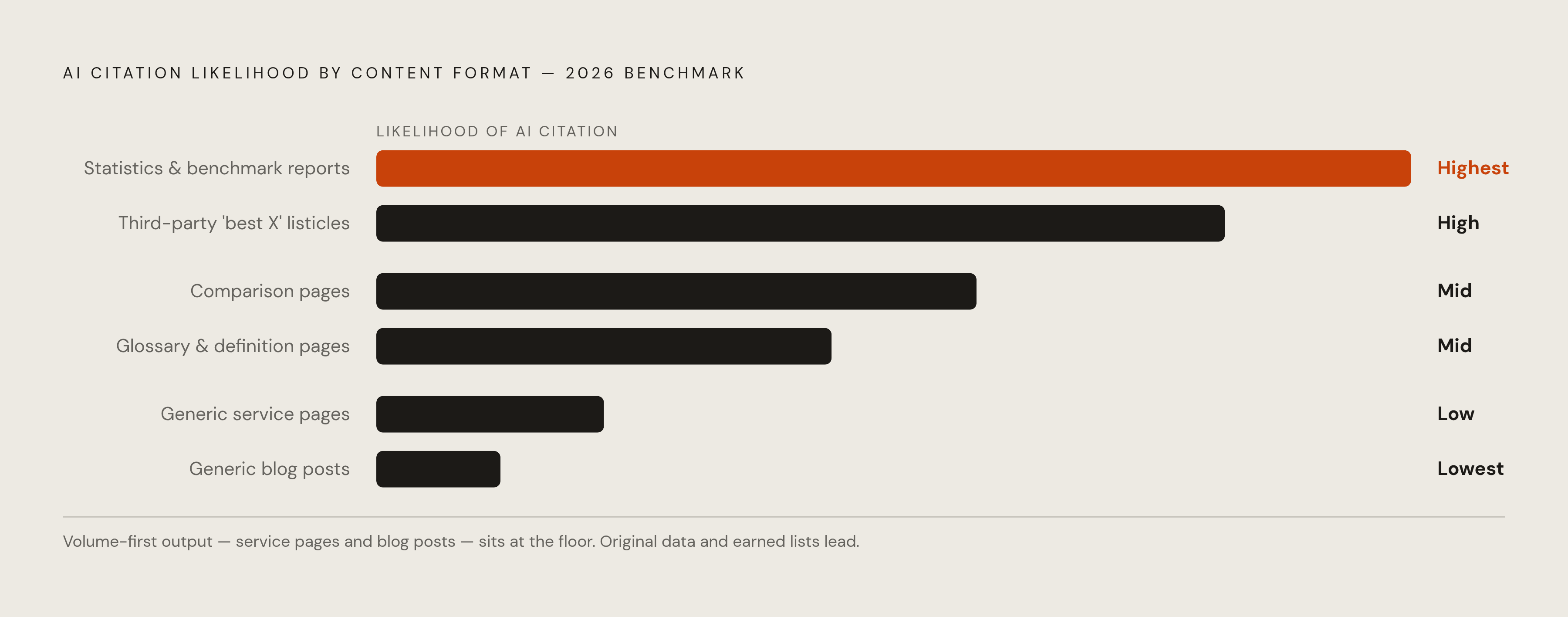
Not all content formats carry equal weight in a model's eyes. A 2026 benchmark of content types by citation likelihood found that statistics and benchmark reports, along with third-party "best X" listicles, carry the highest citation likelihood, with comparison pages and glossary or definition pages close behind. Generic service pages and generic blog posts sit at the bottom of that list. The implication follows directly: a brand that publishes only service pages and promotional blog content is producing exactly the kind of material least likely to earn an AI citation, no matter how much of it exists. Shifting even a portion of a content calendar toward benchmark data, honest comparisons, and clear definitions does more for AI visibility than doubling the volume of standard marketing pages.
Entity clarity on a brand's own site matters just as much as the format of any individual page. A plain-English page laying out what the brand does, who it serves, where it operates, and what it costs gives a model the clean, extractable summary it needs during the background-check pass, the same pass that eliminates brands over thin or contradictory evidence. Consistency between that page and everything third parties say about the brand elsewhere is what keeps a brand out of the contradictory-evidence trap and squarely inside the shortlist a model is willing to vouch for.