AI Citation Influence on B2B SaaS Pipeline Attribution
AI citations now drive pipeline differently than organic search rankings do.

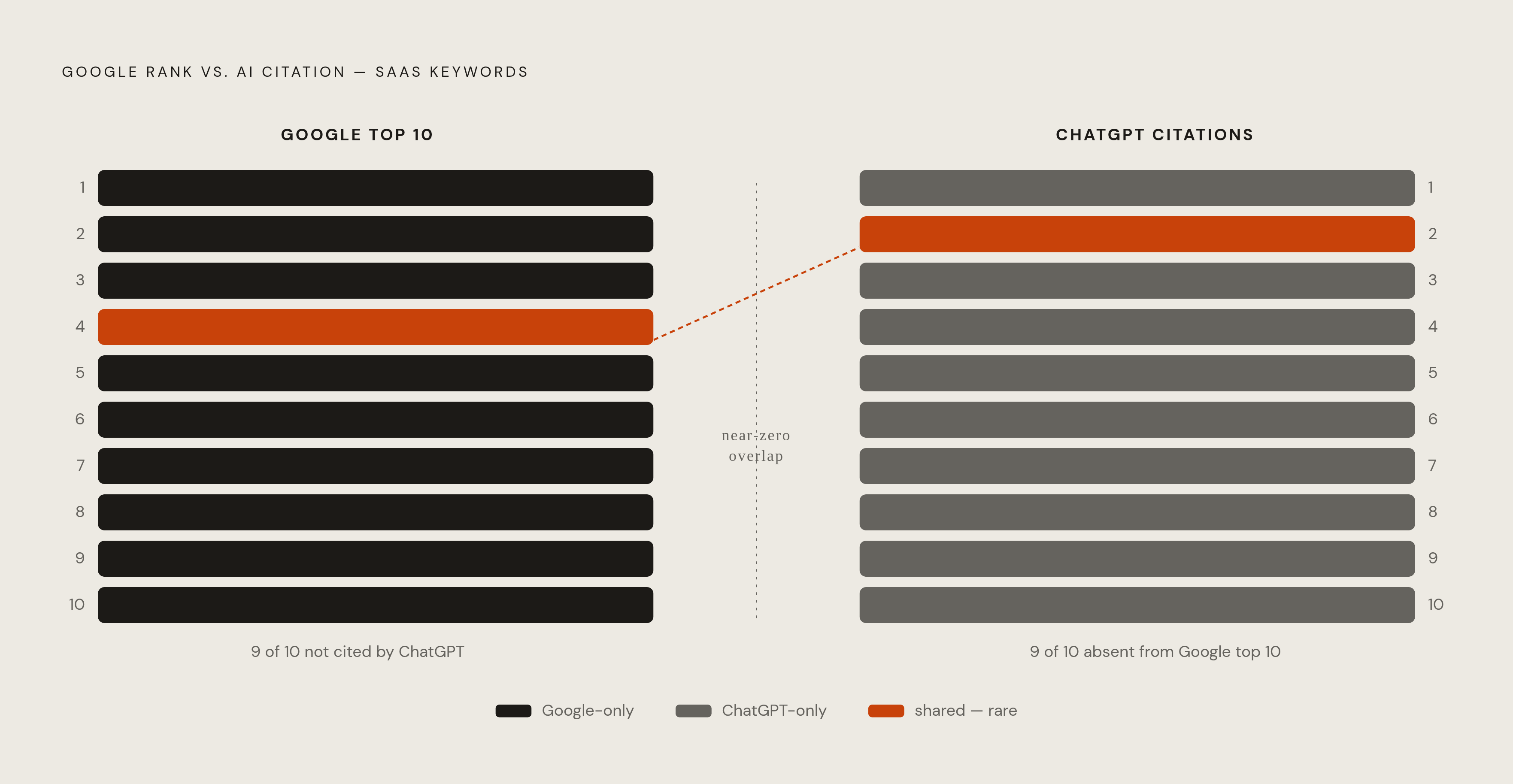
The cleanest finding in the recent research is also the most disruptive. The overlap between brands ranking in Google's top results and brands cited by AI assistants for those same queries has mostly fallen apart. One study of SaaS companies found that a large chunk of brands sitting in Google's top ten get zero ChatGPT citations for those same keywords. Flip it around and the pattern still holds: most brands ChatGPT recommends aren't in Google's top ten at all. This isn't a fringe case, it's the normal relationship between organic rank and AI citation across the category now.
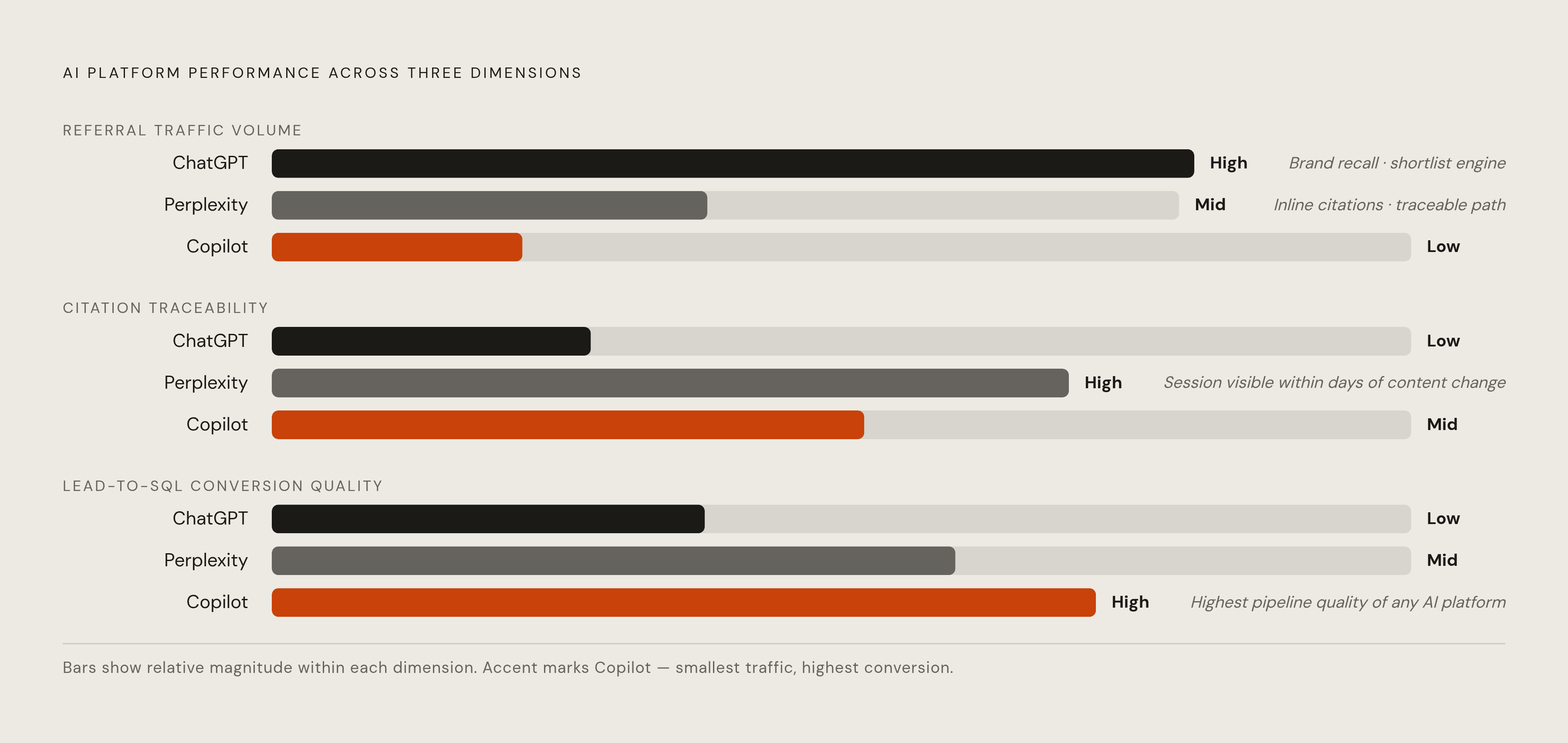
B2B SaaS companies need a measurement layer built independently of their SEO stack, because the inputs AI platforms weigh, brand mentions across the web, entity confidence, third-party validation from sources like Gartner and G2, bear little relationship to the keyword density and backlink signals a rank tracker was built to see. The core metric is AI Share of Voice: brand citations divided by total category citations across a defined prompt set, tracked weekly against the specific buyer-intent prompts where competitors get cited and the target brand does not. Platform behavior diverges sharply enough to demand separate attention: Perplexity's inline citations create a traceable path from citation to session within days of a content change, ChatGPT reflects training-data patterns and editorial backlink history accumulated over years, and Microsoft Copilot drives small referral volume but the highest lead-to-SQL conversion of any AI platform in the research. On the attribution side, AI-referred sessions should run under their own UTM source and be evaluated against a dark-funnel model of influence, since AI citations shape shortlist formation well before a buyer reaches any touchpoint a CRM can log.
So what is AI citation logic actually weighing, if not rank? Third-party validation carries a lot of the weight. When Gartner, G2, or a respected trade publication cites a brand, that signal enters the training data and shapes what the model recommends later, sometimes with no recent content update from the brand at all. Research on AI citation predictors found that brand mentions across the web, not backlinks, not keyword density, carry significant weight among predictors of AI citation. Freshness cuts differently by platform, too: Perplexity runs live web search and rewards recency, while ChatGPT reflects patterns baked into training data and years of editorial backlink history. Underneath all of it sits entity confidence: how clearly a brand's identity, products, and expertise are structured and cross-referenced across the open web.
I went looking for a shortcut here — some way to eyeball AI presence off an existing SEO dashboard — and kept hitting the same wall: the inputs these systems weigh just aren't the inputs a rank tracker was built to see. A marketing team needs a separate lens, built around how these systems actually pick and stitch together information, not how they rank pages.
How should B2B SaaS companies measure AI share of voice in a way that connects to pipeline?
Start with a clean definition. AI Share of Voice is the percentage of generative AI responses, across a defined set of category queries, where a brand gets cited as a primary entity or recommended solution. Old-school share of voice measured ad spend or search position; AI SoV measures how often a brand gets named inside the synthesized text of an LLM's answer. The math itself is simple: brand citations divided by total category citations across the prompt set, times 100.
Inclusion is the whole game here. Most AI search sessions end without a single click to any website. If the brand's name never shows up in the answer, it doesn't exist in that channel for that buyer, full stop. There's no second chance at a landing page, no retargeting pixel waiting to catch them later, nothing to pick up the slack.
Underneath AI SoV sit three metrics worth tracking on their own. Citation rate measures the share of prompt responses linking to a domain the brand owns; this moves independently of brand mentions, since an answer can name a brand in prose without linking to it, or link to a page without naming the brand at all. Mention frequency counts how often the brand name shows up across the full response set, including passing references that never rise to a full citation. Prompt-level gap mapping finds the specific buyer-intent prompts where competitors get cited and the target brand gets nothing.
That last one is where the pipeline connection actually shows up, and it's the one I initially underweighted. My first instinct was that an aggregate SoV score would be good enough to act on. It isn't — it hides the exact problem that costs deals. A brand can post a perfectly respectable overall SoV number while sitting completely invisible on the handful of prompts buyers use during final vendor comparison, which is the moment that matters most. The average papers over the gap. Check this weekly, not quarterly: capture prompts and flag gaps every week, roll results up monthly for stakeholders, revisit strategy each quarter. AI answers shift more often than classic search rankings do, so the cadence has to keep up.
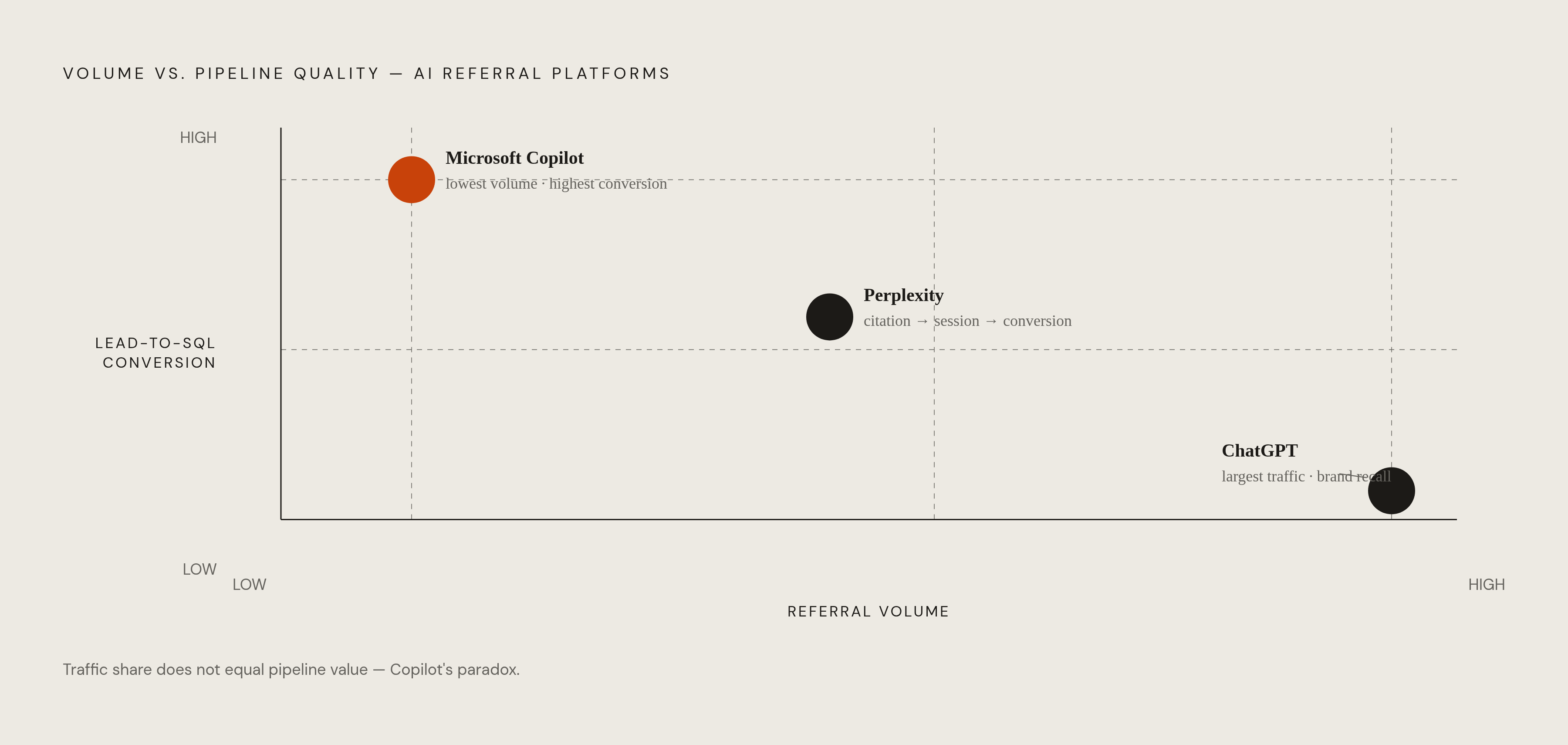
Platform behavior differs enough to matter for where a team spends its time. Perplexity shows inline linked citations that map directly to referral sessions, and content changes can show up in its responses within days, which makes it the fastest feedback loop available for testing what actually moves citation. Microsoft Copilot carries a smaller share of AI referral volume overall but produces the highest engagement rates and the highest lead-to-SQL conversion of any AI platform in the research: small volume, outsized pipeline quality. Google AI Overviews now shows up across a large and growing share of searches, and there, structured data is the main lever deciding which sources get pulled into the answer.
Measuring AI SoV tells a team where the gaps sit. The harder question is whether closing those gaps actually moves pipeline, or whether this is still just a fancier brand-awareness number.
How AI citations function as a discrete attribution layer, not a brand awareness channel
The standard objection sounds something like this: this is brand awareness, not pipeline, so why fund it like a demand-gen line item? It's a fair challenge, and the conversion data pushes back hard on it. Visitors arriving from AI platforms convert at higher rates than standard organic traffic, and several data points across the research put that gap at several multiples, not some marginal edge. The premium tracks with intent. Someone asking an AI assistant to compare B2B SaaS vendors head-to-head has already done a chunk of the funnel work that someone casually scrolling search results has not done.
What this points to is a dark-funnel model of influence. AI citations shape preference and shortlist formation well before a buyer reaches any touchpoint a CRM can log. First-touch attribution misses it; last-touch attribution misses it too. Only models built to account for pre-contact influence can capture what's actually happening, and most marketing attribution stacks today weren't built with that in mind. One practical workaround: track AI-referred sessions under their own UTM source and watch whether the conversion pattern looks like qualified buyer behavior or casual browsing.
Not all AI referral traffic carries the same weight, either. ChatGPT drives by far the largest share of AI referral traffic, functioning mostly as a brand recall and shortlist-formation engine. Perplexity drives less traffic, but its inline citations link straight back to source pages, which creates an actual traceable path from citation to session to conversion. Copilot's referral volume stays small, yet it posts the highest engagement and qualification rates observed, a sign that different platforms may be pulling in entirely different buyer profiles.
For a CMO walking into a board meeting, the framing is straightforward. AI SoV works as a leading indicator of pipeline. A brand that improves its citation rate on high-intent category prompts should see downstream movement in the quality of AI-referred sessions, not just a bump in raw traffic count.
None of that holds up, though, if the citations themselves are wrong.
What AI hallucinations cost B2B SaaS brands at the moment of vendor evaluation
An AI assistant tells a buyer that a SaaS product lacks a security certification the company has actually held for years. Or it misquotes an enterprise pricing tier. Or it attributes a competitor's feature set to the wrong brand entirely. Each of these happens at the exact moment a buyer is forming a decision, and the buyer has no reason to doubt what they're reading.
That's what makes this a pipeline problem, not a footnote about data quality. Enterprise buyers treat AI-generated summaries as pre-vetted, already-synthesized research; the confidence behind how the answer gets delivered masks whatever inaccuracy sits inside it. A hallucinated answer during vendor comparison doesn't generate a support ticket or an angry email. The brand just doesn't make the shortlist, and nobody on the vendor side ever finds out why. Hallucination rates on factual entity questions stay meaningful even in the most advanced models, so brands can't assume accurate description is the default. It has to be earned.
The failure modes repeat across categories. Invented statistics get attributed to the brand, phrased as if the company published research it never conducted, while product specs and pricing tiers get fabricated outright. Entity confusion sets in: wrong founding date, wrong headquarters, wrong leadership team. Fake citations point to studies the brand never ran.
The root cause is structural, not malicious — worth sitting with, because it changes where the fix belongs. When a brand's digital footprint is thin, inconsistent, or poorly organized, the model fills the gaps with whatever sounds plausible. That's gap-filling behavior with real consequences attached, not an evil algorithm at work. The fix isn't a support ticket to OpenAI. It's building the information environment so the model has something true to draw from in the first place.
Building the information infrastructure that AI platforms draw from
AI models don't browse a website the way a person does. They absorb structured signals about what a brand is, what it sells, and what credible sources say about it elsewhere. The job is building those signals so they stay consistent, machine-readable, and checkable against outside sources.
Schema markup does a lot of the heavy lifting here. Organization schema needs the official name, URL, logo, and a set of sameAs links pointing to verified profiles on LinkedIn, Crunchbase, and comparable directories, so every platform resolves the brand to the same underlying entity instead of several fuzzy variants. Product or Service schema should spell out offerings and pricing explicitly, which heads off pricing hallucinations right at the point where a model tries to verify specs. FAQPage schema lets a brand write its own answers to common security, policy, and compliance questions so the model can pull them directly instead of paraphrasing and getting it wrong. ClaimReview schema has a narrower job: correcting a confirmed hallucination or pushing back on a persistent inaccuracy that keeps surfacing in AI answers.
Third-party citation works as a kind of ground-truth layer underneath all of this. When Gartner, G2, an industry analyst, or a trade publication cites a brand's claims, those citations enter the same information environment the models draw from later. That's why digital PR now counts as a generative-engine-optimization tactic and not just a brand-awareness one. Consistent, accurate facts spread across reputable third-party sites shrink the information vacuum that produces hallucinations in the first place. The old E-E-A-T signals, experience, expertise, authority, trust, work as entity confidence markers for AI systems too, not just for Google's ranking algorithm.
For companies building AI-assisted sales or support tools in-house, retrieval-augmented generation offers a more direct lever. RAG forces the model to consult a verified, controlled set of documents instead of leaning on whatever it absorbed during training, and that shift, from generative mode to summary mode, cuts hallucination rates by a wide margin.
Infrastructure keeps a brand from being described wrong. It doesn't guarantee the brand gets picked over a competitor when both descriptions are accurate. That's a separate job entirely.
Content that earns AI citations rather than content that merely exists
Most B2B SaaS content teams are churning out material that restates what's already common knowledge, and that habit gives AI models no reason to cite the brand over any other source saying the same thing. The content gets folded into the general consensus without ever earning attribution.
The concept that matters here is information gain. Forrester's 2026 research found that content offering genuinely new information ranks well ahead of content that just rehashes the existing consensus in AI-generated responses. Information gain means something the model can't invent on its own and competitors haven't already scraped together: proprietary data pulled from internal systems, quotes from named experts, an original framework, a counter-argument backed by real evidence.
The GEO research out of Princeton, led by Aggarwal and colleagues, sharpens this further by isolating which content signals actually move the needle. Adding direct quotations from credible sources produced a real lift in how much of an AI-generated answer a given source accounted for, and statistics produced a similar lift. External citations helped too, though the effect ran smaller. The pattern across all three: how claims get sourced and structured inside a piece of content matters, separate from whatever topic the content covers.
There's a two-step filter most content never clears, and it took cross-referencing the citation data against actual page structure to see it clearly. First, a page has to get picked as a plausible source at all for a given category query. Then the evidence inside it has to be easy for the model to pull out and use. Plenty of content that clears step one fails step two because it's written for human reading flow rather than extraction. Clean, quotable structure with clearly defined claims and named attributions gets absorbed far more easily than prose written for narrative feel.
Running the diagnostic is simple in principle, harder in practice. Take a defined set of buyer-intent prompts, run them across the major LLMs, log which brands get cited and which sources get linked, then isolate the prompts where competitors show up consistently and the target brand doesn't. Each gap maps to something concrete: a missing use case, a missing industry angle, a missing expert voice, missing original data, rather than a vague note that the team just needs "more content." That specificity is what turns a measurement exercise into an actual content roadmap.