Competitor Citation Gap Analysis in AI Search Results
How AI models cite sources differently than search engines rank them.
Generative AI has changed what it means to win a search. This piece lays out what competitor citation gap analysis measures, why it works differently from backlink or rank tracking, and how to run one that actually tells you something.
AI Search Citations vs. Traditional Search Rankings
A search engine ranks pages. An AI platform answers a question, and it only answers using sources that survive a multi-stage process: interpreting the query, retrieving candidate documents, ranking them, synthesizing an answer, then deciding what to cite. A source has to clear every one of those stages to earn an attribution, and falling short at any point means an AI platform never surfaces the content, no matter how well it would have ranked under the old rules.
The scale of this shift is hard to overstate. ChatGPT alone handles over 2 billion queries a day and reaches hundreds of millions of people every month, Google AI Overviews now show up in a large share of all Google searches, and by mid-2025 the number of website sessions arriving from AI platforms had grown sharply. A buyer can have an entire research conversation inside these tools before a brand's website ever enters the picture. A prospect can form what amounts to a silent shortlist during a single AI session, and that shortlist may already be locked in by the time anyone lands on a brand's page.
What makes this especially hard to track is that citation behavior does not hold still the way rankings do. If you follow brand citation patterns across repeated AI answer runs, only a small fraction of brands keep appearing across consecutive runs for the same prompt. A single snapshot, taken once, tells a brand almost nothing about whether it will still be cited next week. That volatility alone is reason enough to treat competitor citation gap analysis as its own discipline, separate from rank tracking.
What competitor citation gap analysis measures and what it does not
Competitor citation gap analysis is a measurement discipline, and it earns that label by refusing to collapse distinct outcomes into one number. It separates whether a brand gets mentioned at all, whether it gets recommended, whether its domain gets cited as a host, whether the exact URL shows up, what share of relevant answers include it, and whether its own language gets absorbed into how the model describes the category.
The framework breaks down into the same components: mention, source citation, exact URL reference, share of relevant answers, and language absorption, each tracked as its own observable unit. From there, you can sort what turns up into three gap types. A visibility gap is a prompt where the brand should show up, given its category and the buyer's intent, but instead the brand is absent from the answer. A citation gap is a prompt where competitor domains get cited as sources but the brand's own domain goes uncited, even if the brand gets a passing mention. A share-of-voice gap compares citation rate and share of model between a brand and its named rivals, across a set of prompts you define.
Each gap type points to a different problem and a different fix, so lumping them together gives you a misleading picture. A brand can rank well on its own site, get cited by a trade publication, get mentioned by name in an AI answer, and have its language baked into how the model phrases a category description, and these are four separate outcomes. Winning one says nothing about whether the brand has won the other three. This isn't a theoretical distinction. It tells you whether a gap audit has found a content problem, a reputation problem, or a formatting problem, and each of those needs its own response.
Why GEO is primarily a third-party game
An AI model doesn't read a brand's own website first. It reads what the rest of the internet has already said about that brand, and that reputation, built across publications, reviews, and trade coverage, carries more weight in what gets cited than anything posted on the brand's own domain. The dominant source of AI brand citations is third-party content, not brand-owned pages, and that single fact inverts an assumption most teams carry over from traditional SEO, where owning and optimizing your own pages was most of the job. A citation gap cannot be closed by publishing more content on a brand's own site alone, because that's not primarily where the citations are coming from.
The data backs this up directly: a large majority of brand mentions in AI search trace back to industry publications, analyst reports, consumer reviews, trade press, and earned media, not to brand-owned domains. A brand can have a deep, well-maintained website and still lose citations consistently to a competitor whose own site is thinner but whose presence across the surrounding ecosystem, review platforms, analyst writeups, press coverage, runs wider.
This reorders what a gap audit should actually be looking for. So GEO work leans more on positioning and earned presence across the ecosystem than on technical fixes to a brand's own pages, and if a team starts with schema markup before it has earned any third-party coverage, it is working the wrong end of the problem first.
How AI platforms differ in what they cite
Every major AI platform has its own mechanism for deciding what to retrieve, rank, and cite, so a citation gap on Perplexity is a structurally different problem than the same gap on Google AI Overviews. Running a gap audit against a single platform will consistently give a distorted read on the competitive landscape, because the forces that produce a citation on one engine don't carry over cleanly to the next.
Google AI Overview stands out for having the lowest citation rate among major platforms, and it draws most of its citations from pages that sit outside the top 10 organic results, so traditional organic rank still acts as a gatekeeper there in a way it doesn't elsewhere. So every citation a brand wins on ChatGPT now carries a clickable link straight to its site.
Cross-platform overlap turns out to be thin. Only a small fraction of domains get cited by both ChatGPT and Perplexity, which confirms that strong presence on one platform cannot be used to infer strong presence on the other. A brand that closes its gap on one engine may still be functionally invisible on the next, and the only way to know is to check both rather than assume. This is the core argument for tracking citations across every major platform rather than optimizing against whichever one happens to be easiest to monitor.
How to run a competitor citation gap audit
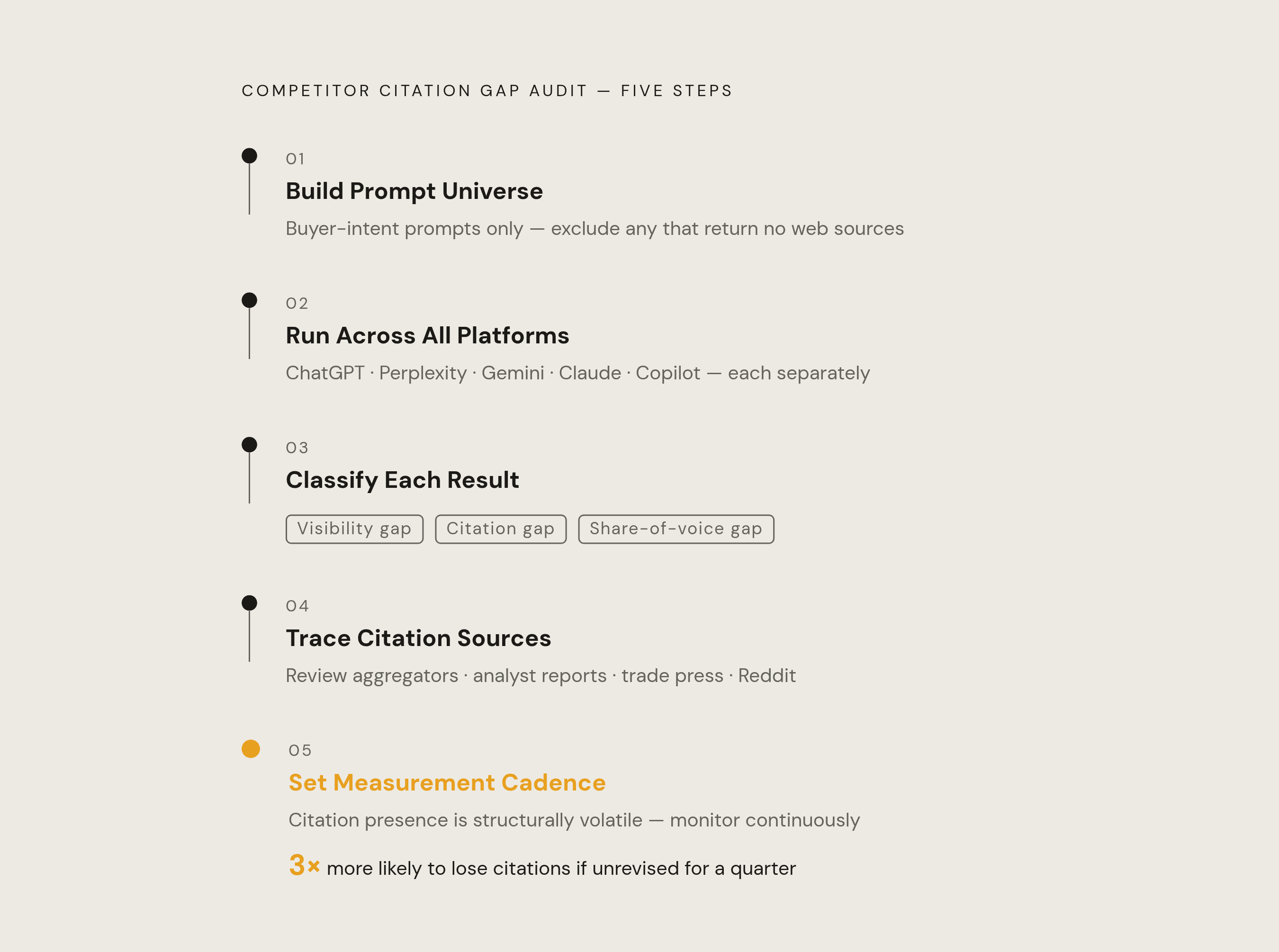
A competitor citation gap audit works as a sequence, not a one-off scan: build the prompt universe around buyer intent, run those prompts across every major platform, classify each result against the three gap types, then trace competitor citations back to the third-party domains carrying them, before drawing any conclusion about what content or authority work is actually needed.
The first step is building the prompt universe. Not every type of content earns an AI citation. Original data, middle-funnel comparison material, and head-to-head content tend to get cited, but top-of-funnel definitional questions get answered directly by the model, with no source pointed to at all. A useful prompt set includes only the prompt types where AI platforms are actually likely to pull from outside sources rather than answer from what the model already knows. Part of this step means excluding prompts where the AI returns no web sources at all. A meaningful share of ChatGPT responses skip citations entirely and instead recommend tools pulled from training data, so you should leave those out of citation-rate calculations rather than count them as zero. The prompt set should lean into brand-versus-brand comparisons, category recommendation questions, and feature-specific queries, since that's where share-of-model gaps tend to be largest and where they carry the most commercial weight.
The second step is running those prompts across every target platform. Each prompt needs to run separately across ChatGPT, Perplexity, Gemini, Claude, and Copilot, because platform behavior diverges enough that merging the results erases the signal a gap audit depends on. Tools such as the Google AI Overview Tracker on Apify can automate this step, returning structured output per query: whether an AI Overview appeared, whether the brand got mentioned, whether its domain got cited, which competitors got cited, which domains carried those citations, and the full text of the AI answer, exportable as JSON, CSV, or Excel for further analysis. For each platform's output, the useful record includes which domains got cited, whether the brand got named, whether its domain got cited, and what language the answer used to describe the competitor.
The third step is classifying every result. A prompt where the brand doesn't appear at all, with the entire category answer going to competitors, counts as a visibility gap. A prompt where the brand gets mentioned but not cited as a source, while competitor domains do get cited, counts as a citation gap. A prompt where the brand gets cited less often than a specific named rival across the set counts as a share-of-voice gap. What matters here is specificity: recording exactly which unit is missing, on which prompt, on which platform, during which measurement window, since that level of detail is what makes prioritization possible afterward.
The fourth step traces competitor citations back to their source. For every prompt where a competitor gets cited, the audit should identify what kind of third-party domain is carrying that citation, a review aggregator, an analyst report, a trade publication, even a Reddit thread. This step turns a gap finding into something you can use as an authority roadmap. It shows not just that a competitor is winning a given prompt but where that competitor built the authority behind the win.
The fifth step sets a measurement cadence. Freshness functions as a gatekeeper on its own: pages that go unrevised for a full quarter are more than three times as likely to lose their AI citations entirely, so the audit needs to repeat on a schedule rather than run once and get filed away. Citation volatility is structural rather than incidental. Only a small minority of brands hold their citation presence across five consecutive answer runs for the same prompt, so a single snapshot misleads and tracking the trend over time is required to know whether a gap is closing or widening.
What the content behind winning citations looks like
Competitors who keep winning citations aren't simply publishing more. They publish content with specific structural and substantive properties that AI platforms are built to pull from, and if you match those properties you get the main lever for closing a citation gap.
Across the models studied, four structural factors consistently act as gatekeepers: how closely the topic matches the query, whether price or comparison information is included, how recent the timestamp is, and where the content sits within a structured list. Those four factors are unanimous across every model examined. A large majority of AI citations come from structured "Top N" style content, and pages carrying statistics and citations of their own get cited substantially more often than pages without them. Some research, including work out of Princeton on generative engine optimization, finds that structured lists, quotes, and statistics correlate with higher visibility in AI responses, though a separate multi-model study from Sprinklr finds formatting itself carries little weight next to topic match, pricing, recency, and list position. The two findings aren't fully reconciled, but both point to substance over styling as what gets rewarded.
Position on the page matters too. A large share of LLM citations draw from the first portion of a page's content, so material buried deep in a long article gets under-cited even when it's relevant. Funnel stage matters just as much as structure. Comparison content and middle-funnel material earn citations consistently, while definitional, top-of-funnel content tends to get answered directly by the model without any citation at all, so publishing more of it does nothing to close a gap. Original data and proprietary research earn a disproportionate share of citations precisely because AI platforms have no other source to synthesize that information from.
The format a brand chooses to deliver its content in matters a great deal here. If a brand puts its best material inside stylized image layouts or gated PDFs, it gives AI platforms nothing they can extract with confidence, so the model tends to exclude that brand rather than risk citing something it can't verify. When clean schema markup, a verified review pipeline, and consistent definitions get used the same way across platforms, a model can extract and categorize a brand's information quickly, and that reliability is itself a factor in whether the brand gets cited at all.
Reading vertical benchmarks for a meaningful gap
A citation gap only means something once it's measured against what's achievable in that particular market, and the range of what counts as strong performance shifts enough between industries that the same share-of-model number can mean category leadership in one vertical and a lagging position in another.
A study of buyer-intent prompts across multiple verticals, run between April and May 2026, mapped out citation density benchmarks across industries and found real structural differences between them. In markets where authority is concentrated among a small number of trusted sources, fintech, healthcare SaaS, and cybersecurity among them, the top brands often combine for a dominant share of citations across both Perplexity and ChatGPT. In more fragmented markets like marketing technology or HR software, a comparatively modest share of citations can still represent the leading position in that category.
So a raw citation-rate number means little until you attach a vertical benchmark to it. If you map gaps across platforms and judge what they mean once you find them, you do better work when you can see a brand's citation presence across every major model at once instead of piecing it together platform by platform. Athenahq, for instance, tracks brand citation presence simultaneously across eight or more major models, so you get a clearer view of where a brand is actually losing ground to competitors than auditing each platform separately would give you. Whatever tool or process a team uses, the benchmark has to come from the vertical itself, reflecting what a strong citation rate actually looks like there.