Entity Authority Building for Brand Visibility in AI Search
Brands must build authority through third-party mentions to appear in AI search answers.

Gartner said traditional search volume would fall 25% by the end of 2026. Gartner said traditional search volume would fall 25% by the end of 2026, and that's the shape of the market right now. AI search engines don't discover brands the way Google's crawler did, by following links from page to page. They recognize entities: coherent, corroborated bundles of signal about who a brand is, what it does, and where it appears across the web. Whether a brand gets cited, recommended, or ignored now depends on how well that entity resolves, and most marketing teams are still optimizing for the crawler that's fading rather than the entity model that's replacing it. That's the wrong bet, and it's an expensive one to keep making in the years ahead.
AI Overviews now show up in close to 55% of all Google searches. Where they appear, the click-through rate for the page ranked first drops from 7.3% to 1.6%, a 58% collapse, based on an analysis of 300,000 keywords spanning December 2023 through December 2025. Ninety-three percent of AI search sessions end without a single click. If a brand isn't named inside the answer itself, it never enters the buyer's field of vision. There's no second chance further down the page, because there is no page anymore. Just an answer.
What entity authority means and how AI systems build it
Entity authority is the degree to which an AI system can confidently resolve a brand's identity, category, attributes, and claims from signals that corroborate each other across the web, rather than from any single page insisting it's true. It's a confidence score built from agreement, not a ranking built from links, and most SEO teams still haven't absorbed that distinction.
The mechanics differ by system, and those differences decide which sources actually shape a brand's representation. ChatGPT and Claude draw primarily on training data, though ChatGPT can also pull in retrieval tools when needed. Whatever shaped the model's understanding of a brand had to be published, indexed, and treated as authoritative well before training happened. There's no fixing a gap in training data after the fact, which makes waiting to build third-party presence a losing bet. Gemini works differently: it has native Grounding with Google Search, pulling real-time web content at the moment of the query, closer to how Perplexity and Google AI Overviews operate through retrieval-augmented generation, or RAG. In a RAG system, the model searches, retrieves a set of documents, and synthesizes an answer from what it finds right then. Fresh content matters more here. AI-surfaced URLs skew measurably fresher than what shows up in a traditional search result, and recency functions as a ranking signal inside retrieval systems in a way it never quite did for organic search.
Training-time citation and query-time retrieval favor overlapping but not identical signals. A brand optimizing for only one leaves half the surface area uncovered, and most brands optimize for the mechanism they already understand rather than the one that actually needs the work.
Corroboration drives both mechanisms. AI engines cross-reference claims across independent sources before trusting them. A brand that describes itself one way on its own homepage while appearing inconsistently, or not at all, across third-party coverage registers as low-confidence. The classic E-E-A-T framework, Experience, Expertise, Authoritativeness, Trustworthiness, still applies here, just aimed at a different judge than the one it was built for.
When the signals run thin, models don't say "unknown." They fill the gap. That's entity confusion: a model attributing the wrong founder, headquarters, or founding date to a brand, quietly borrowing facts from a competitor's history because the two entities weren't clearly disambiguated in whatever data the model had access to. The system is doing what it's built to do, producing a plausible answer, applied to a case where the underlying signal never gave it enough to work with. It's doing what it's built to do, producing a plausible answer, applied to a case where the underlying signal never gave it enough to work with.
Entity authority is not domain authority, and treating them as interchangeable is the single most common mistake in this space. A brand can carry a strong backlink profile and rank well in traditional SEO terms while still being a fuzzy, poorly disambiguated entity in the eyes of an AI system. A strong score in one tells you almost nothing about the other.
Why third-party presence, not owned content, is the primary lever
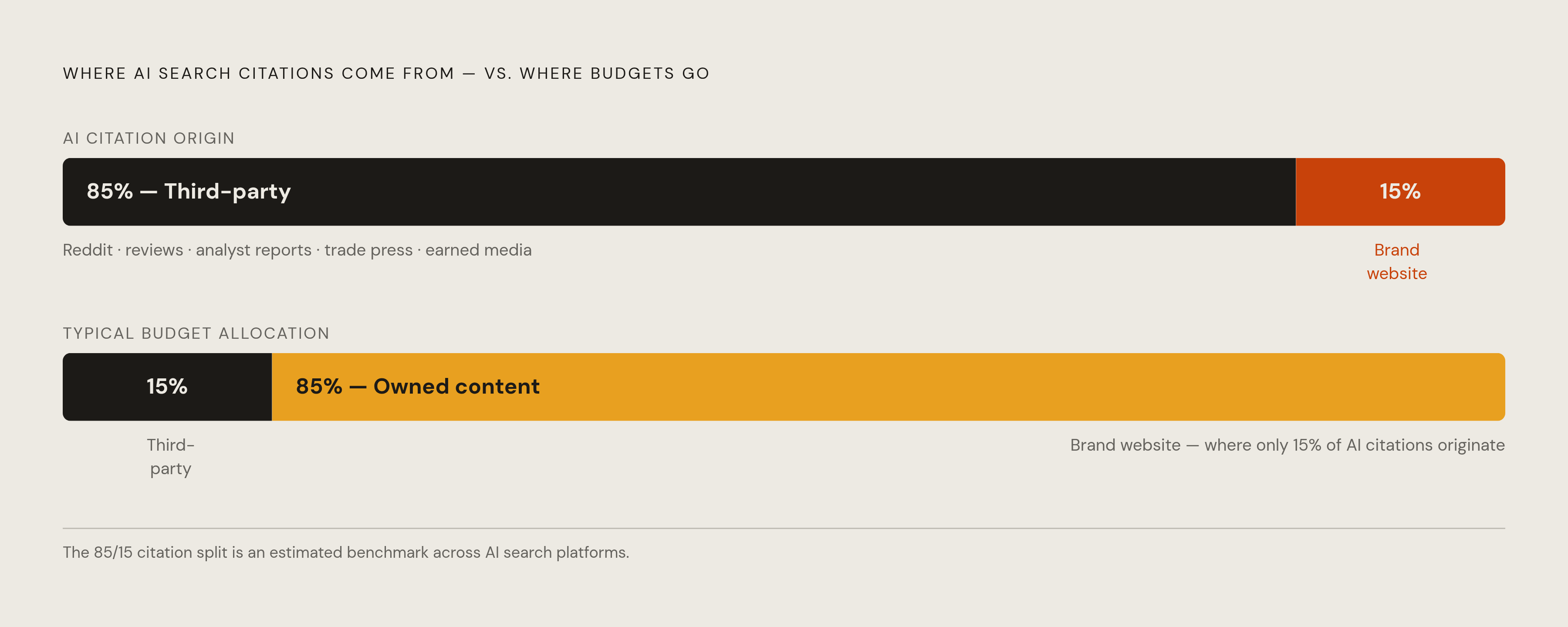
An analysis of over a billion citations found that roughly 85% of brand mentions inside AI search answers come from third-party pages. That ratio should reset how marketing teams allocate budget, because most are still pouring the bulk of their spend into the 15% that matters least: their own website.
The logic holds once you sit with it. When someone asks an AI system which brand to trust in a category, the model synthesizes across industry publications, analyst write-ups, review sites, trade press, and forum discussions, the accumulated, independent record of what other sources have said. A homepage is a claim. A hundred third-party mentions that agree with each other is evidence, and evidence is what these systems are built to weigh.
The specific surfaces carry real weight. Research analyzing millions of citations across ChatGPT, Google AI Overviews, Perplexity, Gemini, and Claude found Reddit sitting at the top as the single most-cited source across every major AI engine. Review platforms, community threads, analyst reports, and earned media round out the rest. ChatGPT Search drives a dominant share of AI referral traffic to websites, and what it pulls from is weighted heavily toward that third-party layer.
Thin or missing entries on Wikipedia and Crunchbase signal weak entity disambiguation, a citation eligibility problem sitting at the foundation rather than a gap to fix eventually.
Research out of Princeton, Georgia Tech, and IIT Delhi quantified which content signals move the needle on share of AI answers. Roughly 41% higher visibility resulted from adding quotations from credible sources. Adding statistics raised it by about 31%. Adding citations added another 28%. Corroboration outperforms self-description by a wide margin, and a brand pouring its energy into polishing its own website copy while ignoring the third-party ecosystem around it has the whole exercise backwards. Entity authority stopped being a web publishing discipline some time ago, if it ever really was one.
The owned-content signals that still determine whether AI can extract and cite a brand
None of this makes owned content irrelevant. It changes the job that content has to do: get extracted cleanly, not just get read.
A common pattern across content audits is pages that are thin or effectively non-extractable, lack visible publication dates, or carry no author signal, all citation eligibility failures that a retrieval system can't parse into something quotable no matter how good the underlying idea is.
The single strongest structural predictor of getting cited is what amounts to an answer capsule: 72.4% of cited content includes a standalone answer immediately following the H2 heading. That format, question as header, direct answer as the very next sentence, is a handshake with the retrieval system. It tells the model exactly where the extractable chunk lives, and skipping it is the most fixable mistake on this entire list.
Recency compounds this. Perplexity data shows content between zero and 30 days old gets cited several times more often than content older than six months, and one analysis found freshly published content inside that 30-day window cited at an 82% rate. That's a mandate to keep a small set of core pages genuinely current, rather than letting a content archive calcify into something no retrieval system trusts.
Schema markup does the quieter, structural half of this work. A documented case study from Broworks identified a schema gap and implemented FAQ Schema, Article Schema, and Local Business and Organization Schema across landing pages, case studies, and blog posts, treating these as essential attributes for LLM indexing rather than optional SEO polish. Schema tells a structured-data system exactly who a brand is, in a format it doesn't have to guess at. Skipping it means the entity gets inferred entirely from whatever third-party signal happens to exist, a far less reliable foundation to stand on.
Quality still has a bar. The principle is well established: content providing genuine information gain, adding something the model hasn't already seen elsewhere, performs substantially better in AI responses than content that rehashes existing consensus. Proprietary survey data, original research, and a framework that doesn't exist anywhere else are the only content types worth the investment now, because an AI system cannot hallucinate first-party data that was never published. A brand publishing its own internal numbers hands the model something no competitor can replicate or claim credit for.
Google's own 2026 guidance backs this reading directly, emphasizing that the fundamentals of optimizing for generative AI search remain grounded in the same principles as traditional SEO. The guidance warns against chunking content into artificial fragments, against creating unnecessary AI-specific text files like llms.txt, and against chasing inauthentic mentions. The instruction is almost old-fashioned: make content people find unique, compelling, and useful, and extraction takes care of itself.
How AI hallucinations expose the gaps in entity authority
A paradox runs through 2026's model behavior. The best models have pushed hallucination rates on simple summarization tasks down to as low as 0.7%. At the same time, the strongest reasoning models, GPT-5 and Claude 4 among them, drift more on complex tasks, not less. These models spend more computation "thinking through" an answer, and that extra reasoning sometimes walks the model further from its source material rather than closer to it. More thinking is not automatically more accuracy, and any strategy built on the assumption that newer models will simply hallucinate less is building on sand.
Hallucination isn't a rare glitch. A global database tracking AI hallucination cases had logged 1,434 documented instances as of mid-May 2026, which makes it a recurring feature of how these systems fail, not an edge case worth waiting out.
For brands specifically, the failures cluster into recognizable patterns. A model generates a round, believable-sounding number, "75% of users reported," when no such study was ever conducted. It references a study that doesn't exist, inventing a plausible author like "Henderson et al." or citing a "2024 Harvard study" that was never done. Or it assigns a competitor's founding date or headquarters to the wrong brand, blending two histories into one because nothing in its training or retrieval made the distinction clear.
The mechanism behind all three is identical. A brand's own website is one signal among dozens the model has access to, and when the rest of those signals are thin, contradictory, or absent, the model doesn't stop and flag the gap. It fills the space with something plausible. Hallucination, in this frame, is confabulation stepping in where corroboration should have been standing guard.
And it compounds. Once AI-generated content containing a false statistic, a broken URL, or an invented product feature circulates on the open web, it starts feeding the same search and retrieval signals that future models will train on or retrieve from, poisoning the well for the next round of queries while chipping away at the brand's credibility with the humans reading it.
RAG is the clearest technical mitigation available right now. Forcing a model to consult a verified, specific document set before answering, instead of reaching into the broader training data, can cut hallucinations by as much as 71%, since the model works in summary mode against a known text rather than generating from a blend of everything it's ever absorbed.
Preventing hallucinations and building entity authority are the same job, described from two angles. Synchronizing brand facts across every channel, closing inconsistencies wherever they appear, and making structured data explicit enough that the model never has to guess eliminates the ambiguity hallucinations feed on.
Measuring entity authority: AI share of voice and the metrics that reflect real citation presence
Measurement has to come first, and AI Share of Voice, AI SoV, is the metric that matters most: the percentage of relevant AI responses that mention, cite, or recommend a brand, measured against the total number of responses across a set of target queries. The formula is mentions divided by total AI responses, multiplied by 100.
Two variants measure different things and should never collapse into one number. Citation-based AI SoV counts actual link-bearing citations: brand citations divided by total citations across the response set. Entity-based AI SoV counts recognition without requiring a link: how often the brand shows up as a named, recommended entity relative to every entity mentioned. A brand can score well on one and poorly on the other, and that gap is diagnostic on its own, since it tells you whether the problem is recognition or extractability.
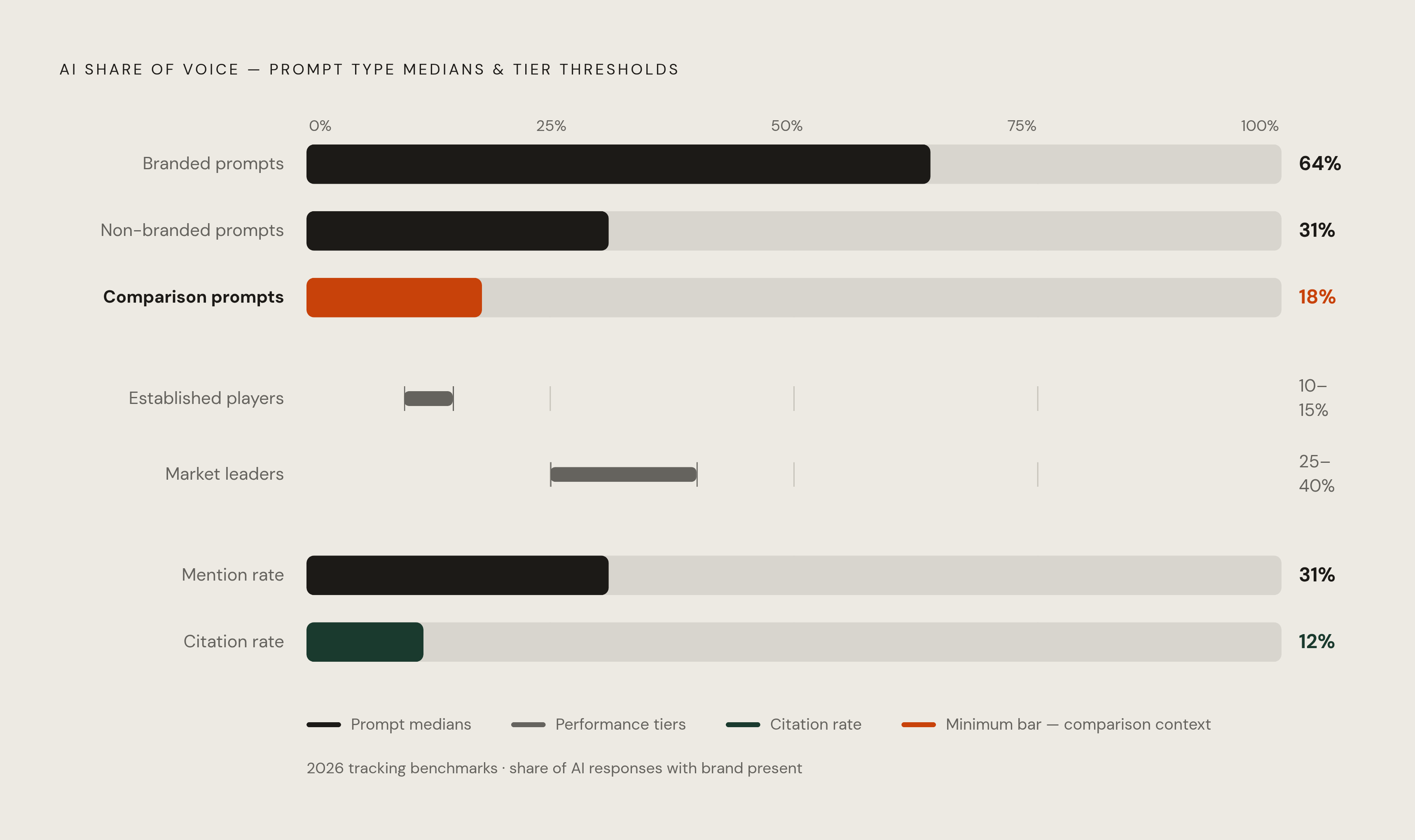
2026 tracking benchmarks put real numbers on this. The median non-branded mention rate across tracked brands is around 31%, so the typical brand appears in roughly one out of every three relevant AI answers. That number swings hard by prompt type: branded prompts push the median up to roughly 64%, while comparison prompts, the "X versus Y" queries where competitive framing is explicit, drop the median to around 18%. Any benchmark quoted without specifying prompt type deserves skepticism.
The citation rate tells a colder story. Median non-branded citation rate, an actual link back to the brand, is around 12%. Engines will name a brand from memory readily enough, but they only link to pages they can fetch, trust, and extract cleanly. That gap between mention rate and citation rate is a structural feature of how these systems work, and it's why extractability, answer capsules, schema, clean publication dates, matters as much as reputation does. An AI SoV between 10% and 15% counts as solid for an established player; market leaders in a category run closer to 25% to 40%.
Volatility complicates the read further. Roughly 30% of brands visible in one AI response for a given query appear again in the very next response to that same query. A single week's reading is close to meaningless on its own. A five-point swing that holds across three or four consecutive weeks is a real signal to act on. A swing that appears once and vanishes is noise, and treating it otherwise wastes a team's time.
Model-specific tracking is non-negotiable. Aggregating visibility across ChatGPT, Gemini, Perplexity, and Claude into one blended number hides exactly the differences that matter, since training data and retrieval architecture vary enough between systems that a brand can be strongly resolved on one model and nearly invisible on another. Six core metrics belong on any serious dashboard: Brand Mention Rate, Recommendation Rate, Prompt Coverage, Share of Voice, Model-Specific Visibility, and Visibility Volatility. An overall AI visibility score is a weighted composite of those six, weighted by how prominently and how positively the brand actually appears.
Annotate model release dates directly on the dashboard. When a major model update ships, visibility numbers can shift purely because the underlying system changed, not because of anything the brand did. Skipping that annotation makes it easy to mistake a platform update for a genuine loss of ground.
Building entity authority as a repeatable discipline across the organization
The work sorts into three layers. SEO establishes baseline visibility in traditional search. AEO, answer engine optimization, makes content extractable for the answer-driven features sitting on top of search. GEO, generative engine optimization, positions the brand as a trusted, citable reference across generative outputs broadly. None of the three replaces the others, they stack. The balance of effort inside GEO skews heavily toward strategy: roughly 80% of the discipline is positioning and ecosystem presence, brand authority built out in the wild, with only about 20% coming down to technical execution on owned pages. Any team spending most of its hours on the 20% has the ratio backwards.
That ratio should reorganize how a content team spends its time. A content gap analysis run in 2026 has to look at two things at once: where the brand is thin in traditional search rankings, and where it's thin or absent in AI citation visibility. The two gaps rarely overlap cleanly. A page can rank respectably on Google while never once appearing inside an AI-generated summary or another engine's answer feature, and the fix for one gap isn't automatically the fix for the other.
An originals audit is the sturdiest anchor for this kind of ongoing work: an inventory of what proprietary data, original research, and first-party numbers a brand actually holds and hasn't yet published anywhere. Combine that with a genuine push into the third-party ecosystem, the Reddit threads, review platforms, analyst relationships, and trade press where 85% of citations actually originate, and layer schema and answer-capsule formatting on top so owned content is extractable when it does get pulled into an answer. Run as one coordinated effort rather than three teams working from three separate playbooks, that's the whole discipline. Treated that way, entity authority functions as ongoing infrastructure, checked and adjusted the way a brand monitors its own reputation, because that is, in the end, what it is.
Sources
- GEO, AEO, and SEO in 2026: The enterprise guide to AI visibility
- Generative Engine Optimization (GEO): The Complete 2026 Guide to Ranking in AI Search | Enrich Labs
- Answer Engine Optimization: Complete AEO Guide [2026] | Frase
- Google's Guide to Optimizing for Generative AI Features on Google Search | Google Search Central | Documentation | Google for Developers
- searchatlas.com
- searchengineland.com
- searchengineland.com
- llmpulse.ai