Integrating PR and Content Teams Into an AEO Cross-Functional Strategy
Brands must align PR and content work to control how AI engines cite them in generated answers.

AI engines don't rank pages in the way a search engine does. They synthesize answers and name sources, and that single shift has moved the real target of marketing work from rankings and clicks to citations and recommendations inside a generated response. The mechanism behind this is mechanical and repeatable: a query gets broken into sub-queries, a retrieval system pulls passages from across the web to answer each one, the system synthesizes those passages into a single answer, and it cites the sources it drew from. A brand that wants to show up in that answer has to be present across many of the contexts the engine draws from when it builds a response, not parked at one well-optimized page waiting to be found. Writer's enterprise guide, drawing on an industry analysis of more than a billion citations, found that the large majority of brand mentions in AI search come from third-party pages rather than brand-owned sites, and that brands are cited through outside sources far more often than through their own domains. That means a brand's visibility in AI search depends less on what it publishes itself and more on what the rest of the information ecosystem says about it, and that ecosystem, industry press, analyst coverage, reviews, trade publications, has always been PR's territory.
What PR and content each control
The inputs an AI engine weighs most heavily split almost cleanly along the line that already separates PR work from content work, and that split is why neither team can produce reliable AI visibility on its own. PR's domain covers earned media placements, third-party mentions, coverage in industry publications, analyst relationships, and press distribution, the external signals an AI engine treats as proof of authority. Content's domain covers long-form authoritative articles, structured on-site pages, schema markup, data assets, executive bios, and downloadable fact sheets, the owned material that gives an engine something extractable and citable to draw from. When these two functions operate apart, a predictable gap opens on both sides. PR can earn coverage in publications an AI engine weighs heavily, but if the facts underlying that coverage are thin, outdated, or unstructured, the engine is less likely to extract and name the brand and more likely to paraphrase it into something generic. Content can produce rich, well-built owned assets, but without a distribution plan into third-party sources, those assets stay largely invisible to engines that weigh outside mentions over a brand's own pages. Opollo's AEO/GEO analysis of 42 B2B websites, covering the fourth quarter of 2025 into the first quarter of 2026, found that the large majority of AI citations traced back to third-party platforms rather than brand-owned sites, confirming that content quality by itself, without distribution, produces limited visibility. Writer's enterprise guide frames this as the dominant rule of GEO: the practice is mostly strategic work, positioning, ecosystem presence, brand authority, and only a small part technical, so most of the leverage sits with functions outside a technical SEO team. None of this reflects a failure by either PR or content to do its job well. The argument is structural: the division of labor that made sense for traditional search is poorly matched to the citation-based logic of AI engines.
Earned media as a direct citation input, not a brand-awareness side effect
Third-party coverage in authoritative outlets acts as a direct signal into an AI engine's answer, which makes earned media the single highest-leverage external input a brand has for its AI citation rate. That is a different way of judging PR work than the brand-awareness framing most teams still use, and it changes what a placement is actually worth. Research cited in the sources found that brand mentions across the web correlate far more strongly with AI Overview visibility than backlinks do, a reversal of the hierarchy traditional SEO spent years building. PR teams should read that reversal as a direct validation of their function's weight in this new system, not as a side note. A controlled study found that distributing content through third-party news outlets produced a substantial median lift in AI search visibility, with some campaigns reaching even larger gains; earned distribution behaves as a measurable lever on citation rates rather than a vague directional benefit. Roughly half of all AI citations reference content published within the last eleven months, so a steady cadence of earned coverage builds durable visibility in a way that occasional bursts of placements separated by long gaps do not. Coverage in a respected outlet should be treated as citation infrastructure in its own right, and the quality and structure of the facts behind that coverage matter about as much as the outlet's own authority. Volume alone won't carry a brand here: a company can rack up a large number of media mentions and still be effectively invisible in AI search if that coverage doesn't land in the specific publications, directories, and sources an engine weighs within its category, a point reporting from The Drum made. PR's job under this model isn't just securing coverage, it's making sure coverage reaches the right places and carries the structured content an engine can actually extract and cite.
What content must do to be citable
Content aimed at AI citation has to be built for extraction: structured so an engine can pull a discrete, verifiable, well-attributed passage out of it, rather than optimized for the reading experience or keyword density. The foundational evidence for this comes from the Princeton GEO study (Aggarwal et al., KDD 2024), which found that adding quotations from credible sources raised a source's share of the answer meaningfully, that adding statistics raised it further, and that adding citations raised it as well, with the combination of these techniques outperforming any single one by a significant margin. Different engines reward different things, and the differences are specific enough to shape editorial decisions rather than just inform them in the abstract. AI Overviews, for instance, reward concise, extractable summaries over sprawling narrative. The overlap in what gets cited across engines is strikingly small: less than 1 percent overlap exists between what ChatGPT cites and what Perplexity cites, so no single content format can be assumed to serve every engine equally. One of the more effective investments available to a content team in 2026 is what amounts to a verified data vault, executive bios, downloadable fact sheets, annual reports, historical timelines, survey methodologies, interactive dashboards, the kind of verifiable, structured material an engine prefers to cite over looser prose. Because engines fan a single query out into many sub-queries, a brand needs topical depth and a cluster architecture across related content rather than one optimized page trying to answer everything at once. Format itself carries measurable weight in this system: Opollo's analysis of the content structures AI engines favor found that HTML tables, Q&A blocks, and structured lists substantially outperform long-form narrative and unstructured blog posts in how often they get extracted.
Hallucination as a diagnostic (and why it requires PR and content to act together)
When an AI engine hallucinates about a brand, inventing a price, mischaracterizing a product, naming an executive who left the company, or fabricating a policy position, the cause is almost always a mismatch between how much the engine is being asked about that brand and how much accurate, structured, authoritative content exists to answer with, and fixing it takes both PR and content working together. Read this way, a hallucination is less an embarrassment to manage defensively than usable intelligence: an engine that keeps getting details wrong about a brand is revealing that query demand for that brand runs high while the data supply available to the engine runs low, and treating that gap as a content roadmap rather than a technology failure is the more productive response. A four-tier protocol matches the response to the risk involved. Outdated information counts as low risk and gets fixed by updating the brand's facts page, a content team action. Wrong pricing or a missing product integration counts as medium risk and gets corrected on-site with detailed product schema, a content action that needs input from product marketing. A false legal or compliance claim counts as high risk and calls for escalation to PR and legal together, deployment of ClaimReview schema, and a corrective press release, a joint PR and content action. Acute reputational risk calls for a full crisis communications response, grounded in content accuracy. The online newsroom functions as key infrastructure here: press distributions and the newsroom itself should operate as a source of record, giving an AI engine verified, structured facts to prefer over whatever it would otherwise infer from outdated material. Neither team can run this protocol alone. PR doesn't have the technical capacity to rebuild schema or restructure a page, and content doesn't have the media relationships or crisis communications experience needed to correct a reputational hallucination once it appears in third-party coverage.
Building the cross-functional operating model
Making this work in practice means treating citation itself as the shared output metric, giving PR and content distinct but interdependent responsibilities, and building workflow touchpoints where the two functions trade intelligence and build assets together rather than filing separate reports to separate stakeholders. The shared objective is simple to state: every PR placement should carry citable content behind it, and every content asset should have a distribution plan aimed at third-party authoritative sources. Neither half is complete without the other.
PR should own identifying the specific publications, directories, and platforms an AI engine weighs within the brand's category, earning placements in those outlets, managing the newsroom as a verified source of record, monitoring third-party coverage for anything hallucinated or out of date, and running corrective communications when a hallucination carries reputational risk. Content should own producing the structured, citable assets that make PR's placements work: data vaults, fact sheets, schema-marked pages, cluster content architecture, executive bios with credentials that can be verified, and keeping all of it current and formatted for extraction in line with the sub-queries an engine generates in the brand's category.
Four workflow touchpoints turn those separate ownership areas into one coordinated operation. A shared content gap audit, run against AI-generated responses across the brand's core query set, should identify where the brand is missing, misrepresented, or cited weakly, and that audit should drive both the content production calendar and PR's outreach target list. A pre-placement briefing should have content hand PR structured, schema-ready supporting material ahead of each major pitch, so the outlet on the receiving end has something citable and well-formatted to work from. A post-placement monitoring cadence should have PR flag new coverage back to content so pages stay fresh and schema stays aligned once that coverage starts attracting citations. A joint hallucination monitoring review, scheduled on a calendar rather than triggered only after something breaks, should use AI-generated responses across core queries as a standing quality check on brand accuracy across both owned and earned material. Writer's enterprise guide names the failure mode directly: treating this as a project for the SEO team alone, when it actually requires content, brand, PR, analyst relations, and social teams working together. None of these touchpoints survive on goodwill between team leads. Marketing leadership has to own the mandate directly, because without executive sponsorship, these workflow steps are the first thing to get skipped the moment individual team priorities start competing for time.
Measuring shared performance: the metrics that hold both teams accountable
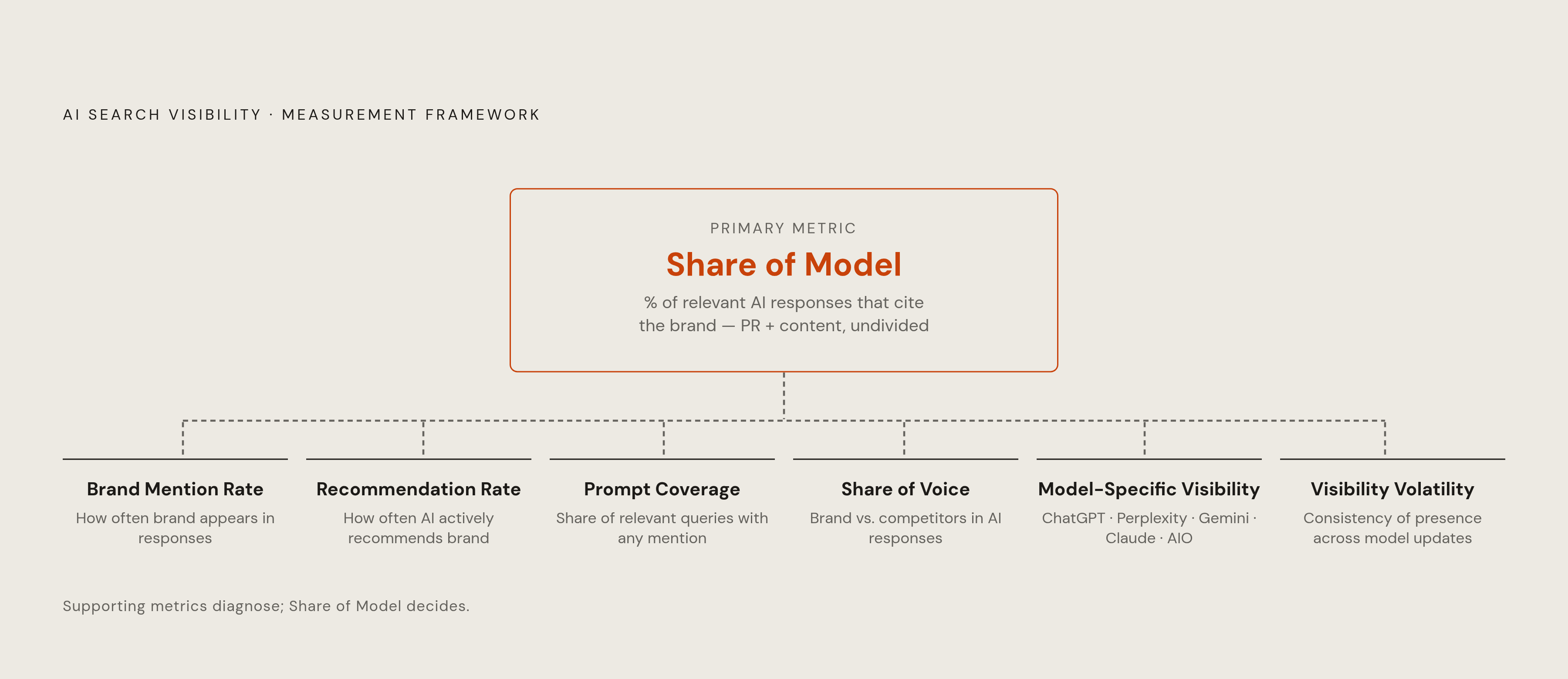
Shared work needs a shared scoreboard, and the standard taking shape for this is Share of Model, measured across multiple AI platforms at once, the only measurement built to capture what PR and content produce together rather than crediting either team in isolation. Share of Model, also called AI Share of Voice, measures the percentage of relevant AI-generated responses that include a brand as a source or a recommendation. It is the direct successor to traditional share of voice, with one key difference: where paid share of voice can be bought, Share of Model is entirely earned.
Six supporting metrics give that top-line number its context:
- Brand Mention Rate: how often the brand appears across AI responses to relevant queries.
- Recommendation Rate: how often the brand gets actively recommended rather than just mentioned in passing.
- Prompt Coverage: how wide a range of query types the brand appears across.
- Share of Voice: how the brand's presence compares against named competitors.
- Model-Specific Visibility: how performance shifts across individual platforms, including ChatGPT, Perplexity, Gemini, Claude, and AI Overviews.
- Visibility Volatility: how steady citation frequency stays over time, a signal of whether a brand's coverage is running on a sustained cadence or showing up only in episodic bursts.
Together, these six metrics turn Share of Model from a single headline number into an operating dashboard that can tell a marketing leader where the gap sits, whether it's PR's placements landing in the wrong outlets, content's pages failing to extract cleanly, or coverage so irregular that visibility keeps resetting to zero between campaigns. That diagnostic power is why shared measurement holds the rest of the model together: without it, PR and content each have a reason to claim credit when visibility rises and a reason to point elsewhere when it falls.