In-House AEO Team vs Agency Model for Mid-Market Brands
Mid-market brands can hybrid agency speed with internal control for sustainable AEO results.
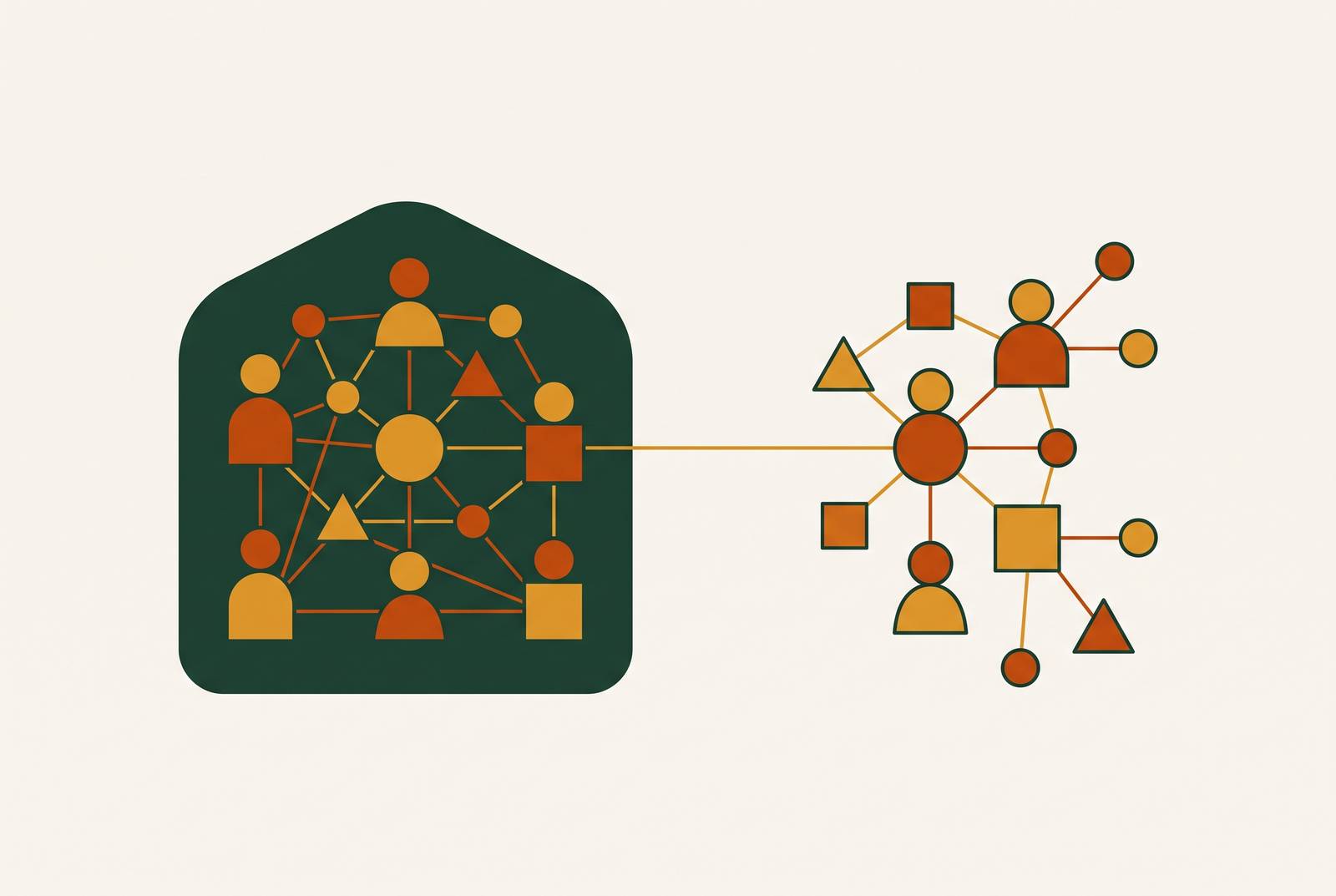
Mid-market brands face a decision that neither enterprise playbooks nor startup shortcuts actually solve: whether to build an answer-engine-optimization function in-house or hand it to an agency. The right choice depends on four variables specific to each brand's situation, not on a rule that applies across the board.
Why mid-market brands face a different AEO decision than enterprises or startups
Mid-market brands sit in the hardest spot in the whole AEO landscape. They're big enough that disappearing from AI-generated answers costs real revenue, but too lean to absorb the full cost of either model without running the numbers first. A useful way to define this category: aisearchrankings.com describes it as having content writers and basic SEO knowledge on staff, but lacking advanced technical expertise. That's a company with marketing muscle and no one who can rebuild a schema markup from scratch or run citation audits across multiple AI engines at once.
Enterprises can absorb a multi-year break-even on a full in-house build without blinking. The budget is there no matter how long payback takes. Startups can go all-in on a lean agency retainer, because they have nothing to protect yet and speed matters more than cost discipline. Mid-market brands have to satisfy both constraints at the same time: move fast enough to matter, and spend carefully enough to survive the ramp. The stakes aren't abstract. A McKinsey report cited by omnieclipse.ai projects that AI-driven answers will route hundreds of billions of dollars in US consumer revenue by 2028, and a brand invisible in that channel is losing the place where a growing share of purchase decisions will actually get made.
What the agency model delivers in the first year, and where it breaks down
For a brand that needs citations in AI answers within months, not years, an agency is the faster route to get there. aisearchrankings.com puts the speed differential in stark terms: agencies can land first citations in a fraction of the time it takes an in-house hire to even finish ramping up. Year 1 cost favors the agency too. According to aisearchrankings.com, Year 1 agency spend runs materially lower than Year 1 in-house spend once you count salary, tooling, and training for a new hire.
What makes the early months valuable is density of output, not just speed. A competent agency front-loads a full citation audit, benchmarks the brand against competitors across multiple AI answer engines, and fixes structured data problems, often inside the first sprint. That's work an internal hire starting from zero would take months to replicate, simply because the agency has already built the tooling and the pattern library from other client engagements.
The advantage concentrates early and fades if nobody inside the company is managing the relationship. Agencies juggling a roster of retainer clients can take a week to respond when an LLM surfaces a misattributed price or an outdated claim about the brand, and a week's lag matters a great deal in a regulated category like healthcare or finance. There's a deeper structural limit too: most of AEO is a third-party game. Most brand mentions inside AI-generated responses come from third-party pages, not from anything the brand owns, so an agency can shape the brief and pitch coverage, but it can't guarantee that outside editorial attention actually lands. And when the contract ends, the pattern recognition the agency built up over months of work usually leaves with it, because none of that knowledge transferred to anyone on staff. An agency makes the most sense for a brand that needs results within months and currently has no internal technical SEO expertise to lean on.
What the in-house model delivers over time, and what it costs to get there
In-house AEO capability becomes the cheaper, more defensible option once a brand clears the break-even point, but getting there costs real time and real money that need to be priced honestly before anyone commits. aisearchrankings.com puts that break-even at 24 to 36 months, assuming the team stays in place and performs well over that stretch.
The core advantage of an internal team is how fast the feedback loop runs. When an AI engine surfaces a hallucinated claim, a wrong price, or an outdated product detail, an internal team can escalate it and fix it the same day, a point confirmed by both influencers-time.com and aisearchrankings.com. An internal team also carries context that's hard to hand off to an outside shop: which product claims will actually hold up, which spokesperson quotes are cleared for use, which competitor comparisons legal won't sign off on. That kind of brand-specific judgment doesn't transfer into an agency brief quickly, no matter how good the brief is.
Price the costs that rarely appear in internal proposals before the project starts. It takes three to four months to recruit for a GEO or AEO specialist role, because the talent pool is still shallow. Software licenses for citation tracking and schema validation add to the Year 1 number on top of salary. And pulling an existing content strategist off current priorities to help close knowledge gaps during ramp carries its own opportunity cost, even if it never appears on an invoice. The practical signal that in-house is the right call: a seasoned content strategist who already understands AEO principles is already on staff, and the brand is prepared to fund tooling and measurement infrastructure for the long haul, a combination aisearchrankings.com points to directly. Skipping that signal risks the sunk cost of a partial build. Research cited in the source material shows that a large share of companies that tried to build AEO purely in-house ended up switching to an agency after months of slow progress, and that sunk cost is a real risk before committing to a solo build.
Why the hybrid model resolves most mid-market trade-offs
For most mid-market brands, pairing an agency sprint with an internal hire isn't a watered-down version of either path. A company needs this structure if it wants citations soon but doesn't want to stay dependent on an outside vendor forever. The outcome data backs this up directly: a large majority of companies that combined an agency sprint with in-house maintenance met all their AEO KPIs, compared to roughly half of the companies that tried to build in-house from a cold start.
In a well-run hybrid, month one belongs to the agency. The agency's job is to map the prompt space, the actual questions buyers type into AI models when they're deciding what to buy, benchmark the brand against its competitors, check how consistently the brand's entity is represented across engines, and lay out the gap between how AI currently describes the brand and how the brand wants to be described. That's dense, specialized work, and it's exactly where an outside team with existing tooling earns its retainer.
The internal hire's value compounds from there. Brought in alongside the agency rather than after it, the hire absorbs the playbook in real time, so that when the retainer narrows or ends, the institutional knowledge stays inside the company instead of leaving with the vendor. For brands in regulated categories like healthcare or finance, this structure resolves compliance lag directly: the internal hire owns hallucination monitoring and same-day escalation, while the agency owns the technical implementation, and neither function sits unattended. The stakes compound further once visibility has to span more than one platform. AI Overviews now account for most AI search sessions that end without a single click to any website, so staying visible means you have to track presence across several large language models at once, not just optimize for one. Tools built for this problem, such as AthenaHQ's AI search optimization platform, give mid-market brands a single place to track citations across eight or more major models simultaneously, which is the kind of infrastructure that makes the internal half of a hybrid arrangement actually workable.
The four variables that determine which model fits a specific mid-market brand
The in-house versus agency choice is the output of four variables, and where a brand sits on each one points toward a different answer.
Speed requirement comes first. If a brand needs AI citations within a matter of months, because competitors are already winning the recommendations or a product launch is bearing down, an agency is the only path built to deliver on that kind of timeline. If the horizon stretches out further, the in-house math starts to look different, and the urgency that favors an agency simply isn't present.
Cost trajectory and budget horizon come second. Year 1 agency cost runs materially lower than Year 1 in-house cost, and the two cost curves cross somewhere between 24 and 36 months. A brand that can't commit to a multi-year in-house investment shouldn't start one. The costliest outcome in this whole decision is building an internal team partway and then defunding it before the break-even point ever arrives.
Hallucination and brand-integrity risk come third. Brands in heavily regulated categories, healthcare, finance, anything carrying FTC disclosure exposure, face a different order of risk from AI misattribution than a brand selling, say, home goods. For those regulated brands, the same-day feedback loop of an internal monitor works as a risk-management asset. For lower-stakes categories, a week's agency lag is an inconvenience rather than a liability.
Cross-LLM sophistication required comes fourth. ChatGPT, Perplexity, Gemini, and Claude each cite sources through genuinely different architectures, and the gap between them is large: Perplexity averages roughly twice as many citations per response as ChatGPT, and only a small fraction of domains get cited by both platforms at the same time. If a brand competes across several LLMs at once, it needs a partner with multi-model monitoring infrastructure already built, because assembling that stack from scratch in-house costs significant time and tooling investment. A brand competing mainly on a single platform has more room to decide later. Where an agency's monitoring doesn't extend evenly across every model a brand competes on, that gap in coverage is exactly the kind of blind spot that lets a citation shift go unnoticed for weeks, which is the reason cross-LLM visibility tooling matters as much as the people running the strategy.
Evaluating an AEO agency for the mid-market hybrid model
Most agencies today claim some AEO capability, so if a mid-market brand wants the hybrid model, it needs a sharper filter than just hiring whoever answers the pitch fastest. The goal of a hybrid engagement is a partner that can hand off a working playbook to an internal hire, and that requires evaluating the agency differently than a brand just buying a result would.
The first filter is whether the agency treats AEO as a distinct practice with its own measurement infrastructure, or whether it's running an old SEO playbook with new labels stuck on top. The recent budget surge toward AI search has pulled in every SEO agency, growth consultancy, and solo freelancer looking to add "AEO" to a services page overnight. The real separator is whether a prospective partner can show published AEO-specific case studies with citation and revenue numbers attached.
Beyond that, the agency's monitoring capability matters directly, because the internal hire in a hybrid model depends on the agency's tooling during the handoff period. An agency that tracks citations across only one or two AI engines leaves the same blind spots described above, gaps that a brand competing across ChatGPT, Perplexity, Gemini, and Claude simultaneously can't afford. Platforms built specifically for cross-LLM visibility, AthenaHQ among them, give a hybrid team a shared source of truth to work from during the transition, rather than each side tracking a different, partial picture of where the brand actually stands. That shared visibility is what turns a sprint-then-handoff engagement into a lasting internal capability, instead of a report that goes stale the month the retainer ends.