Share of Voice Measurement in Generative AI Across Multiple LLMs
Brands must measure AI visibility across multiple engines, not just search rankings.
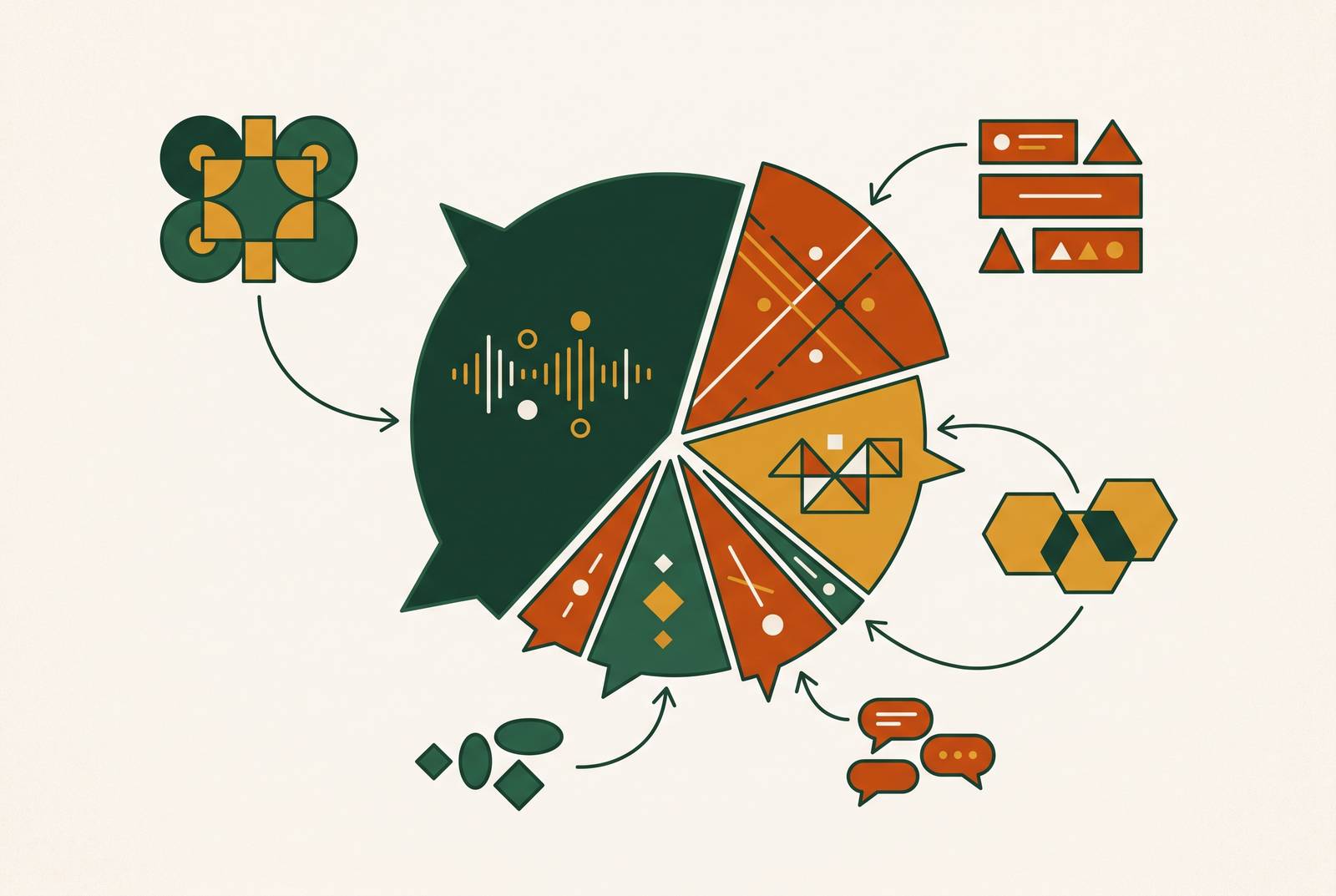
Share of voice in generative AI is a different measurement problem entirely, built around a buyer who now asks ChatGPT for the best tool, asks Gemini for a comparison, asks Perplexity for a shortlist, and sees an AI Overview, all before a single traditional search result ever loads.
AI share of voice measures something different from search rankings
For the question a brand asked about its digital presence was simple: are we ranking? That question assumed a stable, observable position on a page, something a tool could check once a day and report back as a number. The question has changed. What matters now is whether a brand gets mentioned, cited, and recommended at the moment an AI engine answers someone's question, and that is a fundamentally different signal that calls for fundamentally different instrumentation. A generative engine has no position #1 to hold. Large language models are non-deterministic: run the same prompt five times and you can get five different sets of brand mentions, so you have to measure visibility as a frequency rate across many prompts, not a fixed rank on a results page.
That shift breaks the tools built for the old question: rank trackers were built to watch a URL's position on a search results page, and they were never built to watch how a brand gets folded into a synthesized answer. The two are not measuring the same thing even when they look at the same brand and the same query. Classic rank tracking tells you where a URL sits on a SERP, but AI share of voice tells you how often a brand's name, recommendation, or citation turns up inside a generated narrative across a large set of relevant prompts. A brand can hold the top organic position on Google and still be completely absent from what ChatGPT, Perplexity, Gemini, or Claude tell a buyer asking the identical question, because the signals driving organic rank and the signals driving AI citation only partially overlap. That gap is the reason GEO, AEO, and LLMO exist as distinct disciplines, closely related and tactically overlapping, each aimed at getting a brand cited inside AI answers but each targeting a different surface or optimization layer, and each has needed its own measurement system built alongside it from scratch.
How each major LLM decides what to cite
Two mechanisms produce this divergence: because ChatGPT, Perplexity, Gemini, Claude, and Microsoft Copilot combine these mechanisms so differently, a brand's visibility on one platform tells you little about its visibility on the others. Retrieval-augmented generation, or RAG, fetches information from outside sources, databases, documents, the open web, at the moment someone asks a question, then builds a response from what it finds; training-data citation instead draws on knowledge the model absorbed during pre-training, long before the question was ever asked. Engines built around RAG, Perplexity and Google's AI Overviews among them, reward pages that answer the query directly and completely in their opening content, carry strong authority signals, and are easy to crawl. Engines leaning more on training data, Claude and, to a lesser degree, ChatGPT, instead favor brands with a broad and established presence across the web, original data that third parties have cited, and definitional content that was already recognized as authoritative well before the model's training cycle closed.
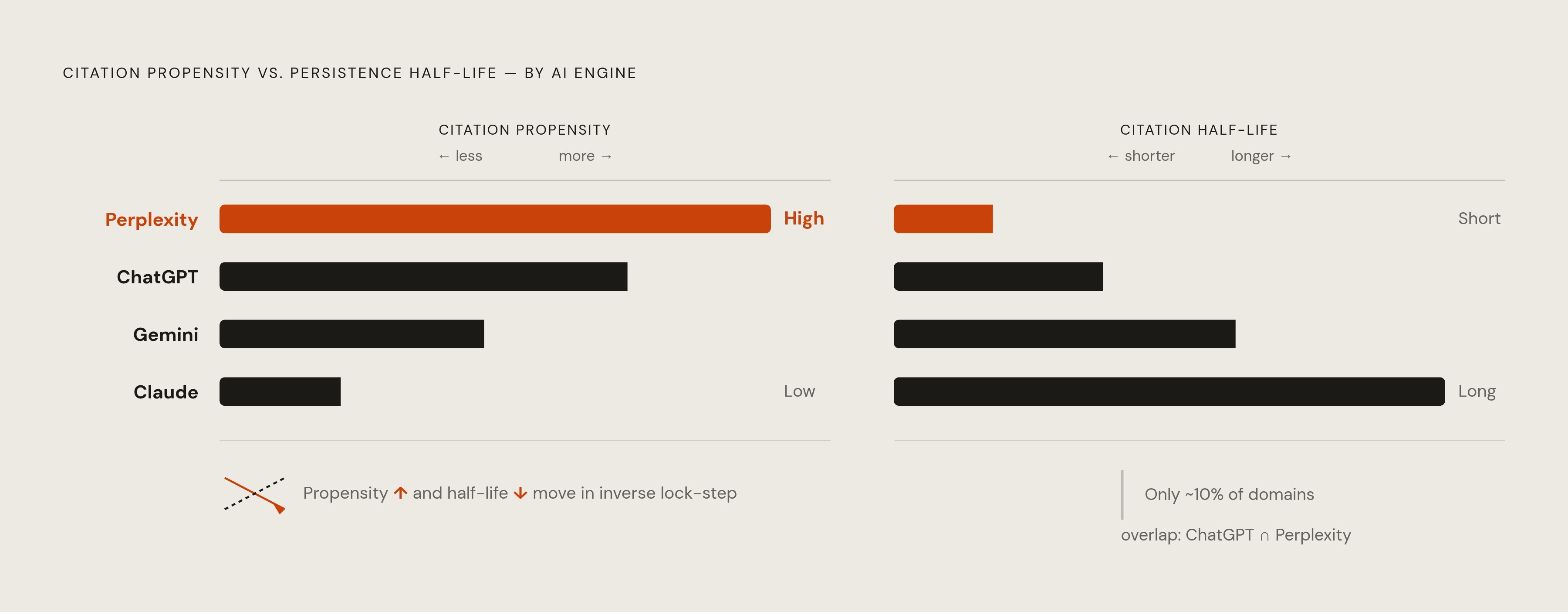
These mechanical differences are what give each of the five engines its own personality. Perplexity leans on live, search-backed results and cites them openly; ChatGPT blends training data with web browsing and tends to favor brands with wide, established presence; Gemini runs on Google's own ecosystem, so traditional search strength still carries real weight; Claude gravitates toward primary sources and careful technical framing, rewarding depth and precision over marketing language. These engines differ sharply in how often they cite anyone. The Visionary Marketing AI Search Visibility Tracker found that across a large set of commercial prompts, Perplexity cited at least one named brand more often than any other engine, followed by ChatGPT, then Gemini, then Claude, confirming that citation propensity varies substantially from platform to platform.
Winning a citation once does not mean keeping it. A citation on Perplexity can fade within a month, since its median half-life runs well short of Claude's, where a citation tends to hold up far longer. The engines are not even drawing from the same well. Overlap between the domains different engines cite can run strikingly thin, since in some cases only around a tenth of the domains ChatGPT cites also turn up in Perplexity's citations, so if you measure one engine and assume the other behaves the same way, you get a picture that is wrong. A brand strong on one platform can be functionally invisible on another, and that divergence is what makes measuring every major engine, rather than picking a favorite, the only approach that reflects reality.
What AI share of voice measures: the metrics architecture
Given that divergence, no single number can answer the question. AI share of voice works as a multi-signal architecture, one that captures how often a brand appears, how favorably, how deeply, and through what sources, across a defined set of prompts relevant to that brand's category. The foundation is mention rate, the share of prompts in a target query set where the brand appears in the engine's answer. From there, share of voice adds the competitive layer: of every brand mention across a prompt set, what portion belongs to this brand versus its named competitors, functioning the way traditional share of voice tracks relative position in paid or earned media.
A full measurement system goes further than those two figures. Source mix tracks which kinds of pages, brand-owned sites, Wikipedia, Reddit threads, review sites, comparison content, the engines are actually drawing from when they cite a brand, which tells a marketing team exactly where to put its content effort. Sentiment and framing tracks whether the AI's description of the brand is accurate, favorable, neutral, or subtly off the mark, because a mention that gets the product details wrong is not a win just for showing up. Multi-turn engagement depth tracks how substantively an AI assistant keeps engaging with a brand's claims as a conversation continues through follow-up questions, including how it handles the opening answer. Somantra's AEO Metrics Suite, which launched in September 2026, shows where enterprise-grade measurement is heading: it tracks brand mindshare score, brand consideration score, and brand engagement score, running a minimum of 15,000 simulated customer conversations per brand across ChatGPT, Google AI Overviews, Claude, and Perplexity.
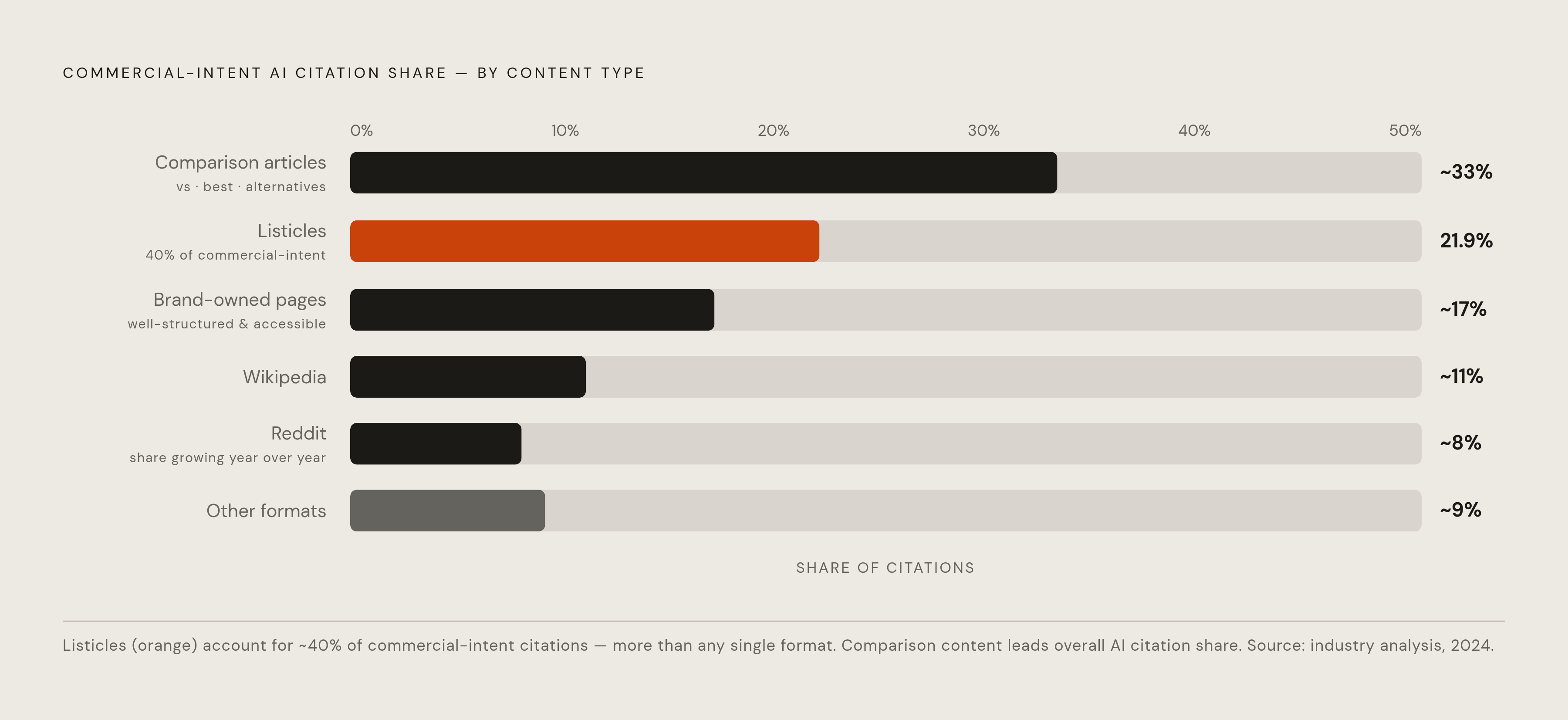
Source mix data holds one finding that should make you reorder a lot of content budgets. A majority of all AI citations point back to a brand's own pages when those pages are accessible and well structured, but Wikipedia and Reddit also account for substantial shares of citations, and Reddit's share has been growing year over year, so a brand cannot treat third-party presence as optional even when its owned content is strong.
Running a multi-LLM share of voice audit in practice
A real audit starts with the prompt set: you map the actual questions buyers ask at each stage of the purchase journey, since AI engines answer queries and visibility only exists in relation to a specific kind of question. That set should include category-level queries such as "best [category] for [use case]," comparison queries such as "X vs Y for [use case]," and problem-statement queries such as "how do I solve [problem]." Comparison content, listicles and head-to-head pages, draws the largest share of commercial-intent AI citations of any content type, with listicles alone capturing around 21.9% of all citations and roughly 40% of commercial-intent citations.
Once the prompt set exists, each engine needs to be queried on its own terms. ChatGPT, Perplexity, Gemini, Claude, and Copilot diverge substantially in what they surface, so querying them separately is not optional. Because none of these models behaves the same way twice, each prompt needs multiple runs per engine to produce a stable estimate rather than a single noisy data point; Somantra's suite, for example, runs a minimum of 15,000 simulated conversations per brand across ChatGPT, Google AI Overviews, Claude, and Perplexity to get there. What gets recorded matters as much as the running of the query itself: not just whether the brand appears, but where in the response, how it's described, which competitors sit alongside it, and which sources the engine leaned on.
From there, the audit turns to source mix, identifying which owned pages, third-party sites, Reddit threads, Wikipedia entries, and comparison pages the engines are actually pulling from, since that reveals both content gaps and the places where competitors are winning citations a brand is losing. Sentiment and accuracy scoring comes next, flagging any response in which the brand appears with wrong product details, outdated pricing, an incorrect leadership name, or a missing capability. These hallucination risks demand active correction as a priority item on the content to-do list. Finally, the audit needs to run on a schedule rather than as a one-off. Citation persistence data shows that visibility drifts, sometimes fast on engines like Perplexity, so a single audit only gives you a snapshot, not an ongoing measurement program.
Why brands go invisible across AI engines, and the content signals that fix it
Most brands that disappear from AI answers have not been excluded by the engines. Their content simply is not built in a way retrieval systems can extract and trust, which is a structural problem rather than a popularity one, and it is fixable through deliberate content architecture. The scale of it is larger than most marketing teams assume: half of audited brands turned up invisible across all four major AI platforms, ChatGPT, Perplexity, Claude, and Gemini, for their own buyers' questions, because their content cannot be retrieved and synthesized effectively, not because nobody has heard of them.
The Princeton GEO research, published on arXiv and accepted at KDD in 2024, along with the field research that followed it, points to three content pillars that have the strongest evidence behind them. Factual densification, adding citations, statistics, and verifiable sources into content, carries the most weight: the three most effective techniques identified in the Princeton study all involve this approach, and each delivered a meaningful lift in visibility. AI models favor content with specific, citable data over vague claims. A precise finding gets picked up far more readily than a general statement about improvement. Structural extractability matters just as much: clear heading hierarchy, question-based headings, bullet points, comparison tables, and a direct answer to the primary query placed in the opening content.
Comparison and "best of" content carries outsized weight in this system. Comparison articles make up roughly a third of all AI citations, because generative engines lean on "X vs Y," "best X for Y," and "alternatives to X" formats to match how people actually phrase questions to an AI assistant. Format preferences also shift by engine: Microsoft Copilot favors structured data and lists, Claude favors depth and primary-source citations, Perplexity favors live, recency-forward content that answers the query immediately, and Gemini benefits from alignment with Google's traditional authority signals. None of this replaces the SEO fundamentals you already have in place. RAG-forward engines still crawl the live web, so the organic authority a site has built over years continues to feed its visibility in AI answers. GEO builds on top of a solid SEO foundation, and it does not ask a brand to start over.
The hallucination risk hiding inside low AI share of voice
A brand that is not actively shaping its AI presence does not just fade into the background. It risks active misrepresentation, since AI engines will synthesize whatever they can find and fill the remaining gaps with outdated or fabricated detail, and a 2026 survey found that 35% of brands report inaccurate AI responses have already damaged their reputation. The mechanism runs on two layers. The parametric training layer holds static knowledge baked into the model's weights, and that knowledge decays over time: a certification a company earned after the model's training cutoff simply does not exist as far as the model is concerned. The live web retrieval layer is where a brand's content architecture has its most immediate protective effect, because what the model retrieves at query time can correct what its training data got wrong or missed entirely.
The exposure is not evenly distributed. Healthcare and financial services face amplified stakes, since a hallucination in either field can carry consequences well beyond a lost sale, reaching into regulatory and liability territory, and these are among the industries that have lagged furthest behind in publishing the kind of AI-citable, well-structured content that would prevent it. Remediation is not mysterious or especially expensive. Publishing a verified "Brand Facts" page, putting in place rigorous schema markup for Organization, Person, and Product entities, and keeping entity data consistent across the web all give AI engines verified material to draw from instead of guesswork. Field research in the GEO discipline has already pointed to meaningful gains in model accuracy once that kind of structured knowledge is in place. If you measure a brand's AI share of voice properly and track it across every engine that matters, it tells you whether buyers are hearing the truth about the business or something the model filled in on its own.