How AI Assistants Describe Category Leaders vs Challengers in SaaS
AI systems are narrowing vendor shortlists before sales conversations even start.

AI assistants are now the primary entry point for B2B vendor research, and they compress the field before any sales conversation begins. By the time a human reaches out to a vendor, an AI has already decided who belongs in the conversation and who doesn't.
B2B SaaS shortlist compression by AI assistants
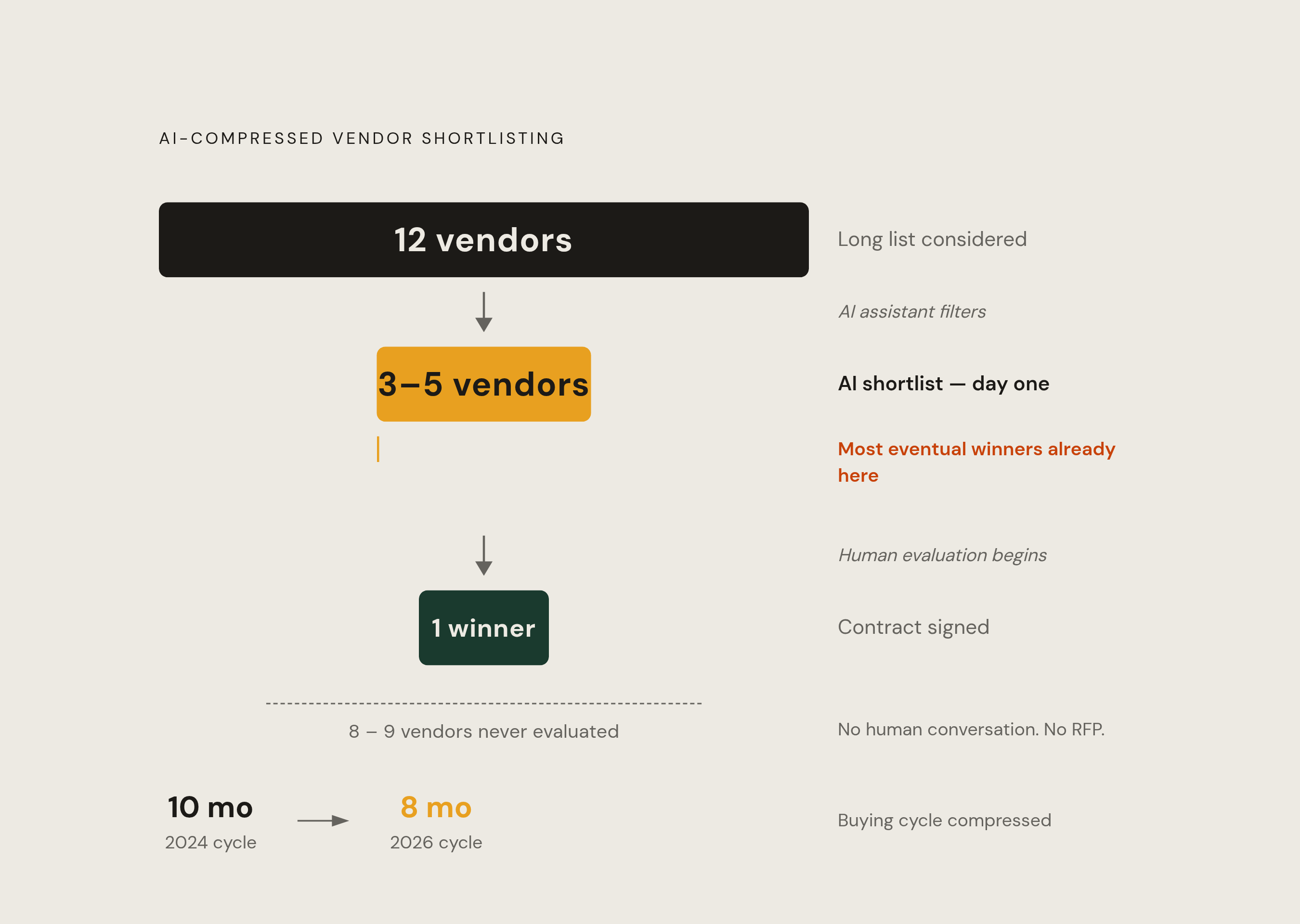
CompetLab's 2026 AI visibility guide documents the mechanics of this compression: buyers who once weighed roughly 12 vendors now arrive at a shortlist of 3 to 5, and the vast majority of eventual winners were already on that list on day one. Whitehat's 2026 UK B2B research puts a sharper point on the shift. AI chatbots have become the number-one influence on vendor shortlists, surpassing both review sites and vendor websites, and buying cycles themselves compressed from roughly 10 months to 8 months between 2024 and 2026. That compression changes what a sales pipeline actually consists of: a vendor left out of an AI assistant's answer does not just face a tougher pitch, a slower close, or a skeptical buyer. It's facing no evaluation at all, regardless of how strong the underlying product is. Marketing teams accustomed to measuring visibility through search rankings or paid acquisition are now contending with a filter that operates upstream of all of it, deciding the field before any traditional funnel metric has a chance to register.
The gap between leaders and challengers in the scored data
The scale of that filtering is already measurable, and it is not a modest spread between first and second place. Across a representative benchmark of SaaS companies and buyer-intent prompts, the gap between category leaders and challengers is categorical rather than marginal. DerivateX's 2026 B2B SaaS benchmark scored a large sample of buyer-intent prompts across ChatGPT, Perplexity, Claude, and Gemini and found an average score of 56.9, with 44% of the field scoring below 50, a threshold the study treats as functionally invisible. Category-level spreads show the same shape at smaller scale: leaders in a given SaaS category post AI mention frequencies that outpace challengers by margins rarely seen in traditional marketing channels, and that gap widens over time because AI systems tend to reinforce citations they've already made. None of this means the challengers in question are weak products. Attio, Folk, Linear, and n8n are established names in their categories, known to buyers and to the market broadly, yet that market recognition does not automatically carry over into how AI systems describe or recommend them. The benchmark data should be read as a picture of structure rather than a ranked leaderboard. It shows how wide the gap between visible and invisible brands can get, not which specific company deserves the top spot. Seeing that structure at all requires scoring brand presence across multiple models at once, which is the kind of systematic benchmarking that platforms including Athenahq are built to run, tracking citation patterns across ChatGPT, Perplexity, Claude, and Gemini simultaneously so a marketing team can see exactly where its brand goes dark and why.
How embedded AI agents raise the cost of invisibility
The gap documented in that benchmark data is getting more expensive to sit on the wrong side of, because AI agents are moving deeper into the software that enterprise buyers actually use, and discovery itself is migrating away from search engines and review sites toward AI surfaces. Klarna offers a documented illustration of what that migration looks like from the buyer's side. Exporis's SaaS analysis found that by 2025, Klarna's AI assistant was handling 80% of the company's customer-service chats, and in the wake of that shift Klarna reduced or cancelled contracts with a large number of suppliers, moved away from Salesforce as its CRM while continuing to run a mix of internal technology and external CRM products, and cut spending with external marketing suppliers. Those decisions were driven partly by AI-assisted evaluation of vendor value rather than product reviews alone, and the source frames this as a nuanced account of vendor consolidation rather than a simple story of AI replacing SaaS wholesale. The same Exporis analysis cites OMR Reviews traffic data showing a related but distinct pattern: categories where AI has absorbed interface tasks directly, such as AI image generation and AI text generation, saw steep drops in traffic, while categories built around AI agents and AI sales assistants gained ground. Vendors whose core category is being absorbed into a general-purpose model face a visibility problem that looks different from simple underperformance in AI answers, but the underlying risk is related: the category itself is shrinking as a distinct destination. The pace of new entry compounds the pressure. Companies like Sierra, Harvey, and Legora have moved fast to become cited answers within their verticals, so you can see how quickly the competition for AI citations is intensifying even in categories that weren't AI-native a few years ago. If a brand treats AI visibility as a dedicated optimization channel, separate from traditional search strategy and tracked with its own ROI measurement and content architecture, it can protect its position against the very systems now screening its buyer pool.
Why AI platforms describe brands differently
The size of the gap between leaders and challengers is only half the picture. The gap doesn't show up the same way on every platform: the five major AI surfaces are not interchangeable in how they surface and describe SaaS brands. Each rewards a different set of content signals, and a challenger that optimizes for one surface while ignoring the others remains partially invisible no matter how well the first effort worked.
CompetLab's guide draws the foundational distinction between training-time visibility and retrieval-time visibility. Training-time visibility means a brand appears in an AI's answer because it was present in the model's pretraining corpus, and that kind of visibility only updates when a new training run happens, a cycle measured in quarters or years. Retrieval-time visibility means the model searches at the moment of the query and surfaces a brand because its content is retrievable and relevant at that moment, and this is the lever a marketing team can actually pull, with changes capable of showing up within days or weeks. For a brand starting from low or zero AI visibility, retrieval-time visibility is the practical place to begin.
Behavior differs substantially once you move platform to platform. ChatGPT has the largest B2B audience of the major assistants, it answers about half its prompts from training memory alone, and it rewards content that reads with authority and clarity. Its True Audience share fell below 50% for the first time in March 2026 as competitors gained ground. Claude was the fastest-growing of the major platforms in 2026, with True Audience up substantially year over year and rising share in the US. It over-indexes for developer and coding-tool audiences, rewards long-form structured expertise, and fires web search conditionally when a query is time-sensitive. Perplexity is fully retrieval-grounded and has the strongest recency bias of the group, so it rewards source-backed data and performs with particular precision when buyers are sophisticated and categories are reference-heavy. Content past a certain age enters a decay window for fast-moving queries on that platform. ChatGPT reaches the largest B2B audience by a significant margin.
A brand that wins on ChatGPT's authority signals may still read as thin on Perplexity's recency-weighted retrieval, or absent from Gemini's schema-driven results. Cross-platform visibility is the only measure that captures the real size of the gap, since each platform surfaces a different slice of it. Because training-time memory, retrieval-time search, schema depth, and authority signals each pull in a different direction, a brand tuned for a single surface tends to stay partially invisible everywhere else, and Athenahq's cross-platform command center is built around that problem, showing which retrieval and content signals move the needle on each individual model.
The content and technical signals that determine whether an AI describes a brand with authority or not at all
What separates a category leader described with specificity from a challenger described vaguely, or not described at all, comes down to a narrow set of content and technical signals that AI systems weight heavily when they decide what to cite.
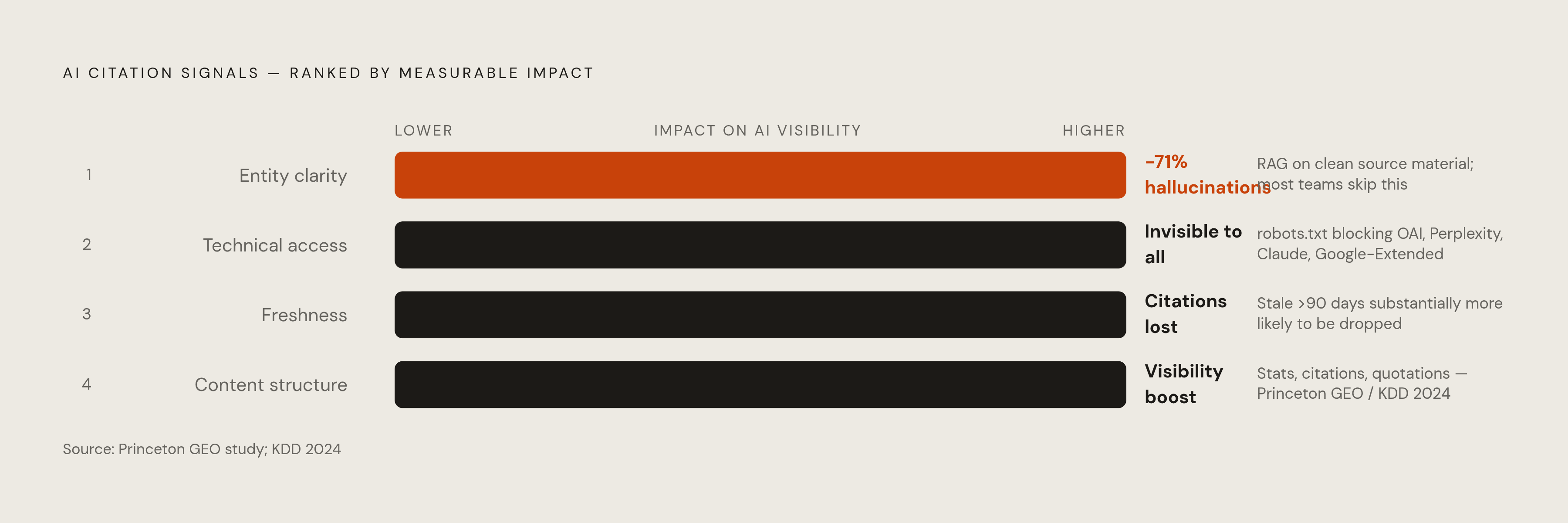
Content structure is the first of these. The Princeton GEO study, Aggarwal et al., published at KDD 2024, found that adding statistics to a page meaningfully boosts AI visibility, and that adding citations and quotations boosts it by a comparable margin. MaxAEO's study of cited passages found that statistic lines, definition sentences, and table rows get pulled by AI systems at far higher rates than plain narrative prose. Answer Engine Optimization formats, meaning concise direct answers, question-based headings, and FAQ schema, make a page extractable in the first place, and GEO techniques add entity clarity, citation signals, and source credibility on top of that extractable base.
Freshness functions as an operating requirement rather than a nice-to-have. If a page goes unupdated for a full quarter, it is substantially more likely to lose its AI citations entirely, and content updated recently earns meaningfully more citations than older content on the same topic. Perplexity's recency bias is the strongest among the major platforms, so for fast-moving query categories, aging content enters a decay window and starts dropping out of answers. For challengers especially, stale content is a main reason an AI description comes out vague or missing, even when the product itself is strong.
Technical access is the failure point most often overlooked. The fastest GEO win available to any team is checking that AI crawlers aren't blocked in robots.txt, explicitly allowing OAI-SearchBot, PerplexityBot, ClaudeBot, and Google-Extended. A brand whose crawler access is blocked stays invisible to every retrieval-time system regardless of how good its content is.
Entity clarity works as a defense against hallucination. When a website's structure is confusing, an AI model fills the resulting gaps with invented information, and publishing a verified Brand Facts page, implementing Organization, Person, and Product schema, and keeping entity data consistent across the web directly reduces that risk. Retrieval-augmented generation can cut hallucination rates by up to 71% when the model has clean, authoritative source material to draw from, which is the structural argument for giving AI systems clear facts in the first place. AI models have attributed false policies to real companies, as in the Air Canada chatbot incident, and for a SaaS challenger a hallucinated product description can actively damage consideration rather than merely failing to help it.
None of this replaces traditional SEO. Most Google AI Overview citations come from pages that already rank in the top 10 organic results, so strong traditional SEO feeds AI citation probability directly, and brands pursuing GEO are not abandoning SEO so much as building on top of it.
What challengers who closed the gap did
The gap between leaders and challengers is not fixed in place. When brands applied deliberate AEO and GEO strategy, they moved from near-invisible to cited, and in some documented cases this took only weeks.
Ramp, in financial automation, started out with low AI search visibility in the accounts-payable category. Ramp built buyer-intent-matched comparison content and automation-focused resources, and after that its visibility rose substantially: it moved from 19th to 8th most visible brand among fintech brands in that category, and two targeted pages generated over 300 citations within a single month. Ramp's case mirrors the SaaS challenger scenario most directly: a specific category, a low starting position, and a fast, measurable gain.
Hone, an employee development SaaS platform, published a case study reporting a dramatic rise in visibility for a key growth category, with citation share climbing from near zero to become the top cited source for relevant prompts. Mentimeter, the SaaS presentation tool, worked with Siege Media and saw 555 keywords appear in AI Overviews, along with 124,000-plus ChatGPT sessions generated over six months and 3,400 conversions in a single month. Rough Country, an automotive e-commerce business working with Tinuiti, achieved AI visibility well above its nearest competitor across high-intent prompts and multiple AI models, and it saw a substantial increase in AI referral traffic and directly attributed AI revenue. Chemours, an industrial chemicals company in a B2B context, reached high AI citation rates across its target query set, and its program generated substantial pipeline that it directly attributed to AI-assisted discovery. The Chemours pipeline numbers anchor the broader ROI argument: AI visibility work produces outcomes that can be traced back to specific pipeline, not just impressions.
What connects these cases is the kind of work behind them. None involved a months-long brand campaign. Each involved targeted technical interventions, restructuring specific content for AI extraction and matching it to the queries buyers actually use, and each produced a measurable gain in citations as a result.
How to measure AI share of voice across platforms
Closing a gap like this requires measurement most SaaS marketing teams don't yet have in place, and that absence of measurement is itself part of why so many challengers stay invisible. A team that cannot see where it's cited, on which platform, for which query, has no way to know whether a content change made any difference.
AI Share of Voice has become the primary KPI for this era of marketing, and it measures something more specific than a ranking position. It captures whether AI models trust a brand enough to recommend it as the actual answer to a buyer's problem, rather than simply mentioning it in passing. That distinction matters because a brand can appear in an AI's training data without ever being the one the model reaches for when a user asks a direct question, and the gap between appearing and being recommended is what the benchmark data earlier in this piece describes at scale. Building that kind of measurement means tracking citation frequency, sentiment, and positioning across ChatGPT, Perplexity, Claude, and Gemini at once, since a single-platform view, as the earlier section on platform mechanics shows, will always undercount the real gap. Most SaaS marketing teams have the tooling to measure search rankings and paid performance in detail, but few have built the equivalent discipline for AI citations, and that infrastructure gap is the next frontier for any team serious about competing in the shortlist an AI assistant builds before a human ever gets involved.