AI Search Investment Sizing for Mid-Market Brands
Brands need a separate AI search budget based on visibility audits, not leftover SEO spend.

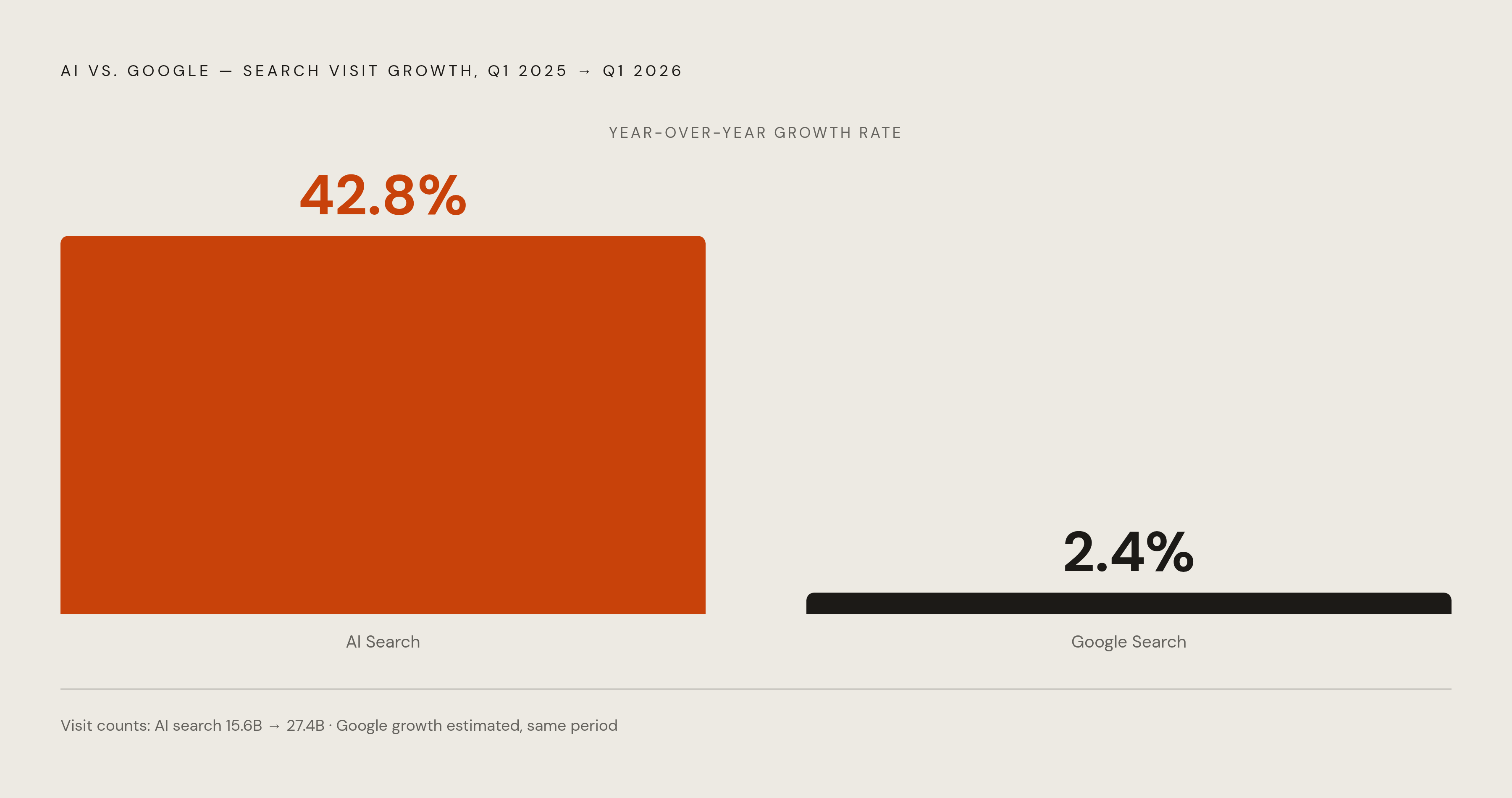
AI search is a revenue channel now, and mid-market brands need a real budget line for it, separate from whatever is left over in the SEO retainer. AI search visits hit 27.4 billion in Q1 2026, up 42.8% from 15.6 billion a year earlier; Google search visits grew just 2.4% over the same stretch. Enterprise marketing teams already run generative engine optimization (GEO) programs. Mid-market teams mostly have not started, and the guidance available to them mostly misses the point: enterprise frameworks built for eight-figure budgets, or SMB advice that amounts to "add a schema tag and write one blog post." Neither fits a company doing $10 million to $200 million in revenue, and the frameworks below start from that scale, not scaled down from somewhere else. Here is the part vendors won't say out loud: the technical fixes they sell first are the smallest part of the job.
For a company doing $10 million to $200 million in revenue, the AI search budget should be sized as a percentage of the revenue currently influenced by organic search, then adjusted upward based on how fast the channel mix is already shifting in the brand's own analytics. Four spend categories cover the work: monitoring and measurement, content architecture, ecosystem presence, and brand integrity and hallucination defense. Year one leans heavy on content architecture and ecosystem seeding, with monitoring treated as a recurring line item that never gets cut to zero; by year two the mix shifts toward iteration and defending the citations already earned. Separate one-time setup costs from ongoing operating costs when pitching this internally, because finance treats recurring line items very differently from project spend, and conflating the two is how a budget gets cut in year two.
How large the AI search opportunity actually is at mid-market revenue scale
The scale of revenue shifting through AI-powered search is significant, and finance teams are starting to notice: Adobe Analytics reported AI search referral traffic to U.S. retail sites up 4,700% year over year in 2025, a source that barely showed up on a traffic dashboard two years ago.
Here is the fact that should reframe the budget conversation: 93% of AI search sessions end without a click. The brand named inside the answer captures the value. The brand left out isn't part of the conversation at all. Research into AI search queries has found most e-commerce brands invisible across ChatGPT, Perplexity, Claude, and Google AI Overviews, and it isn't because those brands perform badly. It comes down to how the training data and retrieval systems get built, and which sources they lean on. In considered-purchase categories, B2B software, healthcare services, financial products, specialty retail, AI-influenced pipeline is already happening whether or not anyone at the company is measuring it.
Stop asking whether the company can afford AI search. Ask what invisibility is already costing, every quarter it goes unmeasured.
What mid-market brands are actually buying when they invest in AI search
GEO and answer engine optimization (AEO) run roughly mostly strategic and a smaller part technical, and that ratio should decide where the money goes, not the other way around. Four spend categories cover the work, and treating them as interchangeable is the fastest way to waste a budget.
Monitoring and measurement means tracking brand mention rate, citation rate, and AI share of voice across multiple large language models on an ongoing basis, not as a one-time report. Content architecture means rebuilding what already exists and writing new material AI systems can actually parse and cite: question-based headers, clear sourcing, schema markup, the signals behind what Google calls E-E-A-T. Ecosystem presence means earning mentions in the third-party sources these systems pull from, trade publications, review sites, forums, comparison pages, instead of assuming owned content alone gets cited. Brand integrity and hallucination defense means checking that what AI systems say about the company is accurate and current, so that when the brand does get cited, the citation is right.
Monitoring is the category most mid-market teams skip, and skipping it is the single biggest mistake on this list. Without it there is no feedback loop, no way to tell whether the content spend is doing anything at all. The category most teams overweight, on the other hand, is the one-time technical fix: a schema update here, an llms.txt file there. Google's own guidance has flagged that these get more attention than they deserve relative to sustained authority-building. Separate one-time setup costs from ongoing operating costs when pitching this internally. Finance treats recurring line items very differently from project spend, and conflating the two is how a budget gets cut in year two.
The baseline visibility audit: what to measure before setting a budget
No budget number means anything without a baseline. A brand sitting at zero AI citations needs a different plan than one already at a 15% mention rate with accuracy problems in what gets said about it. Treating those two situations the same is where most first-year budgets go wrong.
Three metrics anchor the audit. Mention rate is the share of category-relevant AI responses that name the brand at all; one published example put this at 38 mentions across 250 responses, a 15.2% mention rate. Citation rate is the share of responses that actually link to or attribute a brand-owned domain, and it can diverge sharply from mention rate, since a model can name a brand without ever pointing to its site. AI share of voice is brand citations divided by total category citations, times 100, measured across the platforms where the brand's buyers actually spend time.
Which platforms matter changes fast. As of early 2025, ChatGPT accounted for 87.4% of all AI referral traffic, and that share has fallen since as Gemini and Claude scale up their own user bases. An audit that checks only ChatGPT is already out of date the day it runs. The query set matters as much as the platform list: queries should map to real buyer decision stages, not just the brand's own name. Run a hallucination check alongside it, what each model currently says about pricing, leadership, and product positioning, and how much of it is wrong, then map competitors across the same query set. That gap, not some abstract notion of full visibility, is what the investment needs to close.
The output should fit on one page: current AI share of voice by platform, an accuracy score, and the competitive gap. That page is the actual budget conversation. Everything after it is negotiation over how fast to close the gap.
How should a $10M–$200M revenue company size a dedicated AI search budget?
Four variables set the size of the number. Current visibility gap comes first: a brand starting near zero citations needs heavier upfront spend on content and ecosystem work, while one with moderate visibility already can put more of the budget into monitoring and iteration. Categories where two or three players already dominate AI citations demand more aggressive ecosystem investment than categories where the models still give generic, uncommitted answers.
Revenue at stake is the third variable, and it cuts differently by business model. A B2B brand with a long sales cycle and a high average deal size can justify more spend per AI-cited impression than a high-volume, low-margin retailer chasing the same visibility. Internal capacity is the fourth: a team already producing strong long-form content needs less incremental content budget than one starting from an empty editorial calendar.
Spend allocation across the four categories follows a rough pattern, and getting the pattern wrong is more common than getting the total wrong. Monitoring is a recurring cost, not a project; it should never get cut to zero, regardless of overall budget size, whether the team is using a feature bundled into existing marketing software or a dedicated AI visibility tool running into the hundreds of dollars a month. Content architecture is usually the biggest line item in year one, covering both the rework of existing pages and net-new content aimed at high-value query clusters. Ecosystem presence has the longest lead time of any category, since earned placement in third-party sources often needs PR, partnership, or analyst relations work behind it. Brand integrity and hallucination remediation cost less on an ongoing basis but need periodic structured review, since model training cycles update and can reintroduce old errors.
Research out of Princeton has documented GEO techniques that lift AI visibility by up to 40%. The open question at mid-market budget levels is sequencing, not whether the spend works. A workable rule of thumb: size the AI search budget as a percentage of the revenue currently influenced by organic search, then adjust upward based on how fast the channel mix is already shifting in the brand's own analytics. Year one leans heavy on content architecture and ecosystem seeding. By year two, the mix shifts toward monitoring, iteration, and defending the citations already earned.
Connecting AI search spend to pipeline metrics the CFO will recognize
AI search shapes pipeline before it ever shows up in last-click attribution, and that is the hard part of measuring it. A session that starts in ChatGPT or Perplexity often ends in a separate browser session, with no UTM parameter tying the two together. Here is the actual failure mode: a buyer researches a vendor shortlist inside ChatGPT, closes the tab, opens a new one, and types the winning brand's name straight into Google. Every dashboard downstream credits that conversion to branded search. None of it credits the AI session that built the shortlist in the first place.
Rising AI share of voice alone is a directional signal, useful but not proof of anything by itself. Real evidence comes from triangulating three things at once: AI share of voice trends, AI-sourced traffic showing up in web analytics, and conversion data from the CRM. When all three move together, that is a clean signal the investment is working. In the meantime, three proxy metrics carry the load: AI-referred sessions identifiable from known AI referrer domains, branded search lift that follows increases in AI share of voice, and assisted conversion rates from AI-sourced sessions compared to other organic traffic.
A sustainable cadence for a mid-market team looks like daily automated scans on the highest-priority category queries, a weekly review of brand-level share of voice, and a monthly pass at competitive positioning. Present all of it to the board as a leading indicator, alongside pipeline metrics, not as a defense of a cost center. Roughly one in ten U.S. internet users now goes to generative AI first when searching online, and buyers check an average of 2.4 platforms during a purchase decision, so a metric built around a single LLM understates the brand's actual reach. The case for finance comes down to a simple comparison: the estimated pipeline influence times the current AI share of voice gap, set against the projected cost of closing that gap over the next twelve months.
Tooling choices at mid-market budget levels
The tooling market is splitting into tiers fast, and matching the tool to actual measurement maturity matters more than picking the platform with the longest feature list. Do not buy the command-center tier before the team can even read a mention-rate report; that is the single most common way mid-market budgets get wasted on tooling, which is the gap platforms like AthenaHQ, an AEO and GEO tracking platform for enterprise brands, are designed to bridge once a team has baseline habits in place.
HubSpot rolled out AEO tracking in 2025, with a full release in spring 2026. It tracks brand visibility scores, share of voice, and citations across ChatGPT, Gemini, and Perplexity, bundled with Marketing Hub Pro and Enterprise or standalone for around $50 a month. For a team already running on HubSpot, that is the lowest-friction entry point available, and most mid-market teams should start there, not with a specialized platform they do not yet know how to use.
Further up the market sit platforms built specifically for AI visibility: unified monitoring across eight or more LLMs at once, content gap analysis, brand integrity tracking, deployment tools for AI-optimized content. That tier suits brands that need something closer to a command center than a single dashboard metric, once the baseline habits are already in place. Buying it earlier just means paying for coverage nobody on the team knows how to act on yet.
Four questions should decide the purchase, regardless of vendor. How many engines does the tool track, and do they include the platforms where actual buyers research? Can the query set be customized to match real buyer journeys instead of generic category terms? Does it show competitor AI share of voice next to the brand's own numbers? Can the reports go straight to a CFO or a board member without someone rebuilding them in a spreadsheet first? There is a second-order payoff to picking a tool early, too: teams that start instrumenting AI visibility now build a baseline history that becomes a competitive asset in its own right, one a late-starting competitor cannot just buy back.
Phasing the investment so mid-market teams can start this quarter
The first-mover advantage here is real, and it has a shelf life. AI search held roughly 5 to 6% global market share at the start of 2025 and climbed to 12 to 15% by mid-2026, according to Indexly AI. The window to build citation authority before category positions harden is open now, but it is closing, and waiting another budget cycle is the most expensive option on the table.
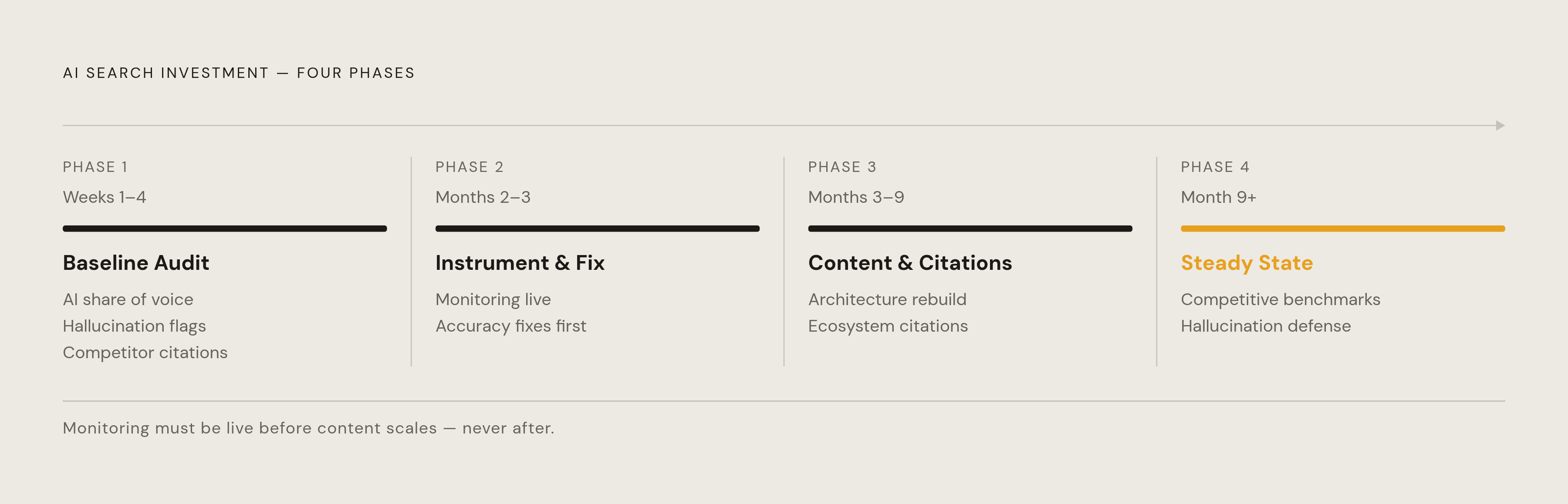
Phase one, weeks one through four, costs time more than money: run the baseline audit, establish current AI share of voice across the target platforms, flag hallucinations, and map where competitors get cited and the brand does not. This produces the data that makes every later decision defensible. Phase two, months two and three, gets monitoring instrumented and fixes the most damaging accuracy problems first, so the feedback loop runs before content production scales up. Phase three, months three through nine, is where content architecture and ecosystem investment happen: rebuilding the highest-value existing content, writing new material against priority query clusters, and starting the slower work of earning citations in third-party sources. Phase four, month nine onward, shifts into steady-state operations: ongoing monitoring, competitive benchmarking, defending citations already earned, and periodic audits as the underlying models retrain.
There is no slow adoption curve worth waiting out here. Every planning cycle a mid-market brand spends without an AI search program is a cycle where competitors bank citations that get harder to dislodge later. The brands that dominate AI-cited recommendations in 2027 are being built now, in 2025 and 2026. Getting the sizing right matters, but starting matters more, and starting late costs more than starting small.