GEO Platforms With Cross-LLM Competitive Benchmarking Capabilities
Each AI engine cites different sources, requiring separate benchmarking strategies to compete.
A brand's position on Google's first page has stopped predicting whether a recommendation from ChatGPT, Gemini, or Perplexity names it. Generative Engine Optimization, or GEO, is the discipline built around that split: it optimizes a brand's presence inside AI-generated answers, a different target than the page-ranking systems SEO was built to climb. The overlap between page-one Google results and what ChatGPT actually cites is small enough to call negligible: only around one in fifty organic URLs make the jump into a ChatGPT answer. A rank-tracking report that only watches Google traffic is telling a marketing team almost nothing about how the brand performs in the channel that increasingly decides what gets recommended.
That channel is no longer a rounding error. AI search visits grew substantially year over year between the first quarter of 2025 and the first quarter of 2026, and AI platforms now intercept a meaningful share of Google searches before a user ever reaches an organic result. The practical consequence: a brand can hold top organic rankings and still be invisible to the buyer who skips the search results page entirely and asks an AI assistant to just tell them who to call. It is a separate competitive arena with its own rules, its own winners, and its own blind spots, and it requires its own measurement discipline rather than a repurposed SEO dashboard, not a marginal gap in coverage.
How each major LLM decides which brands to surface, and why the decisions differ
The five major AI platforms do not share a single sourcing philosophy. Each one makes its own decision about when to cite a source, how many sources to cite, and which brands earn a mention, and those decisions are different enough that a brand tuned for one engine's habits can be ignored by another's. CiteMetrix's State of AI Search 2026 maps out how distinct those habits are.
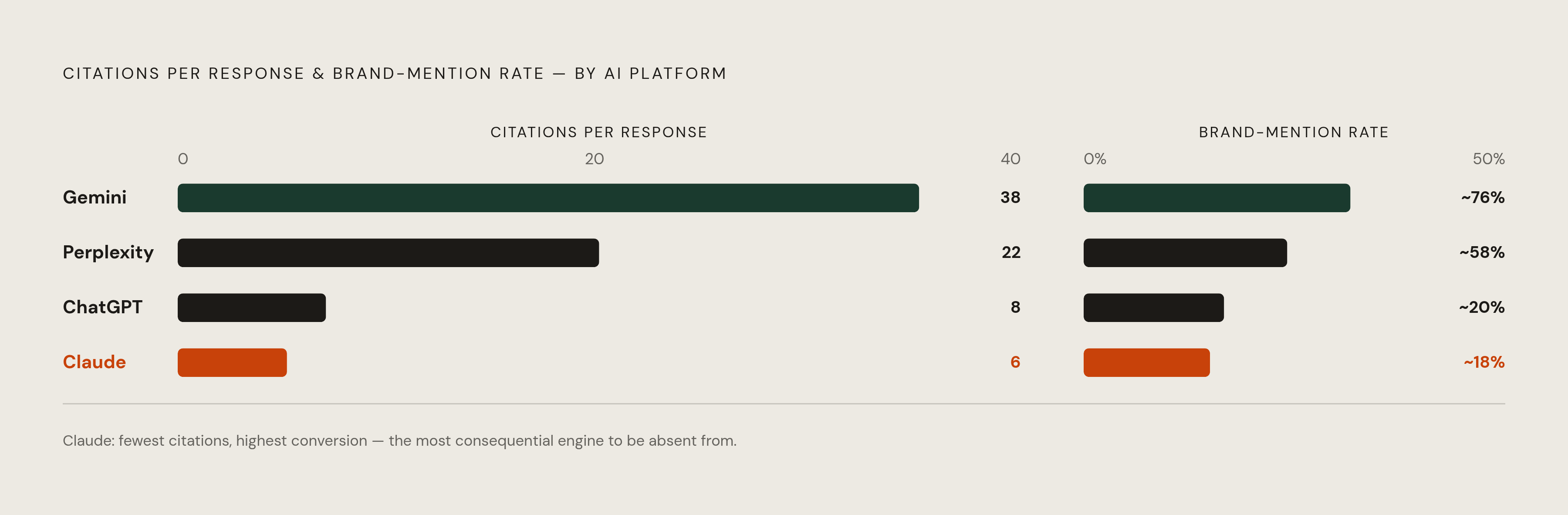
ChatGPT cites sources the majority of the time its search function is active, but it mentions brand names in only around one in five answers, among the lowest brand-mention rates of any platform measured, and it averages roughly 7 to 8 citations per response, favoring a narrow set of sources it treats as authoritative. Perplexity runs the opposite playbook: it averages roughly 21 to 22 citations per response, by far the highest volume of any engine, attaching sources inline to nearly every individual claim, and it recommends brands in category searches at a higher rate than ChatGPT does. Gemini mentions brands in the large majority of its responses, the highest rate of any engine tested, yet it generates an actual citation link in only about one in five responses, the lowest linking rate of the group, leaning instead on first-party content and Google's own Knowledge Graph; Yext's analysis puts its average citation count at 36 to 40 per response. Claude is at the opposite end of the volume spectrum, averaging around 5 to 6 citations per response, with a strong preference for edited, editorial-grade sources, while citing user-generated content at a notably higher rate than its competitors. Copilot and Grok hold smaller shares of the overall market, but their citation behavior is not proportionally smaller: Superlines tracked a single brand across identical queries and found a citation-volume gap between Grok and Claude large enough to call it a different category of behavior entirely.
The gap widens further once the query itself changes. A study tracking startups across thousands of queries found that when buyers searched by category or by problem rather than by brand name, recommendation rates fell by roughly thirty to one, and the size of that drop varied by engine. A brand's name recognition does very little for it if the buyer never typed the name in the first place, and the engines differ in how harshly they punish that absence.
The cross-platform overlap problem
These differences in citation philosophy produce a measurable, structural risk: engines barely agree with each other about which sources deserve a citation. Across hundreds of millions of tracked AI citations, only around one domain in nine was cited by both ChatGPT and Perplexity, and even within Google's own product line, AI Overviews and AI Mode share only a small fraction of their cited URLs with each other. Two products built by the same company, trained on overlapping data, still diverge sharply in who they choose to cite.
A second force compounds the problem. LLMs tend to prefer sources that are already heavily cited elsewhere, a pattern that rewards brands with the strongest existing web presence and lets them accumulate citations across every engine at once, while a smaller or newer brand may build visibility on a single engine and remain invisible everywhere else. That asymmetry becomes a revenue question once conversion rates enter the picture: Claude users convert at the highest rate among AI platforms, followed by ChatGPT, then Perplexity, all substantially outperforming Google organic traffic. It is absent from the single highest-converting channel in the set, which turns a visibility gap into a direct loss of pipeline.
The instinct to simplify the problem by picking one engine to watch and calling it representative does not survive contact with how fast this market moves. Claude's market share grew roughly tenfold year over year, and a brand's own category may turn out to be disproportionately discoverable on a secondary engine even when that engine holds a smaller overall share of the market. Superlines's citation-volume comparison between Grok and Claude for a single tracked brand is the clearest illustration available of what single-engine monitoring misses: a brand can look strong on one platform's dashboard and be functionally absent from a competitor's, and nothing about the first reading would have warned anyone of the second.
What cross-LLM competitive benchmarking measures
Genuine competitive benchmarking in GEO runs five distinct measurement layers at once, across every major engine simultaneously, rather than counting citations on whichever single platform happens to be easiest to track. A tool that reports a citation count from one engine is answering a much smaller question than a marketing team needs answered.
Raw citation share only means something once it is compared against a baseline for the category. Yext's analysis of millions of AI citations puts a competitive citation share for B2B brands, combined across major platforms, somewhere between roughly 5% and 15%, with anything above roughly 20% marking real category leadership, and the exact range shifts depending on the vertical: fintech, developer tools, B2B SaaS, and healthcare each carry their own distinct bands. A share-of-voice number without that vertical context tells a marketing leader almost nothing about whether 12% is a strong result or a weak one, given that marketing technology brands typically lead at just 6–12%.
Academic research backs up the case for cross-engine measurement as the only valid baseline. The E-GEO dataset ran 13,747 product queries across five generative engines and found that strategies that improve visibility on one engine do not reliably carry over to another. That finding is the empirical argument against treating any single engine's results as a stand-in for the whole picture: a win on one platform says nothing certain about performance on the next.
The platforms that currently offer cross-LLM competitive benchmarking
A small number of platforms have built cross-engine coverage, and they differ from each other in which engines they track, how deep their competitive data runs, and whether they're built for a self-service team or a larger enterprise program.
LLM Pulse tracks five models by default, ChatGPT, Perplexity, Gemini, Google AI Mode, and Google AI Overviews, running each prompt across all five at once. It reports share of voice through a Top 4-plus-Others competitor view, a position-weighted visibility score that counts a first-place citation as 100% and a second-place citation as 50%, full URL-level citation attribution, sentiment analysis, and historical trend data, with agency white-label available and pricing starting at €49 a month.
AthenaHQ is built specifically for enterprise AI visibility work, monitoring brand citations and competitive share of voice across eight or more major LLMs, including ChatGPT, Perplexity, Gemini, Claude, Copilot, and Grok. It provides cross-model competitive benchmarking, enterprise-grade visibility dashboards, market-level exposure analytics, content gap identification, and forecasting and trend modeling, and its reporting is built for board-level presentation and pipeline attribution, which makes it a fit for marketing leaders who need to tie AI visibility directly to revenue outcomes.
GEO Metrics monitors nine LLMs: ChatGPT, Gemini, Claude, Perplexity, Copilot, DeepSeek, AI Mode, AI Overviews, and Grok, measuring share of voice across the broadest confirmed engine set of any platform covered here, with the goal of improving how AI systems recommend the brand being tracked.
Geostar takes a hybrid approach: it pairs a self-service platform that surfaces granular AI citation and crawler interaction data with a managed-services layer that builds custom playbooks, runs citation outreach, and executes ongoing campaigns.
Each of these platforms answers the five-layer measurement from a different angle, whether that's engine breadth, pricing accessibility, or the depth of enterprise reporting, and the right fit depends on what a given marketing team needs to act on first.
How citation behavior varies by industry vertical
A cross-LLM share-of-voice number only becomes a useful decision input once it's read against the benchmark for its own vertical, because what counts as a strong share in one category would be a weak one in another. Combined across all five major platforms, a competitive B2B share runs roughly 5% to 15%, with category leadership starting above roughly 20%. Within fintech and financial services, a typical leading citation share runs 15–25%. Within B2B SaaS, a typical leading citation share runs 10–18%.
These ranges are not just descriptive. GEO-Bench research out of USC and Arizona State finds that adversarial content strategies trade effectiveness against stealth, and that black-box content rewriting can match or even exceed gradient-based methods at promoting rank, so a brand leading its category on one engine may be running on a structurally different content and citation profile than the one driving its leadership on another engine. Benchmarking has to stay engine-specific because the mechanics behind a win on one platform don't necessarily explain a win on the next. The E-GEO study separately found a stable, domain-agnostic optimization pattern that held across five generative engines, but researchers could only find that pattern when they compared engines directly against each other, not by testing any one of them in isolation.
The practical stakes of this come into focus with a concrete case: a fintech brand showing 18% citation share on Perplexity but only 6% on Claude is not performing well overall. It underperforms badly on the one engine whose users convert at the highest rate of any AI platform measured, a misalignment between where visibility sits and where revenue actually comes from that single-engine reporting has no way to surface.
What content and citation architecture moves cross-LLM visibility scores
Benchmarking data only pays off once a team can act on it, and the signals that move AI citation rates are measurably different from the ones SEO practitioners have optimized for over the past two decades. Some of the highest-leverage moves live off the page entirely, in territory most brands have never treated as part of their optimization work.
The Princeton and Georgia Tech GEO study tested nine distinct optimization strategies across thousands of queries and found three that produced a statistically significant lift in citations: adding statistics to the content, citing sources directly within the content, and integrating expert quotes with full attribution of a named individual, their title, and their organization. Quotes with only partial attribution produced a far smaller lift than quotes that carried the full set of credentials. Timeliness matters on a short clock: pages updated within the last 30 days draw substantially more AI citations than older content, and pages left untouched for a full quarter are far more likely to lose citations they had already earned. Authorship carries a similar weight. Content with a named author, a stated title, and a linked bio earns substantially more AI citations than equivalent anonymous content, and Onely's large-scale cross-platform study found that the large majority of content cited by AI systems carries an attributed author.
Not every tactic that worked for search rankings transfers over. Keyword stuffing produced measurable performance degradation in the Princeton study.
Sources
- GEO-Bench: Benchmarking Ranking Manipulation in Generative Engine Optimization
- Best GEO Tools in 2026: 11 Generative Engine Optimization Platforms - LLM Pulse
- E-GEO: A Testbed for Generative Engine Optimization in E-Commerce
- Generative Engine Optimization at Scale: Measuring Brand Visibility Across AI Search Engines