AEO Skill Gaps in Marketing Teams and How to Close Them
AI is rewriting how buyers discover brands before they ever visit your website.

Somewhere between a buyer's question and a brand's website, a model now sits and answers for them. It names a short list of competitors, decides which brand belongs on that list, and the buyer never has to click through to find out more. This is the "silent shortlist," a term used by Writer to describe the preferences buyers form inside an AI conversation before they ever land on a company's site. Most marketing teams are losing ground in this new environment because answer engine optimization asks for a different set of skills than the ones search engine optimization spent two decades building.
Why marketing teams are losing ground in AI search despite working harder
The behavior driving this shift is straightforward: AI tools now answer buyer questions directly, pulling together a short list of trusted brands before a prospect ever opens a browser tab. By the time someone does visit a website, a model may have already decided, on the buyer's behalf, whether that company belongs on the shortlist or has been quietly left off it. Answer engine optimization and generative engine optimization grew up to get a brand named inside the answer itself.
None of this points to a lack of effort. Marketing teams are still publishing content, running SEO programs, and keeping up a steady presence on social platforms. The trouble is that all of that work was built to satisfy a ranking algorithm, tuned to put a page higher on a results list. A ranking algorithm and a large language model deciding what to cite are not reading a page the same way, and effort spent pleasing one does not automatically transfer to the other. A team can work harder than ever on the old playbook and still lose ground, simply because the playbook was written for a different game.
How SEO skills and AEO skills diverge
SEO skill does not carry over to AEO work by default, because the two disciplines are built to satisfy different systems, reading different signals, trusting different sources, and judging success by different measures. SEO was built around backlinks, domain authority, keyword relevance, anchor text, and page speed, a set of signals that predicts a page's position in a list of results. AEO runs on a different input: semantic relevance, factual density, source diversity, and how consistently a brand gets mentioned across the wider web, a set of signals that predicts whether a model cites a brand inside a synthesized answer.
Those two outcomes, ranking and getting cited, have split apart, and they split apart quickly. Sloane Staffing puts a number on the disconnect: a team measured purely on position is optimizing for a signal that predicts citation less than half the time. That is not a rounding error. It means a team can hit every ranking target on its dashboard and still have no idea whether a model is naming the brand when a buyer asks for a recommendation.
The surfaces each discipline works on are different too. SEO was largely a first-party exercise, built around tuning a company's own website. GEO runs mostly on third-party ground: the answer a model gives gets pieced together from industry publications, analyst reports, consumer reviews, trade press, and earned media, not from a homepage. A team can polish its own site for years and still go unmentioned, because the model is reading everything written about the brand elsewhere, not just what the brand says about itself.
The 80/20 split: why AEO is mostly a strategic problem, not a technical one
Most teams that start working on AEO reach first for the technical minority of the work, things like schema markup, heading structure, and FAQ sections, and skip the strategic majority that actually decides whether any of that technical polish ever reaches an AI-generated answer. GEO breaks down roughly 80% strategic and only a small remainder technical. The strategic share, positioning, presence across the wider industry ecosystem, and alignment with how a category gets defined, is what decides whether a brand gets treated as authoritative by an AI system.
That strategic work sits mostly in a CMO's span of control, touching brand, content, PR, analyst relations, and editorial all at the same time. AI visibility cannot sit with the SEO team alone, because the signals a model draws on live across all of those functions at once. When a buyer asks a tool like ChatGPT which brand to trust in a given category, the answer gets built from industry publications, analyst reports, consumer reviews, trade press, and earned media, not from a homepage. That is the strategic reality most teams still miss when they start their AEO work with a technical checklist.
A new metric gives that strategic goal a name marketers already understand instinctively. "Share of model" (SoM), a term coined by Jack Smyth and Tom Roach, measures how often a brand shows up in AI-generated answers compared with its competitors, playing the same role share of voice played in the paid media era. Share of model is earned through reputation and substance.
Some teams assume that because the systems producing these answers are technically sophisticated, winning at AEO must be mostly an engineering or SEO-technical problem to solve. Large language models synthesize reputation, not page structure, so strategic brand authority work carries more weight, pound for pound, than any markup a developer can add to a page.
A four-skill framework for diagnosing which AEO capabilities a team has
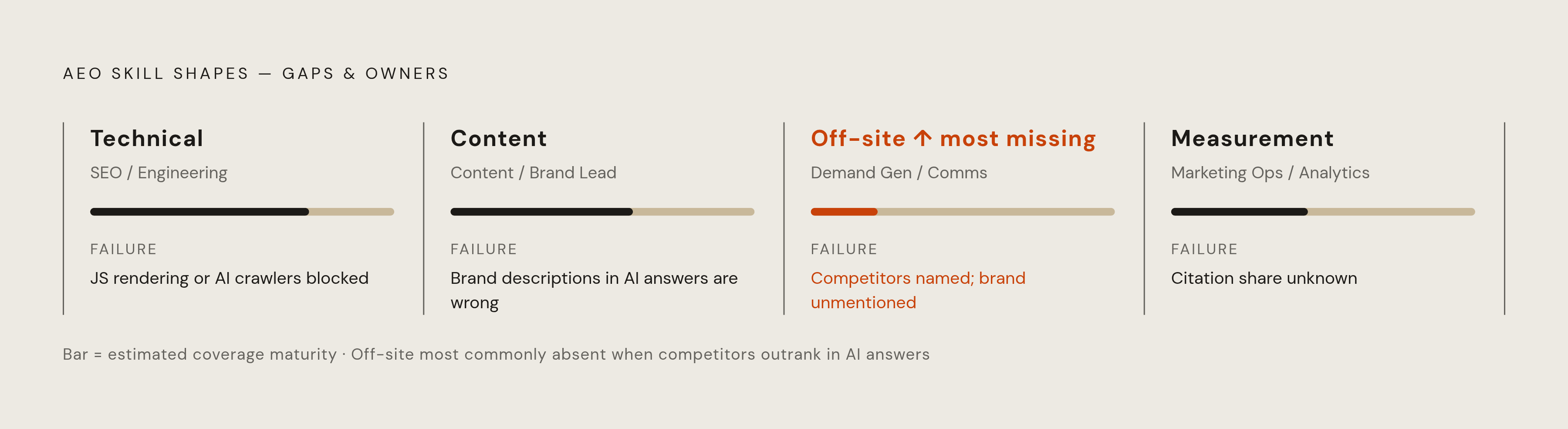
AEO work splits into four distinct skill shapes, and most teams are missing at least two of them without realizing it, which makes diagnosis the necessary first step before any remedy gets chosen. The first shape is technical: structured data, crawlability for AI agents, site architecture, and content feeds, work that usually reports up through a head of SEO or an engineering team. The second is content: writing shaped to be lifted directly into an answer, full entity coverage, and editorial standards, which typically sits with a content or brand lead. The third is off-site: review sites, comparison pages, forums, and PR, the sources models actually pull from when they cite a brand, usually owned by demand generation or communications. The fourth is measurement: running test prompts, tracking citations, tying them back to pipeline, and reporting on all of it, a job that tends to live in marketing operations or analytics.
Each shape carries its own failure mode, and each failure mode points back to a specific fix. If competitors keep getting named in AI answers while a brand goes unmentioned, the gap usually occurs in the off-site shape: models simply are not finding enough independent, third-party corroboration of that brand's claims. If the content itself is genuinely strong but models still cannot parse or extract it, that points to a technical gap, something like JavaScript rendering issues, a robots.txt file blocking AI crawlers such as GPTBot, ClaudeBot, or PerplexityBot, or content that was never structured for easy extraction. If nobody on the team can say what the brand's citation share even is, the measurement shape is missing. If the brand descriptions that do show up in AI answers are inconsistent or just wrong, that points to underdeveloped content and entity work.
Inside the content shape, the clearest tactical shift underway is extraction-first writing: standalone claims a model can lift cleanly without surrounding context, headers phrased as questions, direct answers placed in the first sentence, and lists and tables used as the primary format for an answer. Inside the off-site shape, the gap tends to be an attention problem. Reddit, LinkedIn, and YouTube ranked among the most-referenced domains by major large language models in October 2025, and community forums and social discussion platforms appear in a growing share of AI answers, even as many enterprise marketing teams continue to underinvest in them.
AEO is fundamentally a consensus problem. AI models learn what counts as authoritative by watching where content gets referenced consistently across many independent, high-quality sources, not by crawling one company's site more thoroughly. A brand that has polished its own website to a shine but has no third-party corroboration anywhere else will stay invisible to these systems no matter how clean its code is. Very few people are strong across all four shapes at once, and that scarcity is why most AEO or GEO hiring searches fail on vague scope. Deciding which shape to hire for first is the single highest-leverage decision most teams skip before they even open a job req.
Why tracking visibility on a single AI engine produces a dangerously incomplete picture
A brand that shows up consistently in one AI engine's answers can be nearly invisible in another. A team tracking only one engine is making strategy and budget decisions off a fraction of the real picture. Each major engine rewards different signals and draws from different kinds of sources. ChatGPT rewards broad, long-standing presence across the web, giving it the widest recall but not necessarily the deepest citation of any one brand's own content. Perplexity cites brand-owned sources at a much higher rate than other engines do. Clean, linkable, factual pages earn direct citations there more readily. Claude tends to favor structured data and clearly organized comparison content.
The same brand can come across as strongly positive on one engine and get described with caveats or qualifications on another, because sentiment is not consistent from platform to platform the way it might be across two search engines running similar algorithms. Traffic referral share today still leans toward ChatGPT, but the challengers are closing ground faster: Gemini and Claude have both posted very fast year-over-year growth, and for enterprise use specifically, Claude and OpenAI run close to each other for enterprise large language model market share.
The gap this creates in practice is substantial. A single brand tracked across major chatbots in March 2026 showed a 615 times citation-volume gap between Grok and Claude on the same set of brand-related queries. Single-chatbot tracking does not just miss part of the picture, it actively points strategy and budget allocation in the wrong direction, because a team optimizing for the one engine it happens to be watching can be entirely blind to how five other engines are describing the same brand.
The hallucination and brand-drift problem teams discover when they start measuring
Once a team actually starts auditing its AI search presence, the most common discovery is that AI platforms are describing the brand inaccurately, and fixing that calls for a set of skills most teams have not yet built. The underlying risk has a name: "LLM perception drift." As models get updated and fine-tuned, take in new training data, or run into shifting retrieval sources and fresh competitor content, their understanding of a brand can shift even when the brand itself has changed nothing. What was an accurate description last quarter can be wrong today, with no error on the brand's part.
Fixing drift happens at the source level, not by pleading with the model directly. Schema, third-party listings, corrective content, and digital PR are the actual levers available, and each one lands in a different shape from the four-skill framework: schema is technical, corrective content sits with the content team, and digital PR and third-party listings fall under off-site work. All four shapes need to be functioning at once. A gap in any one of them leaves a hole a model can fall into when it forms its impression of a brand.
This is not a cosmetic problem. A brand misrepresented in an AI-generated answer loses consideration from buyers who never think to ask a follow-up question and never visit the site to check the facts for themselves. The silent shortlist works in both directions: it can leave a brand off entirely, or it can place a brand on the list attached to the wrong description, and a buyer acting on that description never finds out it was wrong before making a decision.
What the four shapes cost to fill
The AEO hiring market right now is defined by three things: scattered job titles, a thin supply of people who can do the work, and a scoping mistake that sinks most searches before they get anywhere close to an offer. Sloane Staffing has observed the same underlying role posted under titles including "AI Search Lead," "GEO Manager," "Content Strategist, AI Visibility," and "SEO Manager (AEO)," a spread that makes it hard for candidates to find the right opening and just as hard for hiring teams to benchmark pay or scope against anything comparable.
Scattered titles compound a deeper issue: a req written for "an AEO person" without specifying which of the four shapes, technical, content, off-site, or measurement, that person needs to own is a req asking one hire to be strong in four different disciplines that rarely live in the same background. That is why, as the earlier framework section laid out, so many of these searches stall on vague scope. A team that names the shape it is missing first, and hires against that specific gap, gives itself a real chance at a strong match. A team that posts a generic "AEO specialist" role and waits for someone who covers all four shapes at once is likely to wait considerably longer, and to end up disappointed with whoever eventually takes the job.