Agentic Marketing Tools and Their Role in AI Search Optimization Workflows
AI now decides what brands get mentioned before buyers even visit your site.
Marketing teams have spent two decades asking whether they rank. The question now is whether an AI engine cites them when a buyer asks for an answer, and that single change in what gets measured rewrites every workflow built to chase the old metric.
Buyers have started building what one enterprise guide on AI visibility calls "silent shortlists": preferences formed entirely inside a conversation with ChatGPT, Perplexity, or Google AI Mode, before the buyer ever opens a browser tab to a company's site. A brand can be cut from consideration in that conversation, and nothing on the brand's own website will show a trace of the loss. Three separate disciplines now sit where one used to: SEO still governs traditional results pages, answer engine optimization governs the direct extractions that engines pull for quick answers, and generative engine optimization governs whether a brand gets named inside an AI-generated response. A team that only works SEO is tuned to one surface while two others move without it.
The metric that matters for that third surface is share of model, a term attributed to Jack Smyth and Tom Roach and described as the natural successor to share of voice: how often a brand shows up in AI-generated answers, measured against competitors, independent of where a page lands on a results list. Share of model cannot be checked the way a keyword ranking can. Research aggregators tracking citation behavior have found that a large share of the sources cited by Google AI Mode and ChatGPT turn over from one month to the next, a rate of change that outpaces any content audit run on a quarterly calendar. A quarterly review runs too slowly to catch this: the citation landscape underneath it has likely already moved again by the time the review happens. Citation sources turn over faster than any quarterly or manual tracking effort can follow, which is the scale challenge the rest of this piece addresses.
Why AI citation optimization resists manual management
SEO always let a brand control a meaningful share of its own outcome: fix the page, win the position. GEO does not work that way, because the engines doing the citing are reading a brand's reputation across the entire web, not the brand's own homepage. The optimization surface is distributed across review sites, community threads, partner pages, and competitor content the brand does not own and cannot edit directly, and that surface shifts constantly and in ways no single team can watch by hand.
Every major engine compounds this by behaving differently from the others. Each one weighs freshness differently, prefers different content formats, and draws from a different mix of sources, so a page built to get cited on one engine may never get cited on another. Nate Elliott, principal analyst at EMARKETER, said: "Almost every GEO response is different from every other GEO response. A spot-check, the kind of manual review where someone runs a few test prompts and calls it a monitoring process, is close to meaningless as a method, because you need a far larger sample size than any person can run by hand on a recurring basis to say anything reliable about citation behavior.
Freshness is no longer a courtesy update. If content sits untouched, it risks dropping out of citation sets entirely, so you end up maintaining a brand's content library all the time, not on a schedule anyone sets in advance. Layered on top of that is the requirement for a "proof ecosystem": mentions across review platforms, community discussions, partner sites, podcasts, and comparison articles the brand doesn't control. That second surface sits entirely outside owned channels, and it has to be tracked alongside the first. The instability inside owned content and the sprawl outside it together mean the workflow needed to manage both is not optional to automate. It has to run continuously, across platforms the brand doesn't control, at a pace no human team can sustain by hand. What a marketing team still has to decide is whether it has built, or bought, the tooling to run that workflow.
What agentic marketing tools do inside an AEO/GEO workflow
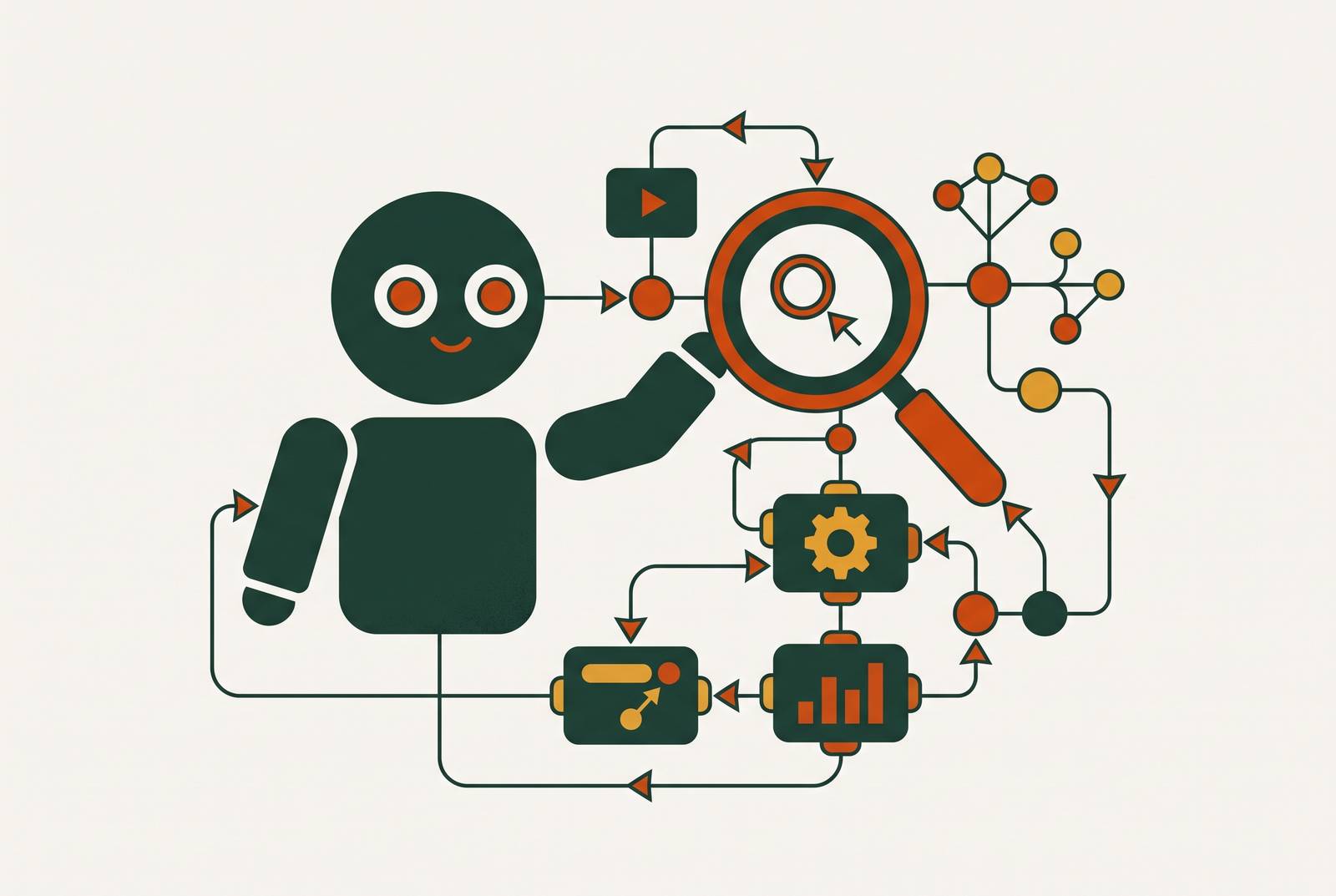
The word "agentic" earns its place here because these tools run a chain of steps on their own, continuously, across many platforms at once, rather than speeding up one step a person still has to start by hand. That distinction separates them clearly from content assistants. A writing tool just helps you get one piece of content out faster. An agentic AEO/GEO tool watches citation signals across multiple engines, flags where a brand is missing, triggers the content work needed to close that gap, and tracks share of model over time, and it does all of that without a person opening the tool each morning to kick off the next step.
The workflow these tools support breaks into four layers. The first is brand citation monitoring: tracking whether and how a brand gets mentioned across ChatGPT, Perplexity, Gemini, Claude, Copilot, Grok, and the other engines buyers actually use, in response to the kinds of questions those buyers actually ask. The second is competitive tracking, where you measure how often a brand gets cited against named competitors, and you break that down by engine and by topic. The third is gap identification: finding the questions where the brand never appears and identifying which sources the engines cite in its place. The fourth closes the loop, connecting a found gap to a content fix and getting that fix into production and distribution, rather than stopping at a report that names the problem and leaves someone to solve it manually.
That fourth layer turns a monitoring tool into an operating system for the whole discipline, because it closes the loop from found gap to produced, distributed content. EMARKETER has found that Reddit, LinkedIn, and YouTube ranked among the most-referenced domains by major LLMs in October 2025, a mix that tells a brand where to build a presence beyond its own site. Tracking that platform mix by hand, across engines that update their preferences on their own timelines, is not a job suited to a person checking a spreadsheet once a week. Running all four layers at once, across every major engine, is what a unified command center is for: it replaces the team of analysts that would otherwise need to run these checks manually, engine by engine, question by question.
Citation monitoring across multiple LLMs
You can run the same brand through every major engine at once, and the picture rarely looks the same twice. A brand might carry strong share of model on one engine and barely register on another, because the divergence in how engines select and weigh sources runs deep enough that performance on one tells very little about performance on the rest. That fragmentation is itself the useful finding: it shows, platform by platform, exactly where a brand's visibility work is paying off and where it is invisible, instead of averaging performance into one misleading number.
Query phrasing changes the answer too. A prompt asking an engine to name the "best" option in a category pulls a different set of citations than one asking it to "compare" two named products, which pulls a different set again from one asking it to simply "explain" a concept. An agentic tool has to run a wide battery of these phrasings rather than a single test query, because any one phrasing only shows a sliver of how a brand actually performs across the range of ways buyers ask.
Because the sources engines cite keep rotating from month to month, the tracking cadence has to match that pace. If you want to catch change before it builds up, you need to monitor weekly across a large enough set of prompts. The monitoring itself identifies which sources filled that space when a brand doesn't appear, whether a competitor's case study, an analyst report, or a thread on a community forum, and that is as important as the brand mentions themselves. Those missing-brand results are the next targets for content work and outreach, and continuous monitoring across every engine at once is the only way you find them, not a single audit run once a quarter.
Closing content gaps with agentic tools, from prompt mapping to AI-optimized content
A citation report that only says where a brand is missing doesn't do much on its own. The output that actually moves a content plan forward is a prioritized map of buyer questions where the brand is absent and a named competitor or third-party source is filling that space instead. To build that map, you run the buyer questions that matter most through every major engine, track which brands show up and which sources get cited, and mark the spots where the brand should appear and doesn't. In this discipline, that prompt-mapped gap analysis is now where content planning starts, not keyword gap analysis.
Closing a gap takes content built for how engines extract information, not just content that reads well to a person. Question-based headings that lead with a direct answer, kept factual and tight, perform better in extraction than content that builds toward its point. FAQs, how-to guides, plain definitions, comparison tables, and step-by-step instructions tend to outperform other formats, because they match the exact phrasing buyers use when they ask an AI system a question, and they hand the engine a clean answer it can lift without having to interpret anything. A GEO best-practices guide from ShopOS, published in September 2026, frames the goal as giving AI systems what they need to "understand, trust, summarize, and cite" a brand, which puts clear entity signals and consistent structure on equal footing with how well the content is written.
Structure matters at the level of the whole site, not just the single page. Engines appear to weigh topical authority, built across a cluster of related pages, more heavily than they weigh any one page optimized in isolation. A pillar page backed by platform-specific guides, real case studies, and benchmark data signals depth in a way a single standalone article cannot. Content built around proprietary data, numbers and findings nobody else can cite because nobody else has them, tends to get picked up more often, because engines treat specific, verifiable figures as a more reliable anchor than a generic claim, and that kind of content gives a brand an asset no competitor can simply copy. Gap analysis also tends to turn up a need that has nothing to do with a brand's own site: engines frequently cite review platforms, community threads, and trade publications ahead of owned content. Part of the fix is building a presence on those external sources directly, not just publishing more on the brand's own domain.
What separates this from a traditional content audit is frequency. A manual gap analysis happens once a quarter if a team is disciplined about it. An agentic tool runs that same analysis continuously, catching a new gap the week it opens rather than the quarter after a competitor has already filled it.
Preventing hallucinations and brand misrepresentation as an agentic workflow function
AI engines sometimes generate false claims about a brand inside an otherwise ordinary answer, and that risk exists now, not just in theory. You can only catch it in time to correct it if monitoring runs continuously, because a wrong answer sitting uncorrected for weeks does real damage before anyone outside the monitoring loop notices it.
The mechanism behind these errors is identifiable. When a brand's own content leaves its entity signals vague, outdated, or inconsistent, the engine fills in the blank with something that sounds plausible but isn't accurate. Weak entity confidence on the brand's own pages causes this directly. It isn't a random quirk of the model. The fix runs in two directions at once: structure owned content clearly enough that engines can pull accurate facts instead of guessing at them, and separately, monitor what engines are actually saying about the brand so factual errors get caught and corrected through updated content and credible third-party confirmation.
Swapping vague, qualitative language for specific, sourced numbers helps on both fronts at once. Generative engines tend to treat a concrete figure as a ground-truth anchor in a way they don't treat a general claim, so specificity both earns more citations and reduces the odds of a hallucinated substitute filling the gap. A tool built to monitor brand mentions across engines is, by its nature, also a hallucination-detection system: every time it checks what an engine says about the brand, it has the chance to catch a wrong claim and hand it to the content or PR team before it spreads further. So hallucination monitoring needs to sit inside the same monitoring platform that does citation tracking, not run as a separate initiative by a different team on a different schedule.
Measuring share of model and making AI visibility reportable to leadership
None of this data earns leadership's attention until it's tracked consistently across platforms, tied to something that looks like pipeline, and put in front of executives in a format they can act on. That reporting layer depends on the same agentic infrastructure already running the monitoring and content work described above.
A board-ready case rests on three signals held together: share of voice broken out by engine, survey data capturing buyers who say directly that they found the brand through an AI conversation, and the pipeline those buyers eventually generate. Click attribution alone understates the picture badly, because most buyers influenced by an AI answer never click through to a site before they've already formed an opinion of the brand. Industry research, including findings from Loamly, has found that AI referral traffic frequently appears in standard analytics as Direct traffic instead of AI-driven traffic, so most teams undercount the pipeline their AI visibility work is actually producing. Correlating a spike in citations with an unexplained jump in direct traffic is one practical way agentic tracking can recover some of that missing attribution.
The reporting infrastructure has started catching up. Starting August 31, 2026, Google rolled out a generative AI performance report inside Search Console to every website worldwide, showing impressions across AI Overviews and AI Mode, though sites with too few AI impressions may not see a report populate. Bing Webmaster Tools has run a public preview of its own AI Performance report since February 2026, and it covers citations inside Microsoft Copilot and Bing's AI-generated summaries. Both are reach metrics, and both belong in any report a marketing team brings to leadership, because they give executives a number straight from the platform, not an estimate built in-house. If you put them together with share of model, buyer attribution, and pipeline data, they turn AI visibility from a claim a marketing team makes into a case leadership can check against the source.