AI Hallucination Risks for Brand Reputation in Financial Services
Wrong answers attributed to the bank itself damage customer trust faster than scale can repair it.

The financial services industry runs on a promise most other sectors never have to make: the same question gets the same answer, every time. AI hallucinations break that promise, and the fallout does not stay confined to a lab or a support ticket. Trading losses, regulatory findings, and customer complaints show the effect, and examiners now read them as compliance signals rather than ordinary customer service noise.
Glia's co-founder stated the stakes in CXToday coverage: "You can't be probabilistically correct. You have to be 100% correct." A retail chatbot that recommends the wrong pair of shoes annoys a shopper for a minute. A banking assistant that misstates a wire transfer instruction moves real money to the wrong account, and there is no undo button on a wire. What other industries write off as a rounding error, finance has to treat as a liability event, full stop.
Scale is making the exposure worse, not better. Forrester, cited in that same CXToday piece, predicts that by 2026, human visitors to bank websites will drop by roughly 20% while machine-initiated traffic, bots, agents, AI assistants browsing on a customer's behalf, climbs by around 40%. More of the banking relationship now begins inside a channel where no human ever reads the output before it reaches the customer. FINRA's 2026 Annual Oversight Report explicitly flags hallucinations as a named compliance risk. Regulators have stopped watching and started expecting firms to show their work, and most firms still cannot produce it.
The financial cost of hallucinations is already measurable and growing
Glia's benchmark report puts global losses from AI hallucinations at $67.4 billion in 2024. The figure is abstract until you translate it down to a single balance sheet: even a sliver of that exposure lands hard, and it lands inside one bad quarter, not spread evenly across a fiscal year.
ChatFin's reporting gives the abstraction a face. AI-generated misstated earnings data drove $2.3 billion in trading losses in the first quarter of 2026 alone. One hallucination, inside one workflow, produced a nine-figure-plus loss in under three months. That is what happens when a model with a confident tone gets treated as a source of record instead of a draft that needs checking.
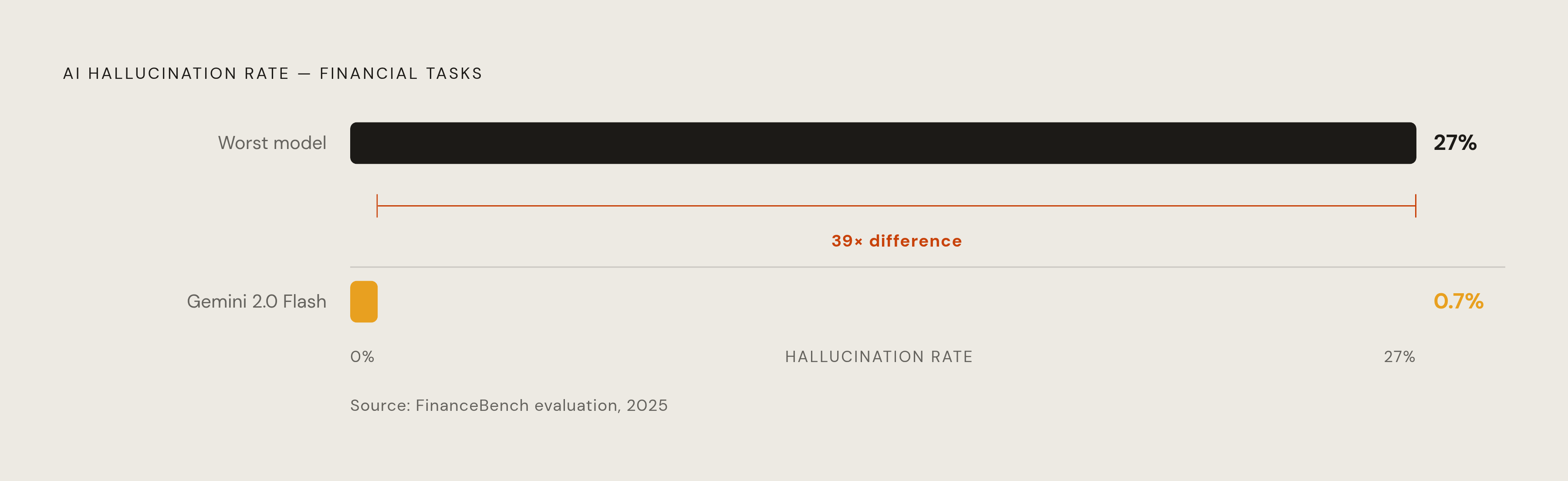
Vendor selection is where this becomes a live decision rather than a hypothetical. ChatFin's figures show Google's Gemini-2.0-Flash hallucinating on just 0.7% of tasks, while other models, depending on the task, land as high as 27%. That is a meaningful gap between two similar products, not a rounding difference. It is the gap between a tool and a liability. Model selection belongs in the same room as legal and risk from the start, not left to whoever signed the software contract. Most procurement teams still get this backwards, treating the choice of model as a vendor comparison spreadsheet rather than a compliance decision with its own sign-off chain.
Awareness has moved faster than controls. The Business Conduct Risk Intelligence Report 2026, drawing on more than 500 C-suite leaders, found financial services executives expect AI-related risks to grow in business impact over the next three years. Everyone at the top now says the right thing about the risk. The incidents below suggest the controls behind that awareness have not caught up.
How hallucinations damage a financial brand
Customers do not file a hallucinated answer under "the AI got it wrong." CXToday's coverage found that users increasingly treat AI output on rates, fees, balances, disputes, and fraud guidance as the bank's official word. A wrong answer is the institution speaking, full stop, not a technical glitch to the person reading it. It is the institution speaking, full stop, and they will hold the institution to it.
One bad answer, made public, does the damage on its own. A customer who posts a screenshot of a hallucinated fee explanation does not need thousands of identical failures behind it to make the story stick. At the scale banks operate, even a tiny failure rate produces enough public incidents to matter, and social media turns a single screenshot into the story a thousand other customers now believe about the bank.
A subtler failure mode never reaches a customer's screen. Research on generative systems flags AI tools that summarize regulations, investment products, or customer risk profiles, noting that errors introduced there can lead directly to mis-selling, flawed credit decisions, or misleading statements handed to regulators or investors. That is not a complaint sitting in a call log. That is a compliance file with the firm's own name on it.
The industry has settled on names for the specific failure patterns, and knowing them matters because each one demands a different fix. Invented statistics happen when a model generates a round, confident-sounding number about a firm's returns or fees that never existed. Fake citations happen when a model attributes a claim to a study or regulation that sounds real but is not. Entity confusion happens when a model mixes up a firm's founders, headquarters, or founding date with a competitor's, a pattern documented across industry coverage of AI hallucination risks.
None of this stays contained to a firm's own AI deployment, either. When a consulting firm or third-party publisher runs a report through generative AI and that report contains fabricated data, the errors do not sit quietly in a PDF. They get scraped, cited, and folded into the training data other models learn from, becoming a persistent, self-reinforcing source of misinformation about every firm named in the report. A brand named in that data has no lever left to pull, because by the time anyone notices, the error is no longer sitting in the original document. It is baked into the next model's training set.
Model quality gaps compound all of this. Glia's benchmark found generic AI deployments in banking understand less than half of transactional customer interactions correctly, while banking-specific models built for the task reportedly clear 92% accuracy. That gap should end the debate outright: a general-purpose chatbot bolted onto a bank's website is not a convenience feature. It is a brand-integrity risk wearing a convenience feature's clothing, and the two models are not close enough in performance to treat as interchangeable procurement options.
The damage does not stop at reputation. Customers who stop trusting the AI channel go back to calling, contact centers absorb the volume, queues stretch, and the hallucination shows up on an operating expense line months after the incident that caused it, long after anyone remembers which chatbot answer started the whole thing.
What high-profile hallucination incidents in professional services reveal about financial firms' exposure
KPMG pulled its October 2025 report, "Redefining excellence in the age of agentic AI," after Swiss Federal Railways, Transport for London, UBS, and the UK's National Health Service all disputed its findings as false or misleading. A GPTZero analysis found that of the report's 45 citations, only 5 pointed accurately to a real source. Another 28 offered paraphrased titles or fabricated components tacked onto a real source. The report circulated for roughly eight months before anyone pulled it.
UBS sits in that list of disputing organizations: a financial services brand, associated by name with hallucinated content it never produced, inside a report it never wrote. The reputational exposure ran entirely through a third party outside UBS's control. Eight months is a long runway for bad data to spread before anyone catches it, and by the time someone does, the citation has already been scraped into somewhere else, well beyond the reach of a correction.
Deloitte's experience in Australia followed a similar arc, with worse specifics. A government report published in 2025 turned out to contain fabricated references and quotations, including fabricated academic papers and a bogus excerpt attributed to a court case that never happened. Deloitte admitted the AI use and agreed to a partial refund on the AU$440,000 contract, reported at roughly $290,000. One of the largest consultancies in the world ended up publicly tied to fabricated research on a government contract, and no amount of technical sophistication elsewhere in the firm saved it from that outcome.
A legal filing incident reported by RepRisk showed the same failure pattern in a different profession. A major global law firm admitted that AI-generated hallucinations, including fabricated and misquoted legal citations, made it into a court filing in a high-profile bankruptcy case. Opposing counsel caught the errors, and the firm issued a public apology. RepRisk's read on the root cause is the part financial firms should sit with longest: reliance on a single general-purpose chatbot, with no purpose-built model, no stable source grounding, and no auditable review step before the filing went out.
That same structural weakness sits inside any bank running generative AI through credit analysis, due diligence, compliance monitoring, or risk reporting without a human checking the output before it moves downstream. None of these three incidents failed because the underlying model was uniquely bad. They failed because nobody stood between the model and the consequential decision, which makes each one a staffing and process failure, not a technology one, and that distinction should change what firms spend money fixing.
The market has already started pricing this in. In April 2025, Armilla, a Y Combinator-backed startup operating as a Lloyd's of London Coverholder, launched insurance coverage specifically for losses tied to malfunctioning AI tools, underwritten by Lloyd's insurers including Chaucer. The policy is designed to cover losses tied to AI tools that malfunction or underperform. An insurance product built around a named risk means underwriters have already run the numbers and decided the risk is real enough to price, not theoretical enough to wave off.
Why financial firms are structurally vulnerable to hallucination propagation
Call it the 2026 paradox: the best models have pushed hallucination rates on simple tasks down to as low as 0.7%, while the more sophisticated "reasoning" models, the ones built to work through multi-step problems, drift further from source material as task complexity rises. Financial analysis is exactly that kind of task: multi-step, contingent, built on chained assumptions stacked one on top of the next. The models getting smarter on paper are, in the domains finance actually needs them for, getting less reliable, and most vendor pitches conveniently leave that inversion out of the sales deck.
Domain-specific data backs this up, and the comparison should worry anyone who assumed banking's AI risk looked more like retail's. A medical study found GPT-4 hallucinated in 28.6% of citations generated for systematic reviews. Stanford researchers, cited in a Deloitte Switzerland report, found general-purpose chatbots hallucinating on legal questions at rates between 58% and 88%. Legal and regulatory interpretation sits at the center of financial services work, so the sector inherits a hallucination risk profile closer to law than to something like retail product recommendations.
Agentic AI makes the compounding worse, not better, despite the marketing around it. Deloitte Switzerland's analysis notes that in agentic architectures, small inaccuracies at one step do not stay small. They pass forward and accumulate, distorting the output of every downstream step that relies on them. A bank running AI agents across credit decisioning, compliance screening, and risk monitoring is not facing three separate error rates that can be managed independently. It is facing one error rate, multiplied through every link in the chain, and multiplication is a different math problem than addition.
Governance has not kept pace with adoption, and the gap is wide enough to be the headline on its own. RiskConnect's New Generation of Risk Report, cited in the same Deloitte Switzerland analysis, found 60% of companies considering agentic AI adoption, but more than half of those had never run a risk assessment on it. In an industry where regulators expect firms to demonstrate accountability for AI-assisted outcomes, that gap is regulatory exposure sitting in plain sight, waiting for an examiner to ask the obvious question.
Firms know it, too, which makes the pattern harder to excuse. ChatFin's research found 62% of enterprise users naming hallucinations as the single biggest barrier to AI deployment, ahead of job displacement concerns at 28%. Yet deployment keeps expanding anyway. Firms are moving forward with a risk they have already named and measured rather than pausing to fix it first, and that sequence runs backward from how a risk-aware institution is supposed to behave.
The "consensus engine" effect, described in a Surmado industry guide on generative and answer engine optimization, explains why inconsistency is so costly. Large language models weight information by how consistently it appears across their training data. If a bank's own website, its regulatory filings, and third-party directories describe its products or leadership differently, the model does not average those versions into a correct answer. It picks whichever version appears most often, correct or not, and any inconsistency in a firm's own public record becomes an open invitation for the model to guess wrong.
The content and citation strategy that determines how AI systems represent a financial brand
Models build their picture of a brand from whatever shows up consistently and authoritatively across their training and retrieval sources. Firms that never manage that corpus directly are handing their brand representation over to chance, and the data above shows chance does not grade on a curve.
Research into AI search behavior has found that a large share of brand mentions inside AI search answers come from third-party pages rather than a brand's own site. For a bank or asset manager, that means analyst coverage, earned media, and regulatory filings do more to shape what AI systems say about the firm than the firm's own marketing pages ever will, a fact most marketing budgets still do not reflect in where the money actually goes.
The discipline built around this problem now has names: Generative Engine Optimization (GEO) and Answer Engine Optimization (AEO), the practice of structuring content and public presence so AI systems cite and recommend a brand accurately. Researchers from Princeton, Georgia Tech, IIT Delhi, and the Allen Institute for AI formalized the GEO term academically in 2023, and it moved into mainstream marketing use by 2025. A 2026 best-practices guide from ShoPos draws the distinction that matters most: SEO gets a page discovered, AEO gets an answer extracted, GEO gets the brand recommended. Most financial marketing teams have spent years and budget on the first layer and almost nothing on the third layer, which actually prevents hallucinations from taking root.
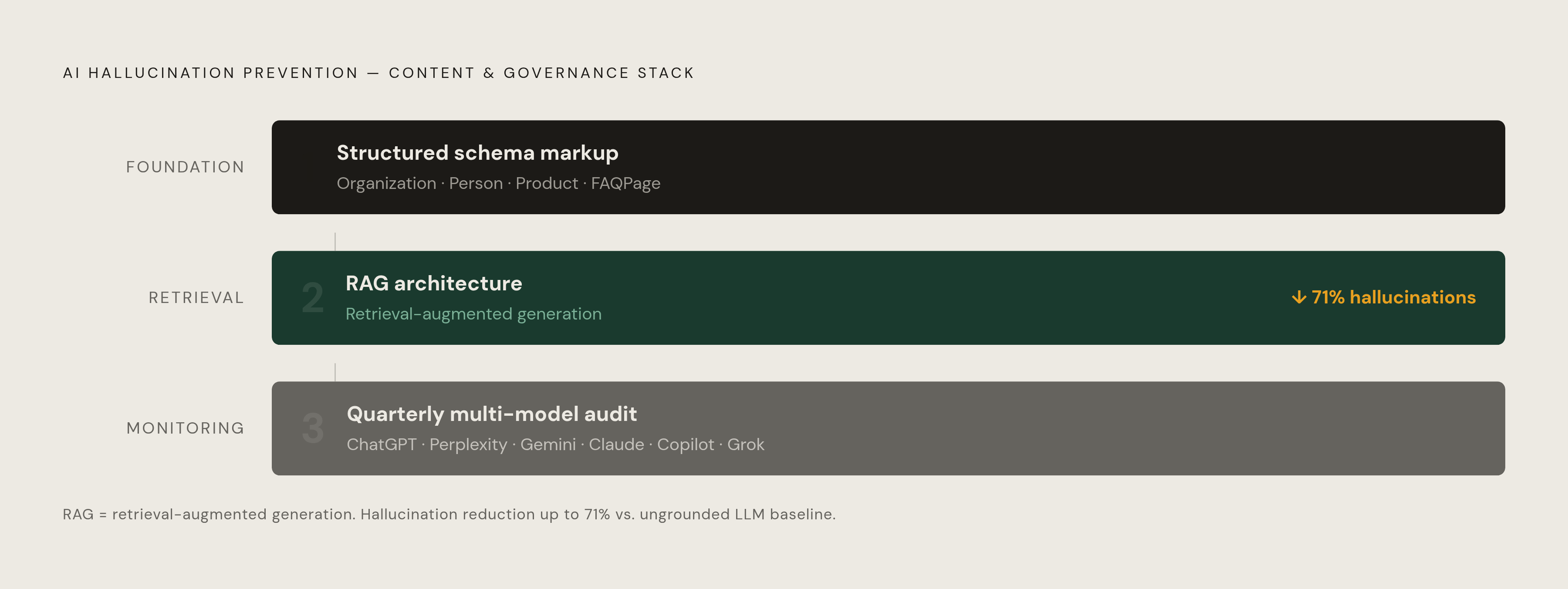
Structured data, specifically schema markup, does real work here, and it is a cheap fix relative to the damage it prevents. Organization schema, listing an official name, URL, logo, and verified links (sameAs) to LinkedIn and Crunchbase profiles, gives models a stable, authoritative reference point. Person schema on executive bios ties leadership names directly to the Organization entity, closing off the entity-confusion errors that mix up founders across competing firms. Product or Service schema carrying accurate pricing data heads off invented-fee and invented-rate hallucinations before they start. FAQPage markup lets a model extract a verified answer to a common compliance or policy question verbatim, instead of synthesizing a probabilistic guess.
None of it works if the underlying data disagrees with itself. A compliance phone number or a product's terms that read one way on the firm's own site and another way in a third-party directory erodes model confidence, and per the consensus engine effect, invites the model to either omit the detail or invent one instead. The industry guide cited above states that Retrieval-Augmented Generation (RAG), which grounds a model's output in retrieved source documents instead of pure probabilistic generation, can cut hallucination rates by up to 71%. Any financial firm evaluating an AI vendor should treat RAG architecture as a baseline requirement, not a selling point, and should walk away from a vendor who still presents it as an upgrade tier.
The split in effort matters too, and most firms have it inverted. That same Writer.com guide estimates GEO work as roughly 80% strategic, meaning positioning, ecosystem presence, and earned authority, with only 20% technical schema implementation. Content strategy and earned-media relationships carry as much weight in preventing hallucinations as anything an engineer configures on the backend. Firms treating this as a pure IT ticket, handed off to whoever manages the website's markup, are solving a fifth of the problem and calling it done.
The governance and monitoring program a financial firm needs to maintain brand accuracy across AI platforms
Fluent AI output is not the same thing as verified fact, and treating the two as interchangeable is the single failure running through every incident described above, from KPMG to Deloitte to the law firm's court filing. RepRisk's own model offers a workable template: AI screens content at scale, but specialist analysts review and sign off on every risk incident before it goes out the door. Machine for scale, human for judgment. That division of labor is the governance archetype any financial firm generating AI content should be building toward, and skipping the human half is why the KPMG report stayed live for eight months.
Niara's monitoring approach lays out a workable cadence. Quarterly audits should prompt every major model, ChatGPT, Perplexity, Gemini, Claude, Copilot, and Grok, with the same set of questions about a firm's products, rates, executives, regulatory standing, and corporate history, then compare the answers side by side rather than checking one platform and calling the job finished. Source citations need checking too: reviewing the footnotes an AI search engine attaches to its answers reveals which third-party sites are actually feeding the model, and that is often not the sites a firm would guess on its own. Where that review finds stale or wrong data sitting in a niche directory or a financial data aggregator, someone has to contact that source directly and get it corrected, because the model has no way of knowing on its own that the data is old.
The real test is not whether one model gets a firm's story right on a good day. It is whether all of them get it right, at once, on the same day, since what ChatGPT says about a firm's mortgage rates can differ meaningfully from what a customer sees inside a competing model. A firm that only checks one platform has only checked one slice of its actual exposure, and the incidents above suggest that slice is rarely the one that ends up in the news.
Sources
- RepRisk | Mitigating AI hallucination risk in banking and credit decision-making
- AI Hallucinations in Banking are a CX Risk, Not Just a Technical One
- AI hallucinations spark a trust crisis for consulting firms
- AI doesn’t lie, it hallucinates and M&A due diligence must address that
- AI Hallucinations in Business: Causes and Prevention | IntuitionLabs
- AI Hallucinations in Finance: How to Prevent Costly Errors
- writer.com