AI Answer Monitoring Tools for Financial Services Compliance
Firms need separate monitoring tools for AI they control and AI that answers about them.

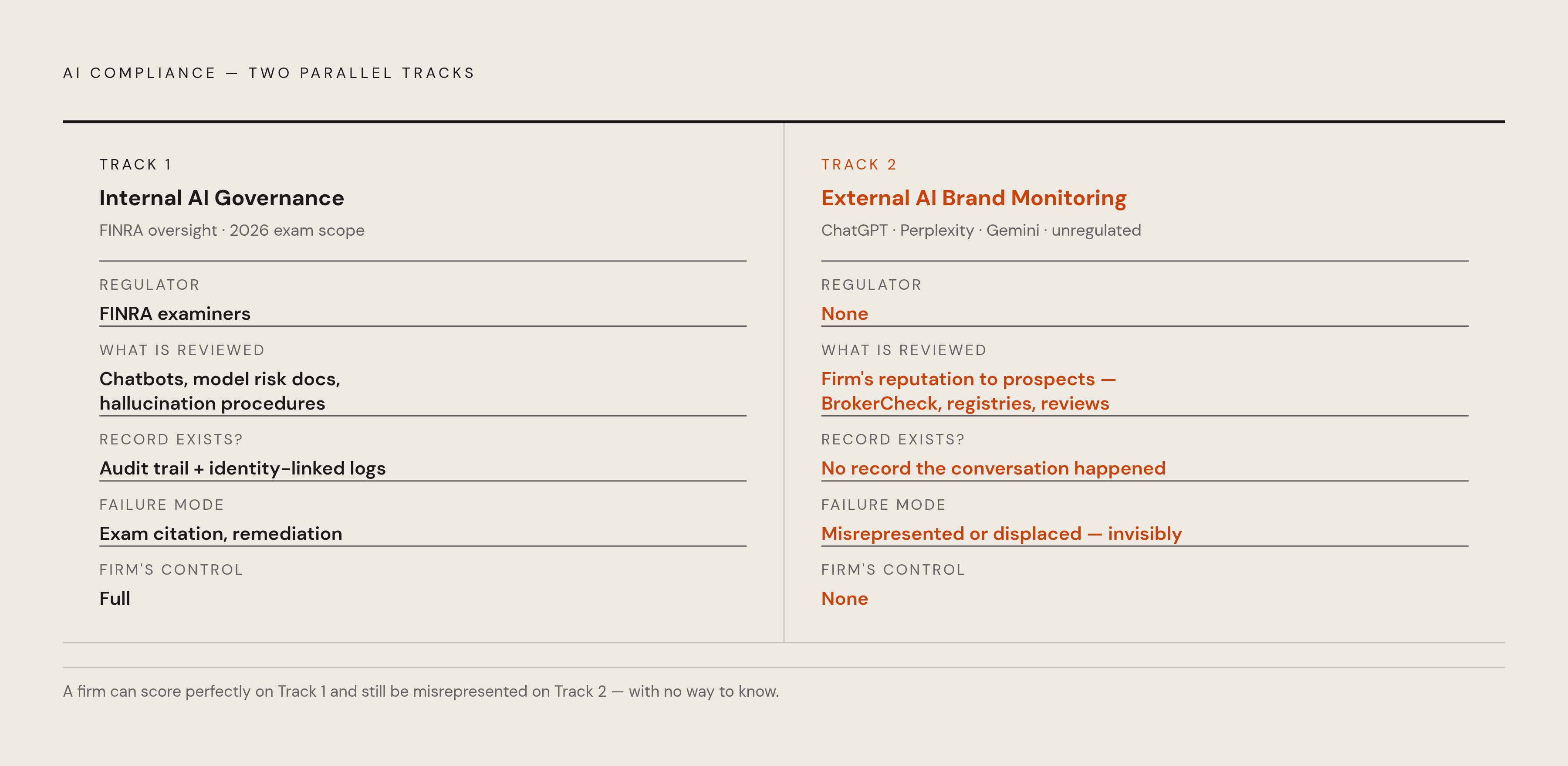
AI compliance in financial services has been built around one question: what does the institution's own AI do, and can that behavior be governed and documented? A second obligation has grown alongside it with far less scrutiny, namely whether AI answers describe the firm accurately to the prospects and clients who never set foot on its website. A firm can have an exemplary internal AI governance program and still be misrepresented, under-cited, or displaced by a competitor in every AI answer a prospective borrower reads, with no examiner to flag it and no audit trail to reconstruct what was said, because they draw on different evidence, answer to different failure modes, and require different tools, and a firm that has solved only one of them is exposed on the front it hasn't measured.
Two separate AI monitoring obligations for financial services firms
The internal obligation already has teeth. FINRA's 2026 regulatory oversight report added a section specifically on generative AI, making clear that existing rules on supervision, communications, recordkeeping, and fair dealing apply to a chatbot or a drafting assistant exactly as they'd apply to any other tool a registered representative touches. The report singles out hallucinations by name, defining them as AI-generated inaccuracies such as misread rules or wrong client and market data, and it tells firms they need procedures that catch these errors before they reach a client file or a trade decision.
The external obligation hasn't caught up to that level of specificity, mostly because it hasn't been framed as a compliance question. Clients already ask AI tools to evaluate products, compare institutions, and check whether an advisor is credible, often before they ever open the firm's homepage.
Treating these as the same problem is where the exposure hides. A firm can run an internal AI governance program examiners would call exemplary and still get misquoted, left out, or quietly replaced by a competitor in every AI-generated answer a prospective borrower reads that week. No examiner flags that failure, and there's no audit trail to reconstruct what the AI actually told the client, because the interaction happened entirely outside the firm's systems.
What the internal AI monitoring obligation requires
Internal AI compliance breaks down into several distinct capabilities, not one umbrella control. A regulated institution needs identity-linked audit trails covering every AI interaction, policy enforcement that happens at the moment someone uses the tool, data classification and access controls that limit what the AI can see, model risk documentation, and the ability to pull up any AI-initiated action for an examiner on short notice.
Those evidentiary expectations have gotten specific. A guide from WitnessAI says examiners are now asking who started an AI interaction, what data moved through it, what the model handed back, and what controls were actually enforced in that moment. Security stacks built around file-level data loss prevention were never designed to answer those questions, because they track files moving between systems, not a conversation between a person and a model.
Traditional compliance QA worked by sampling a small slice of conversations and checking them by hand, a method that made sense when humans handled every customer interaction one at a time. A roundup from Lorikeet notes that once an AI agent is fielding thousands of regulated conversations a day, sampling stops producing a defensible record, and firms need full coverage instead. The grading itself has to shift too, from scoring whether a response sounded polite to checking whether it followed the actual policy or SOP: whether a dispute got acknowledged inside the Reg E window, whether provisional credit went out correctly, whether the required disclosure landed at the right point in the conversation.
What counts as an audit trail has gotten more demanding as a result. A record an examiner can actually follow needs a timestamp on each conversation, a note on which policy or SOP the AI was relying on, and the reasoning behind the decision it made, ideally alongside test traces captured before the system ever went live, so the logic chain is documented from day one rather than reconstructed after the fact.
Agentic AI adds another layer the industry is still working out. Once an AI system starts initiating actions on its own rather than just answering a prompt, the audit trail has to tie each of those actions back to a specific human identity. Regulators will ask who's accountable for what the agent did, and "the model did it" isn't an answer that satisfies that question.
The internal tooling landscape
No single platform covers all of this, and the internal AI compliance market has settled into four functionally distinct categories. Picking the wrong category for a given job doesn't give a firm a weaker version of the capability it needs. It leaves a real gap where that capability should be.
The first category covers network-level AI governance and identity-linked audit trails. WitnessAI works without agents installed on endpoints, watching AI activity at the network level across native desktop apps, browser-based AI tools, IDEs, copilots, and agent or MCP server workflows, and it ties every interaction, including ones started by autonomous agents, back to a specific person. Its Observe module flags where regulated data, PII, NPI, account numbers, KYC records, trading data, is at risk of flowing out to a third-party AI provider. This category fits institutions that need to reconstruct AI interactions end to end for an examiner and can't tolerate blind spots that come from only watching endpoints. Netskope works the same network layer with a different emphasis: shadow AI discovery, real-time data loss prevention enforcement, and coaching policies aimed at users, covering four deployment types, shadow AI, enterprise public AI, private AI, and agentic AI, from one console, with behavior-based anomaly detection built on user and entity behavior analytics.
The second category is GRC, model risk, and AI governance. IBM watsonx.governance fits when the actual problem is governing the institution's AI estate itself, meaning model risk, explainability, lifecycle oversight, and evaluation, rather than day-to-day policy questions or transaction monitoring. Workiva fits structured GRC work: documenting controls, collecting audit evidence, SOX reporting, and mapping controls across multiple frameworks. It isn't a policy Q&A assistant and shouldn't be asked to do that job.
The third category is conversation-level QA and policy correctness grading. The distinction that matters here is between platforms that grade tone and generic adherence and platforms that grade whether a conversation actually followed policy and SOP correctly. These are not interchangeable in a regulated setting, because a tone score can't produce the per-conversation evidence an examiner needs to evaluate a Reg E dispute.
The fourth category is AML, financial crime, and transaction monitoring. NICE Actimize is an enterprise AML and fraud detection platform already used by major global banks, built around AI-powered transaction monitoring, case management, and suspicious activity reporting, and it suits large institutions with complex transaction volumes. ComplyAdvantage covers transaction monitoring, sanctions and payment screening, and financial crime risk intelligence, while Featurespace's ARIC platform takes a different technical approach, using adaptive behavioral analytics to learn what normal behavior looks like rather than matching against fixed rules, which makes it a strong fit for payment processors and digital banks.
A fifth, adjacent job is source-grounded internal compliance Q&A. CustomGPT.ai fits when the main requirement is answering policy questions from approved institutional knowledge: it's built around document ingestion, citations, verification, and no-code deployment, and it isn't a replacement for GRC, transaction monitoring, or AI governance tools. Microsoft Copilot Studio makes more sense when SharePoint, Dataverse, Entra ID, and Power Platform already run the institution's operations, and Glean fits firms where compliance information is scattered across many SaaS applications and permission-enforced retrieval across a large connector ecosystem is the central requirement.
The hallucination problem inside regulated workflows
Hallucination inside a regulated workflow is a specific, assignable liability, not a general accuracy nuisance. When a generative system summarizes a regulation incorrectly, misdescribes an investment product, or misjudges a customer's risk profile, a confidently wrong answer can lead to mis-selling, a flawed credit decision, or a misleading statement handed to a regulator or an investor, and the institution carries that consequence, not the vendor that built the model.
Generative models applied to financial compliance queries often produce answers that aren't grounded in any verifiable fact, or that quietly cross access control boundaries they shouldn't. FINRA's 2026 guidance names this directly, calling out misread rules and inaccurate client or market data as hallucination categories institutions have to build active procedures to catch.
On the technical side, researchers have proposed frameworks such as Secure Graph-RAG, which combines four components: access-level filtering tied to the specific user, content-aware redaction, graph-based evidence retrieval, and generation that's aware of its own hallucination risk and attaches a trust score to its output. The approach matters less as a specific product than as a direction: handling factual grounding and access control together, in one architecture, rather than bolting a fact-checker onto a system that still leaks data it shouldn't share.
A compliance assistant that can't show where its answer came from doesn't belong in a regulated environment, because a confident wrong answer is worse than no answer. It cuts off the one step, checking the citation, that would have caught the error.
How AI is reshaping brand discovery in financial services
AI answer engines now function as a gatekeeper for whether a financial services firm even gets considered. Clients ask AI tools to evaluate products, compare institutions, check an advisor's credibility, and narrow their shortlist, often before they've looked at a single firm's own site, and the answers synthesize external sources the firm doesn't control and can't see without actively monitoring for it.
That shift carries direct compliance weight. When an AI tool describes a financial product to a prospective client with the wrong rate, a missing disclosure, or outdated suitability guidance, the prospect acts on what they were told. The firm never had a chance to review or correct that answer before it reached the client, and there's no record the conversation happened at all.
The problem compounds because AI systems don't ask for clarification when sources disagree. They reconcile a firm's own data against outside sources, FINRA BrokerCheck, state insurance registries, review platforms, business listings, and when those sources conflict, the system still produces a single confident answer. That answer can disadvantage the firm, misstate its products, or send the prospect toward a competitor whose external data simply happens to line up more cleanly.
This is where the compliance framing matters most. A misdescribed product in an AI answer carries the same downstream risk as a misdescribed product in a sales conversation, mis-selling, a client acting on bad information, a regulator asking why the record doesn't exist. The absence of a paper trail doesn't reduce that risk. It removes the firm's ability to catch the error before a client has already acted on it.
AI share of voice and a financial brand's external exposure
The metric that makes this external obligation visible is AI share of voice, defined as the share of AI-generated responses, across a defined set of category prompts, that mention, cite, or recommend a given brand. Financial services firms that have started measuring it are finding a notable pattern: their standing in AI answers often bears almost no resemblance to where they rank in ordinary web search.
Part of the reason is that different AI models draw on different source mixes, weigh licensing databases and review platforms differently, and reconcile conflicting data in their own way, so share of voice measured against ChatGPT can diverge sharply from share of voice measured against Perplexity or Gemini for the exact same firm and the exact same set of prompts, producing three measurably different SoV figures rather than one consistent number. A single snapshot from one model tells a firm almost nothing about its actual exposure across the AI tools its prospects are using.
Financial services carries more of this cross-model disagreement than most other sectors, precisely because its products sit on top of regulatory and licensing data, BrokerCheck records, state registries, disclosure filings, that models weigh unevenly and sometimes miss entirely. That makes a one-time check close to worthless and turns ongoing, multi-platform tracking into a baseline requirement rather than an optional add-on.
Tracking how AI describes a firm to prospects takes a different capability than internal AI governance tooling provides, because you need visibility across multiple models at once, not oversight of a single internal system. Platforms built specifically for that job, such as Athenahq, which tracks brand citations across eight or more AI models simultaneously, show firms how ChatGPT, Perplexity, Gemini, and other major AI engines are actually describing their products, which lets a compliance or marketing team catch a citation drop and pair it with a fix before a prospect ever encounters it.
The firms still treating AI compliance as a single, internally-facing obligation are measuring half the risk they actually carry. The internal obligation has regulators, documentation standards, and an evidentiary bar that keeps rising. The external obligation has none of that formal structure yet, but the exposure is accumulating in every AI answer a prospective client reads today without anyone at the firm knowing it happened.
Sources
- 6 Best AI Compliance Software for Financial Services in 2026
- 8 Best Compliance-Focused AI QA Tools for Financial Services Support (2026)
- Best AI Tools for Financial Compliance in 2026: Top 10
- Best AI for Compliance Monitoring in Finance Department 2026 - ChatFin
- 8 Best AI Visibility Tools for Financial Services in 2026