Board-Ready AI Search Reporting for CMOs
AI share of voice shows up in buyer consideration before pipeline numbers move.

CMOs now face a reporting problem that didn't exist three years ago. Boards are asking about AI search, and the numbers marketers have on hand, citation share, mention frequency, sentiment scores, don't map to anything a board has ever reviewed. This piece lays out which metrics actually matter, how to translate them into revenue and risk terms, and how to build a reporting structure that survives contact with a board meeting.
Citation share maps directly to market share logic: AI SOV measures how often a brand gets named across a fixed set of AI-generated answers relative to every competitor named in that same set, and it moves before pipeline numbers do. On the opportunity side, a rising AI SOV signals presence in more buyer consideration sets earlier, while a competitor's AI SOV climbing against a flat company number is a quantifiable gap in specific conversations. On the risk side, hallucination incidents carry product, reputational, and legal exposure at scale, and absence from an AI answer is functionally equivalent to losing a recommendation to whichever competitor did get named. The cleanest frame for a board treats AI SOV as the leading indicator and pipeline or closed revenue as the lagging confirmation, which turns an unresolved measurement problem into the kind of leading-indicator conversation boards already know how to have.
What AI search actually changes about how buyers find brands
The mechanics of discovery flipped. Traditional search handed a buyer ten ranked links and let them pick one. ChatGPT, Perplexity, and Google's AI Overviews now synthesize a single answer, naming some brands and leaving others out entirely. There's no scroll, no page two. Either the brand shows up in that one answer, or it doesn't exist in that moment of consideration.
Most sessions on these platforms never produce a click back to a brand's website. Sessions, click-through rate, referral traffic, the metrics marketing teams have leaned on for two decades, miss most of the influence AI search now has on what a buyer even considers. A brand can shape a purchase decision without ever showing up in Google Analytics.
That changes what winning means. Outranking a competitor on a keyword used to be the goal. Now the question is narrower and harder: does the AI platform include you in the answer while leaving the competitor out, or does it go the other way? Rankings used to sit on a spectrum. Citation works more like a light switch.
The stakes sit exactly where they always have, at the point of purchase intent, and that's precisely where AI platforms now insert themselves before a buyer ever lands on a company's site. A brand can get cited prominently by Perplexity and show up as a ghost on ChatGPT. Aggregate numbers hide this split. A board staring at one traffic dashboard has no way to see that the brand is winning on one platform and invisible on another.
Getting cut from the shortlist before a buyer ever reaches a page the company controls is a bigger business risk than a soft dip in one traffic channel.
The metrics AI search produces and what they measure
AI Share of Voice, or AI SOV, measures how often a brand gets named across a defined set of AI-generated answers, relative to every other brand named in that same set. It's a percentage: brand mentions divided by total mentions across competitors, for a fixed batch of prompts. Unlike search rank, there's no partial credit here. A brand is either named in the answer or it isn't; there's no "position 3" to point to as a consolation prize. AI SOV needs to be calculated per platform, then blended and weighted by how much reach each platform actually has, because a single-platform number hides the fragmentation problem above.
LLM mention frequency tracks how often a brand shows up across a fixed set of prompts run repeatedly over time, rather than in one check. AI answers are probabilistic, not deterministic: ask the same question twice in a row and you can get two different answers naming two different brands. Roughly a third of brands that appear in one response show up again in the very next response to the same query, which is a thin enough consistency rate to explain why a single snapshot tells you almost nothing. Frequency across many runs is the only version of this number worth putting in a report.
Sentiment classification asks something different: when the brand gets mentioned, is the description positive, neutral, or negative? A brand cited constantly but described inaccurately carries a different kind of risk than a brand that barely gets mentioned at all. The two problems need different fixes, and lumping them together in one report muddies the diagnosis.
AI-referred sessions are the one metric that plugs straight into dashboards a board already trusts, since it's just web analytics attributing a session to a known AI platform domain. Useful, but it only counts the minority of AI search's influence that ends in an actual click. Everything that happens in the buyer's head before that click, the citation, the framing, the comparison against competitors, never shows up here.
Citation source profile looks at which third-party domains, review sites, analyst write-ups, media coverage, directories, get pulled into AI answers about the brand. It's diagnostic rather than a performance number: it tells a CMO where the AI platform thinks authority actually lives.
Here's the frame that lands with boards: AI SOV does for AI search what market share does for revenue. It's the number that moves before the pipeline numbers do.
How do I explain AI search metrics to my board in revenue and risk terms?
Boards look at marketing through two lenses, and they always have. Is this driving growth, and what happens if we sit on our hands. AI search reporting has to answer both, in board language, not marketing language.
On the opportunity side, AI SOV works as an early pipeline signal. Brands with a bigger citation share on purchase-intent queries get into more consideration sets earlier, even when a straight line to closed revenue is hard to draw. If a competitor's AI SOV climbs while the company's own number sits flat, that's a quantifiable gap: specific conversations the brand is part of, and specific ones it's shut out of. Consistent citation across a whole topic area also signals something boards care about beyond new customer acquisition, category authority, which touches pricing power and retention, not just top-of-funnel volume.
On the risk side, hallucination is the sharpest edge. AI systems generate wrong descriptions of a brand's products, its history, its leadership, and a meaningful share of e-commerce brands have already reported a real reputational incident tied to AI-generated misinformation. Being absent from an answer costs something too; functionally, it's the same as losing a recommendation to a competitor who got named instead. And the well-documented drop in click-through rates on queries where AI Overviews appear is a revenue gap sitting inside a channel the board already funds.
None of this needs jargon to land. "Citation share" becomes "our share of AI-driven consideration." "LLM mention frequency" becomes "how consistently we come up when buyers ask AI for options in our category." "AI-referred sessions" becomes "measurable pipeline entries from AI platforms." "Sentiment classification" becomes "how accurately and favorably AI describes us to buyers." Skip GEO, AEO, RAG entirely, those acronyms mean nothing in a board meeting, and skip any explanation of how the models work under the hood. Every metric needs a business consequence attached to it, or it doesn't belong on the slide.
Building the reporting structure: what to track, how often, and at what level of detail
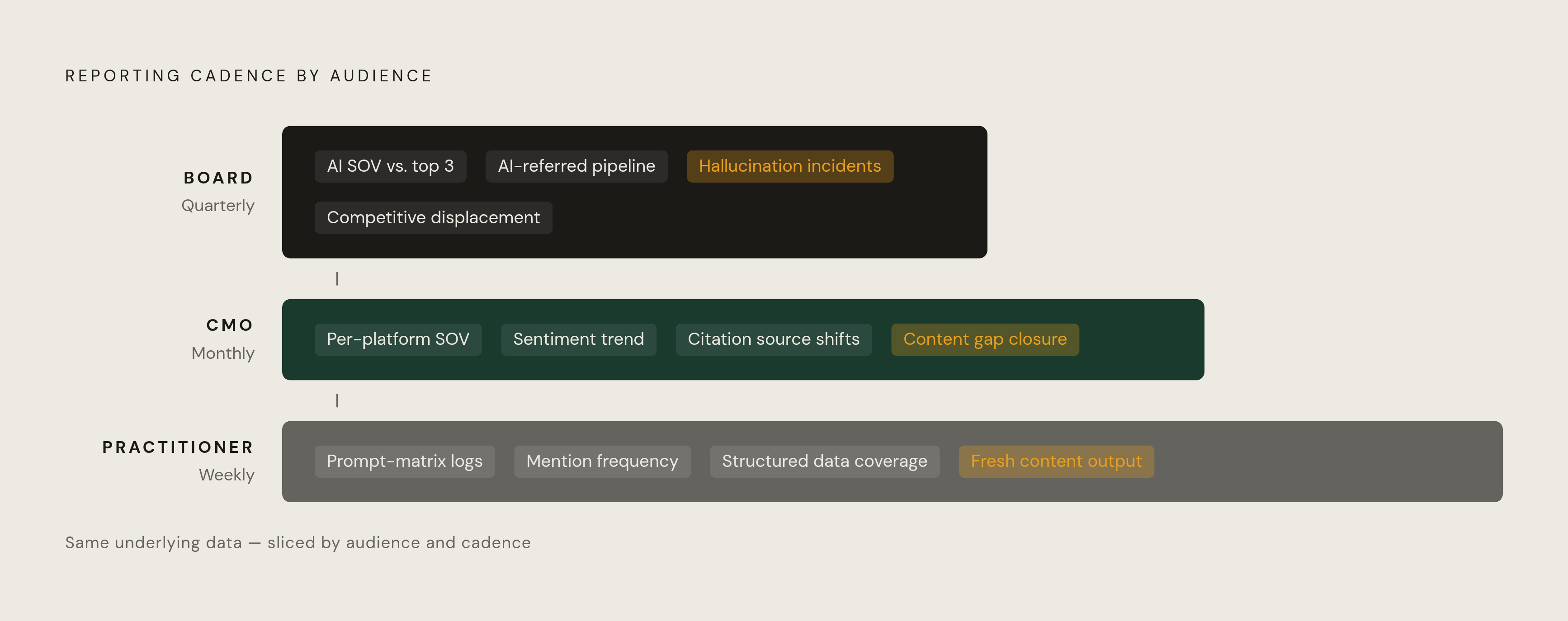
Three layers of reporting, three audiences, three cadences.
At the board level, quarterly: blended AI SOV trend against the top three competitors, AI-referred pipeline contribution, one or two hallucination incidents with resolution status, and a short summary of competitive displacement. At the CMO and marketing leadership level, monthly: per-platform SOV breakdown, sentiment trend, changes in the citation source profile, and how fast content gaps are closing. At the practitioner level, weekly: raw prompt-matrix output logs, mention frequency broken out by query cluster, structured data coverage status, and how much fresh content is going out the door.
The prompt matrix sits underneath all three layers. It's a stable, fixed set of queries, typically a few dozen, spanning category-level questions, problem-aware questions, and direct comparison questions. Run that matrix across the major AI platforms, at minimum ChatGPT, Perplexity, Claude, and Google's AI Overviews, on a consistent schedule. Log each mention as cited or not cited, with sentiment flagged. Change the query set partway through a reporting period and you break the trend line; the matrix has to stay fixed to mean anything over time.
Platform weighting matters more than it looks like it should. ChatGPT carries the largest share of chatbot traffic but is also the hardest to trace, since it often paraphrases without citing a source at all. Perplexity leans on visible source citation, which makes it easier to measure and disproportionately valuable for purchase-intent research relative to its overall size. Google's AI surfaces reach the widest audience and carry the strongest trust signal, simply because consumers already trust Google as an interface. Copilot's visible web share understates its real reach, since a lot of its usage runs through Microsoft 365 in enterprise settings, which matters a lot for B2B CMOs specifically. Whatever weighting method a team picks, write it down and hold it constant quarter over quarter, or the trend comparisons stop meaning anything.
"Good" here is relative, not absolute. AI SOV only means something next to a competitor's number in the same prompt matrix; there's no fixed threshold to hit. Several vendors now offer automated tracking across the major LLMs with weekly trend output, including Athenahq, an enterprise AEO and GEO platform that measures citation share across eight or more models and packages that data into board-ready reporting, which means the CMO's actual job is picking the right query set and the right competitor benchmark, not running the queries by hand.
The factors that actually determine whether AI platforms cite a brand
AI search optimization leans on strategy and content far more than on technical plumbing. Schema markup and site structure matter, but they amplify authority that already has to exist; they don't create it out of nothing.
Most AI citations pull from third-party domains rather than the brand's own site, which makes earned media, analyst mentions, review platforms, and category comparison articles structural inputs, not a nice-to-have layered on top of owned content. Review platform research across a large sample of AI responses found a wide citation gap between brands with no active review presence and brands that actively collect and respond to reviews, wide enough that it wasn't a rounding error. Review and trust platforms turned out to be one of the largest sources of AI citations in that sample, trailing only general brand websites themselves — a finding consistent with what third-party research on AI citation sources has documented.
Content structure matters too. Research out of Princeton and Georgia Tech on generative engine optimization found that adding inline citations to primary sources, specific statistics, and named expert quotes each measurably improved how often content got cited by AI systems, and those structural changes beat technical tweaks in the study. Freshness carries weight as well: AI retrieval systems favor recently published or recently updated content, and most AI bot activity targets pages published within the last year.
Information gain might be the least intuitive factor and the most important one. Content that just restates what's already out there gives an AI system no reason to cite it over the source it's rehashing. Content that adds something new, an original data point, a genuinely different angle, gets cited more often. Content with real information gain consistently outperforms rehashed content in AI answers. Entity clarity rounds it out: consistent identity signals across Wikipedia, Wikidata, schema markup, and directory listings shrink the ambiguity that AI systems otherwise fill in with guesses, which is another way of describing where hallucinations come from.
For a CMO trying to prioritize: brand authority, third-party presence, and content quality drive most of the citation outcome. Schema and technical optimization amplify a signal that's already there. Their job stops there.
The hallucination risk: framing brand integrity as a board-level governance issue
Hallucination, AI-generated content that gets facts about a brand wrong, happens often enough that it stopped being a rare edge case a while ago. It's common enough that the major AI labs treat reducing it as a top priority, because the rates stay meaningful even under normal, everyday conditions.
For a board, the risk splits into a few distinct buckets. Product misinformation: an AI answer describes a feature, a price, or availability incorrectly, which shapes a buyer's decision directly and generates support tickets downstream. Leadership and company history errors: AI attributes a false statement or a false history to a named executive or the company itself, which is reputational exposure and, depending on severity, legal exposure. Competitive misattribution: AI credits a competitor's capability to the brand, or the reverse, which sends the buyer down the wrong path entirely.
Google's AI Overviews now shows up on a majority of all searches, which puts AI-generated brand content in front of an enormous audience that already treats the Google interface as authoritative. That's the scale problem in one sentence.
The right comparison is brand safety in programmatic advertising: a channel the company doesn't directly control can misrepresent the brand at scale, and boards already accepted responsibility for governing exactly that category of risk once before. This isn't a new kind of problem for a board so much as a new instance of one.
CMOs have real levers here. Consistent entity signals, Organization Schema, verified Wikipedia and Wikidata profiles, accurate Crunchbase and directory listings, close the ambiguity gaps that AI otherwise fills with invented detail. Owned content that's factually dense, specific dates, named products, verified numbers, clear attribution, gives AI something accurate to draw from instead of forcing it to guess. Active review management matters again here: the citation gap between brands that manage their reviews and brands that ignore them is one of the largest behavioral differences documented in this space. And weekly sentiment and accuracy checks inside the prompt matrix work as an early warning system, catching hallucination incidents before they snowball.
The board needs to hear plainly that this goes well past marketing. Legal, Communications, and Product all need defined response protocols, which means the board has to weigh in on who owns what before an actual incident forces the question.
Connecting AI search performance to pipeline: the attribution approach that works now
Drawing a straight line from AI search to closed revenue is genuinely hard right now. Most AI sessions never produce a click, and the multi-touch attribution models marketing teams already run weren't built for an influence layer that leaves no cookie behind.
A CMO's best move is showing the board exactly what's measurable today and what it implies, nothing more.
AI-referred sessions can be tracked through standard analytics once a platform's domain is identified, and from there, conversion rate, deal size, and pipeline entry point are all trackable through the CRM the company already runs. SOV movement against pipeline trend is measurable too: when blended AI SOV rises in a category and pipeline from that category grows in the following quarters, that correlation is reportable evidence. Not proof, but evidence worth putting in front of a board. Competitive displacement events are trackable as well. When a competitor's AI SOV jumps in a shared category and win rates in that segment slip at the same time, that relationship belongs on a risk slide.
The cleanest frame for a board is leading indicator versus lagging indicator. AI SOV is the leading one: it measures presence in the buyer's consideration set before the buyer ever takes an action a CRM can log. Pipeline and closed revenue confirm it later, as lagging indicators. Report AI search performance without that distinction and a board will demand attribution precision the technology can't deliver yet. Report it with that distinction, and an unresolved measurement problem turns into exactly the kind of leading-indicator conversation boards already know how to have.