AI Assistant Influence on SaaS Vendor Shortlisting in Mid-Market Buyers
AI now decides which vendors buyers consider before any sales conversation even begins.

A procurement lead at a mid-market company opens ChatGPT, types "best B2B SaaS for expense management," and gets back three to five named vendors with reasons attached, all before visiting a single vendor website. That single exchange has replaced what used to be a sprawling, multi-week search, and it has quietly become the most important moment in the sales cycle.
SaaS vendor shortlist formation by AI assistants before buyers visit any website
The buying journey that defined software buying for the past decade ran through Google, then G2 and Capterra, then a pile of downloaded analyst reports, then anywhere from seven to twelve vendor websites visited one at a time, until the buyer finally narrowed a wide field down to a workable shortlist, a process that typically ran two to three weeks. That sequence assumed the buyer did the narrowing. In 2026, the narrowing happens before the buyer does anything else: a buyer opens ChatGPT, Perplexity, Claude, or Gemini, asks something like "best B2B SaaS for X," and receives three to six named vendors with reasoning already attached. The wide evaluation phase used to take up most of the research cycle, but now it gets skipped. The buyer lands on two to four vendor sites, and only for deep evaluation.
GrowthSpree's 2026 analysis labels this Behavioral Shift #1: buyers now arrive at vendor websites with two to four vendors already shortlisted by AI, versus a larger set of vendors in the traditional pre-AI research cycle. The discovery event that used to be a high Google ranking or a strong G2 profile has moved: a vendor now makes the list only by appearing inside the AI's answer. A vendor's website, review profile, and paid search presence still matter downstream, but the gate a vendor has to pass through first sits inside a language model's response, not a search results page.
Adoption speed among mid-market buyers
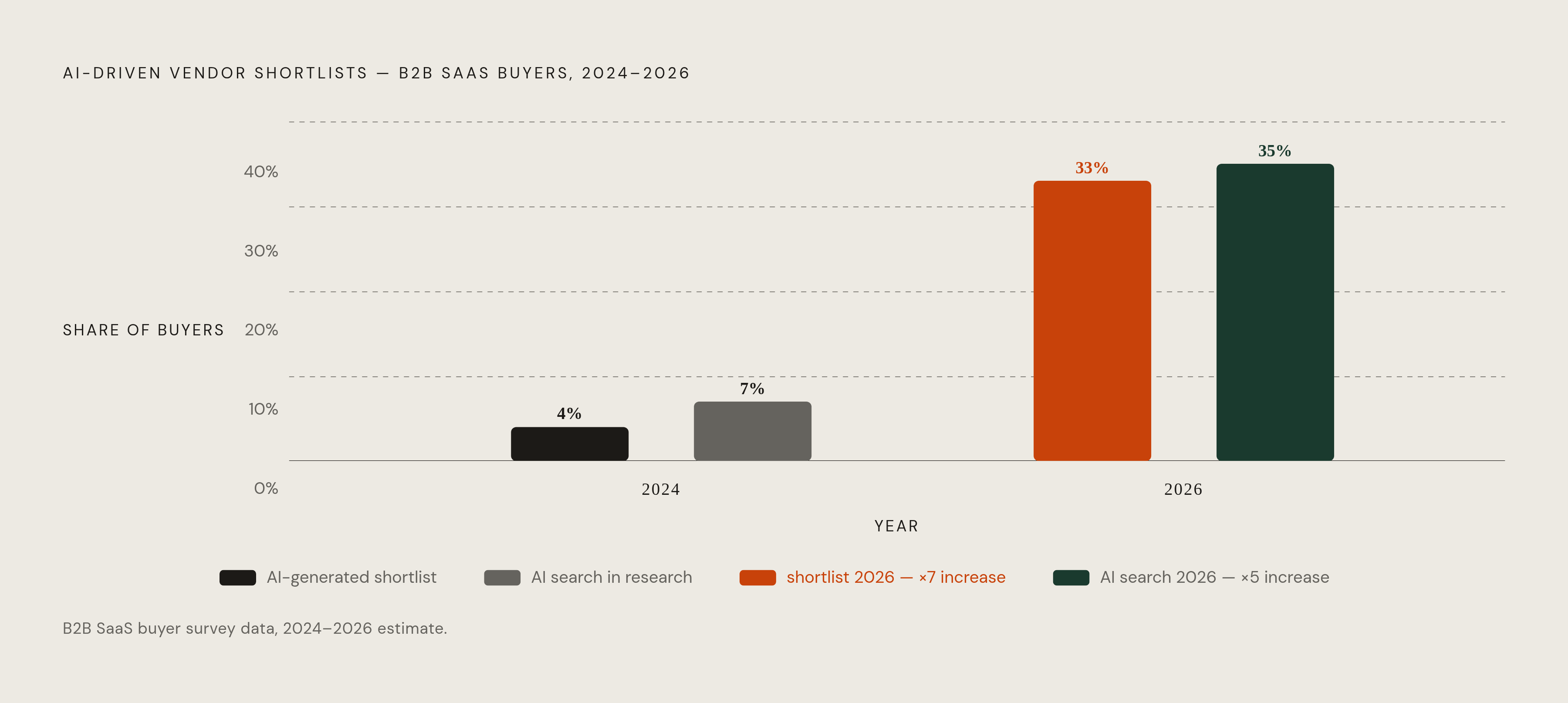
This is not a fringe behavior limited to early adopters. GrowthSpree's 2026 data shows the share of B2B buyers using AI search during vendor research climbed from a small minority in 2024 to more than a third of all buyers by 2026, which is roughly a five-times increase in two years. Narrow that to buyers who let AI actually generate their candidate list, rather than simply using it for supplementary research, and the growth is even sharper: from a near-zero baseline in 2024 to roughly one in three B2B SaaS buyers by 2026, a seven-times increase.
Other sources converge on the same picture from different angles. Geisheker's 2026 analysis cites Google data showing more than half of B2B buyers now use ChatGPT or Gemini to augment their vendor lists, and it cites TrustRadius data showing nearly three-quarters of buyers encounter Google AI Overviews somewhere in their research. Enterprise procurement, where buying committees often run six to ten or more stakeholders, has adopted these tools fastest, because AI can save analyst-weeks of manual vendor comparison for a committee that size. The mid-market tells a different story only in scale, not in kind. Smaller buying teams and shorter cycles mean mid-market buyers feel the same compression, just with fewer people in the room to notice it happening.
Why missing the AI answer effectively removes a vendor from the deal
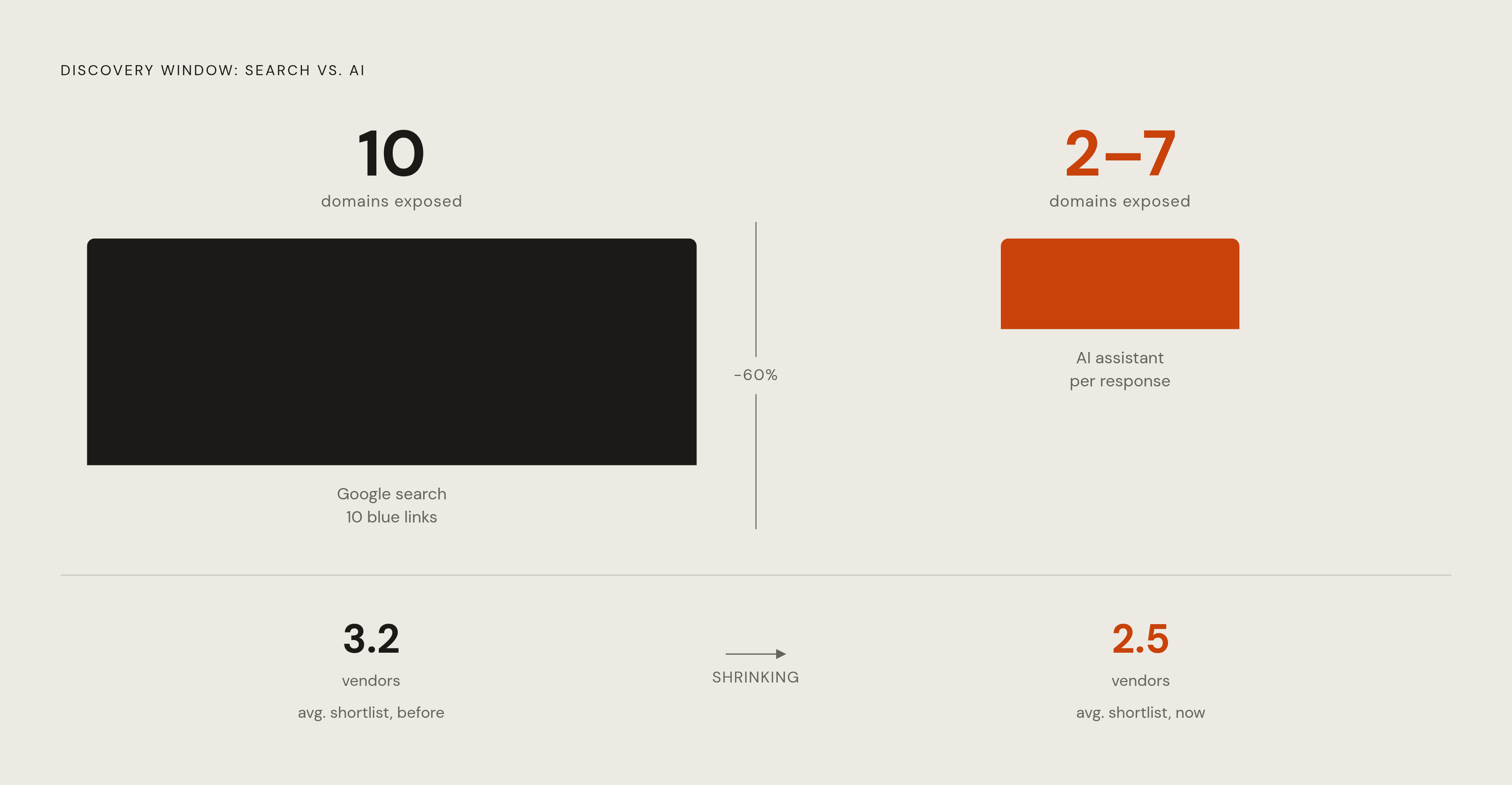
The mechanism matters because of what it does to vendors who miss the cut. If a vendor gets left off the AI's shortlist, it never enters the compressed, single-query candidate search that now replaces the old wide, multi-week process. It removes the vendor from consideration outright, because buyers do not go back and widen the pool once the AI has already answered their question. Large language models typically cite only two to seven domains per response, compared to the ten blue links Google has offered for years, so the discovery window for a vendor has narrowed by roughly sixty percent.
The data on what happens after that initial shortlist forms is stark. Geisheker's 2026 analysis cites 6sense data showing that the eventual winning vendor was already on the buyer's Day One shortlist in the vast majority of deals, and that the vendor who was the pre-contact favorite wins most of the time. The shortlist formed before any sales conversation is the deal itself. And that shortlist keeps shrinking: Geisheker cites Apollo data putting the average shortlist at approximately two and a half vendors, down from three point two just a few years earlier. Each tenth of a vendor removed from that average is a tenth of a vendor's worth of competitive space that no longer exists for anyone left out.
The most dangerous part of this shift is that it is invisible to the people it hurts. GrowthSpree's 2026 analysis documents what it calls the "form-fill collapse": most B2B buyers complete their research without ever filling out a form. The traditional marketing-qualified-lead signal used to tell a sales team when a buyer had entered consideration, but now it never fires. A vendor can lose a deal at the AI-shortlist stage and never know the deal existed. A DerivateX 2026 benchmark that ran more than a thousand buyer-intent prompts against a set of B2B SaaS companies found nearly half of them functionally invisible to AI buyers, present in the underlying training data but absent whenever a buyer searched by category or problem rather than by name. That gap between being known and being discovered is especially severe: models recognize established brand names with very high accuracy when asked about them directly, but recommendation rates drop by roughly thirty to one once the query shifts to a category or problem phrasing, which is how real buyers actually ask. A brand can be famous inside a model's training data and still lose every deal that matters, because nobody searches by the brand's name until after they already have a shortlist.
What determines AI assistant shortlisting
Shortlist inclusion is not random, and it is not bought. It follows a specific, identifiable set of off-site authority and content signals that have nothing to do with how polished a vendor's homepage looks or how much it spends on paid placement. Content freshness carries real weight: pages that have gone a long stretch without updates show a measurable decline in how often AI systems cite them, because recency functions as a proxy for whether a brand's information can still be trusted.
Gupta's guide notes that buyers, including CISOs evaluating security software, increasingly ask AI to synthesize analyst findings such as Gartner or Forrester placement rather than reading the full reports themselves, so that placement now functions as an input to AI citation rather than a final authority. That means a strong analyst placement now acts as raw material an AI model draws on when constructing its answer, rather than as the final authority a human reads directly.
The models do not agree with each other, and that complication cuts across all of this. Only a small fraction of the domains ChatGPT cites overlap with the domains Perplexity cites. A vendor that has built strong visibility on one platform can remain essentially invisible on another. No single optimization effort covers the whole landscape. Whatever a vendor does to earn citation, it has to account for the fact that the major AI assistants are drawing from different pools of material and weighting it differently.
How the compressed buying cycle changes vendor readiness before first contact
Once the AI shortlist has already formed, the research cycle itself compresses in a way that changes what the vendor's own website needs to do. GrowthSpree documents this as Behavioral Shift #4: buyers in 2026 skip the homepage entirely and land directly on case studies, pricing pages, comparison pages, and product feature documentation. The AI has already told them what the vendor does in general terms, so the website's job is no longer to introduce the vendor. Its job is to answer the specific evaluation question the buyer still has.
Behavioral Shift #5 extends this into the sales conversation itself. They are not looking for a walkthrough of the product. They want depth on the particular scenario they are evaluating, and that changes what an account executive's job looks like at first contact.
Winning the AI's shortlist does not finish the job. OneMetrik's 2026 report frames the buyer journey around a core principle: AI builds the provisional shortlist, but trusted evidence, reviews, community discussion, technical documentation, peer input, vendor proof points, and the sales conversation itself decide what actually survives validation. Geisheker's 2026 analysis cites Demand Gen Report 2025 data showing that industry expertise now outranks both price and product fit as the most significant factor in final vendor selection. The same authoritative, well-structured content that gets a vendor cited by an AI assistant in the first place is also what convinces the human buyer once they arrive. Vendors with slow-moving sales processes, whether that means multi-week demo scheduling, cumbersome pricing-request forms, or content locked behind gates, tend to drop off the shortlist before a salesperson ever makes contact, because the compressed cycle leaves no time for friction.
The content and authority strategy that improves a brand's AI citation rate
Improving a brand's odds of AI citation takes a coordinated approach across content architecture, off-site authority, and review-platform presence, rather than any single tactic executed in isolation, and the vendors treating all three as one connected system are already separating themselves from those still relying on traditional search optimization alone. That coordination starts with understanding that three distinct disciplines are now in play, each with a different target: search engine optimization still works toward rankings and clicks, answer engine optimization aims at the direct answers and snippets that appear in AI Overviews, and generative engine optimization aims specifically at citations and recommendations that show up inside the AI's generated response, measured by citation rate and share of model rather than by rank.
On the content side, format drives much of the outcome. Lists, tables, step-by-step guides, and FAQ sections are far more likely to get cited than the same information written as plain prose. Position on the page matters almost as much as format does: a large share of the citations language models pull from any given page come from its first portion, so the most citable material needs to sit near the top rather than buried after introductory framing. That research needs to start from the AI's own answers rather than a conventional keyword list. If you identify what the AI is getting wrong or leaving out, and build content that fills precisely that gap, you get material that satisfies a genuine reference need the model actually has, instead of content optimized for a search term no AI assistant weights the same way. None of this holds if the page goes stale. Content that sits unrefreshed for too long shows a measurable drop in how often AI systems cite it, which makes an ongoing maintenance schedule as important as the initial research and writing.
Review platforms and off-site authority complete the picture; they do not stand apart from it. The same signals that build credibility with a human buyer during validation, strong review profiles, technical documentation other sites reference, visible peer discussion, are the raw material AI models draw on when constructing an answer in the first place. Treating GEO, AEO, and traditional SEO as three separate, uncoordinated efforts misses the point that an AI assistant is pulling from all of it at once when it decides which three to five vendors a buyer sees first.