How AI Is Replacing Bank and Lender Comparison Sites
AI chatbots now answer financial questions before consumers reach comparison sites.
Bank and lender comparison sites built an entire business on a simple bet: consumers would search, click, and browse before they'd ever trust a single bank's own numbers. That bet is now failing. Generative AI has started answering the financial question before the consumer ever reaches a search results page, and the brands it chooses to name in that answer are the ones capturing the customer.
The consumer behavior shift that is already underway
The scale of this shift is no longer a forecast. According to ABA Banking Journal in 2025, 51% of consumers now turn to AI for financial advice. Separate 2025 data puts the broader number at 60% of U.S. adults who now use AI tools to search for financial information of any kind. Industry analysts predicted that traditional search engine volume would decline meaningfully by 2026, and by mid-2026 that directional shift has broadly materialized.
Forrester's banking-specific forecast is worth sitting with. It projects that by 2026, financial institutions will see human visitors to their websites drop 20% while machine-initiated traffic, meaning bots, AI crawlers, and agent-driven queries, rises 40%. That marginal reallocation of traffic is significant. It's a structural handoff from human browsing to automated retrieval, and it means banks are increasingly building websites for machines to read on a consumer's behalf rather than for the consumer to read directly.
The zero-click dimension makes the stakes concrete. A reported 93% of AI search sessions end without a single click to any website. The consumer asks, the AI answers, and the consumer acts, often without ever seeing a homepage, a rate table, or a disclosure page. A brand either got named inside that answer, or it didn't. There's no partial credit, and there's no second impression once the moment passes.
An analytics firm reported that AI referral traffic to retail sites rose sharply. retail sites grew by 4,700% year-over-year in 2025. That experiment has already found its footing. It's a channel scaling faster than any prior shift in digital consumer behavior, and it's arriving in banking at the same time the industry's own product cycles (mortgage rates, refinancing windows, HELOC demand) are highly time-sensitive and search-driven to begin with. The practical question for any bank or lender is no longer whether shoppers use AI. It's whether those shoppers run into the brand's name when the AI answers.
Which financial brands AI currently surfaces, and which it ignores
The intuitive assumption is that AI cuts out the middleman, that consumers now go straight from a chatbot to a bank's own page. The data says otherwise. AI is replacing comparison sites with banks. It's replacing comparison sites with comparison sites, citing them with even more force than organic search ever did.
Industry analysis of AI citations and brand mentions from May through September 2025 found NerdWallet.com cited in 10.14% of tracked financial services citations and Bankrate.com in 8.47%, the two most-cited domains in the entire high-traffic financial subindustry. Neither figure belongs to a bank. AI models reach for sources they judge trustworthy, broad in coverage, and built specifically to answer complex YMYL (your money or your life) questions, and a bank's own product page rarely meets that bar as well as a site whose entire purpose is comparison and explanation.
The surface area for this problem is large. Google's AI Overviews now appear on 25.8% of analyzed queries across the Financials industry overall, with financial services queries at 27.3%, banking queries at 26.2%, and insurance queries at 21.7%. That means roughly one in four financial searches is already resolved, at least in part, by an AI-generated summary before a traditional results page even loads.
Most brands aren't in that summary. Across categories, 73% of brands never appear in ChatGPT citations at all, even when they rank strongly in traditional search. Organic rank and AI citation are separate currencies, and one does not convert into the other automatically. Finance and insurance fares worse than almost anywhere else measured: the sector's citation rate sits at just 2.1%, the lowest of any industry analyzed. The gap between showing up in an AI answer and disappearing from one entirely is wider in banking than in almost any other business category.
The root cause traces back to the content itself. Of the financial pages analyzed, 36% were too thin or too poorly structured for an AI system to extract cleanly. 77% carried no visible publish or update date. Only 21.2% showed any author signal at all. AI systems tend to cite pages they can extract, date, and attribute to someone, and most bank content fails all three tests simultaneously. Legal and professional services offers a cautionary comparison, as that sector's zero-visibility share hits 86%, the highest of any category measured, and it's a preview of where financial services could land if these gaps go unaddressed. Banks chasing AI citations against NerdWallet and Bankrate are, in effect, still competing against the exact intermediary layer they used to pay for placement. The difference now is that AI citation can't be bought. It has to be earned through content that's structured well enough to be lifted and trusted enough to be quoted.
How the four major AI platforms decide which financial sources to cite
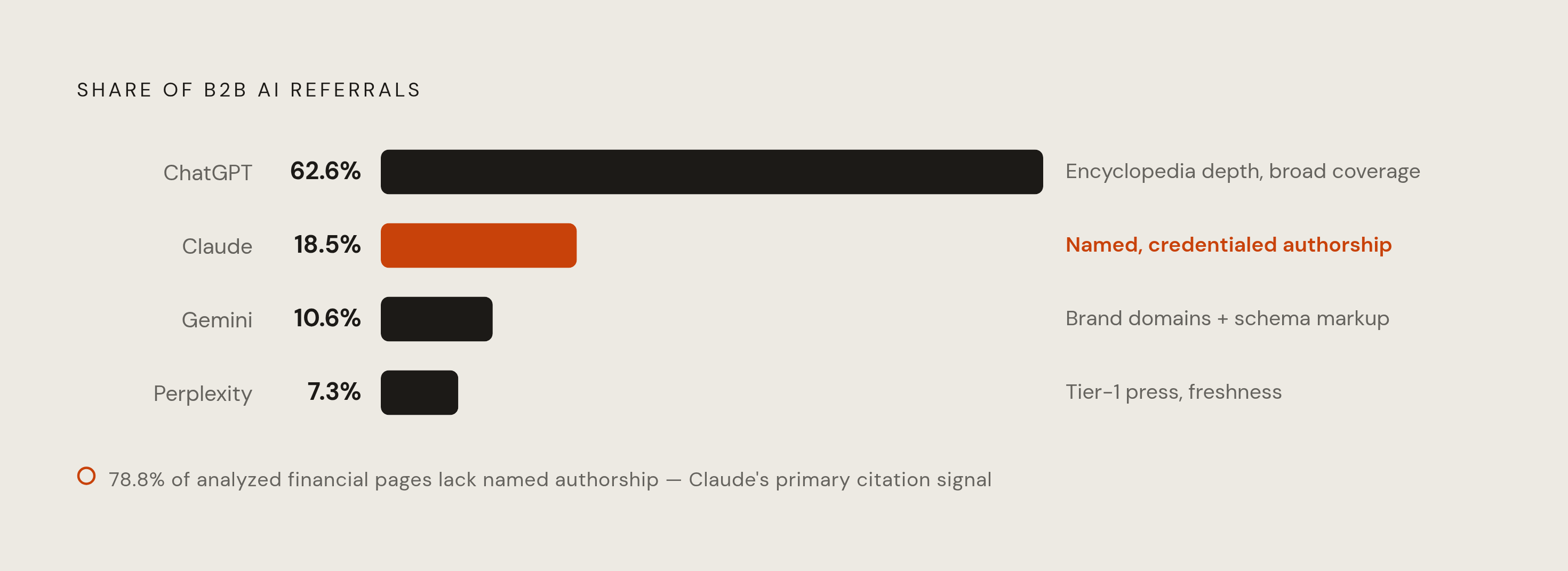
The AI referral landscape has splintered fast, and that fragmentation matters more for banks than for almost any other industry, because financial consumers research across multiple tools before committing. Per an industry traffic report, one model's share of measurable B2B AI referrals fell from 89% to 62.6% between mid-2025 and early 2026. In that same window, Claude climbed to 18.5%, Gemini reached 10.6%, and Perplexity landed at 7.3%. Only 11% of domains get cited by both ChatGPT and Perplexity, meaning a bank optimized for one engine can be functionally invisible on another.
Each platform runs on a different logic, and each demands a different kind of proof from a financial brand.
ChatGPT holds 62.6% share and reported 900 million weekly users in Q1 2026. It favors Wikipedia-style depth and leans on Bing's index for freshness. It also tends to paraphrase rather than cite, so its source attribution is harder to track than Perplexity's. For a financial brand, breadth of coverage and encyclopedia-level credibility carry the most weight here.
Claude, at 18.5% share, was the fastest-growing platform in the period measured. It rewards long-form, analytical writing from named, credentialed authors, and it's become a reference point specifically for senior professionals and knowledge workers, which makes it disproportionately relevant to B2B financial content. Named authorship and source-backed reasoning are the primary levers here, not volume of pages.
Gemini sits at 10.6% share and leans heavily on Google's own index. YouTube and Reddit show up as citation sources but only as minor players. Gemini favors brand-owned domains with strong schema markup, so structured data on product and rate pages is the specific lever that moves visibility on this platform.
Perplexity, at 7.3% share, privileges tier-1 financial press: Reuters, AP, Bloomberg, and the Wall Street Journal carry outsized weight here. It also prioritizes freshness and Reddit community discussion. Of the four, it offers the clearest conversion traceability, delivering a highly qualified audience of decision-makers with measurable click-through.
A bank publishing one format of content and hoping for uniform visibility across all four platforms will underperform on every one of them. Each engine wants a distinct signal, and treating AI visibility as a single undifferentiated channel is the same mistake as treating SEO and paid search as interchangeable.
What content AI citation engines actually extract from financial pages
The single strongest predictor of citation is structural. 72.4% of cited content includes a standalone answer placed immediately after the H2 heading, short enough that an AI system can lift it without parsing the rest of the page. This is the financial equivalent of a featured snippet, except now it's the entire interaction, not a preview of one.
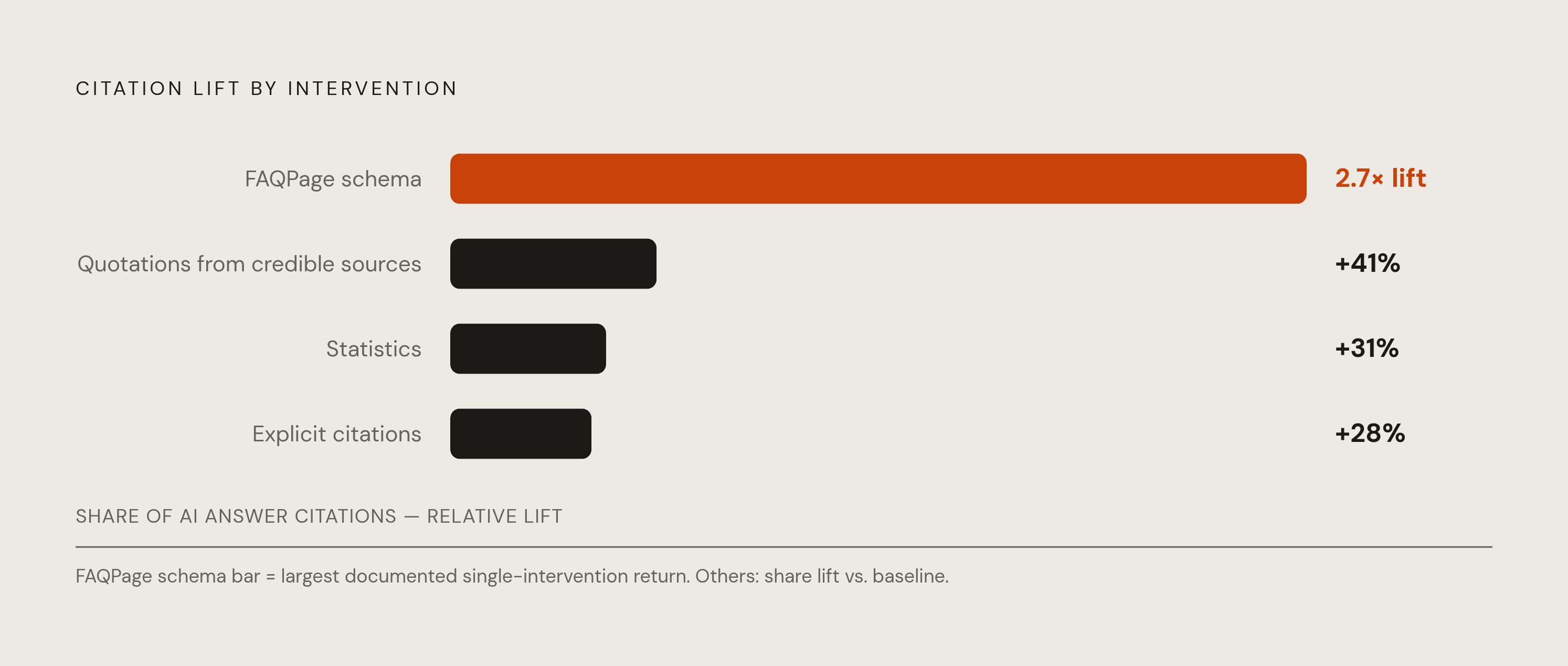
Relixir's 2025 analysis of 2,100 pages found that FAQPage schema markup correlates with a 2.7x higher probability of AI citation, the single most concrete technical fix available to a financial content team right now. Separately, research from Wellows found that quantitative claims get cited 40% more often than qualitative ones. For a bank sitting on proprietary rate data, approval percentages, or processing-time benchmarks, publishing those specific numbers directly on the page, rather than describing them in general terms, functions as a direct citation accelerator.
The GEO research from Aggarwal and colleagues quantifies which content moves add the most lift. Adding quotations from credible sources raised a source's share of the AI-generated answer by roughly 41%. Adding statistics raised it by roughly 31%. Adding explicit citations to other sources raised it by roughly 28%. None of these are difficult edits. They're closer to good editorial habit than technical overhaul.
Structure compounds these gains. Analysis of cited pages found that AI systems extract pages with clear H1, H2, and H3 hierarchies into summaries far more often than pages without that structure. Named authorship matters across every engine measured, and the 21.2% author signal rate found in analyzed pages is a gap most banks could close without touching the underlying content at all, just by adding a byline and a credential.
Freshness is the cheapest fix in the whole list. 77% of analyzed pages carry no visible date, which gives an AI system an easy reason to skip the page in favor of one that shows when it was written or updated. Beyond the page itself, schema types weighted across the major engines include Article, Organization, Person, FAQPage, Product, HowTo, and BreadcrumbList, and third-party validation, meaning consistent mentions across Reddit, G2, LinkedIn, and earned media, reinforces how confidently an AI system recognizes and recommends a brand across all four platforms at once.
None of this, however, is the whole story. GEO breaks down as roughly 80% strategic work, meaning positioning, ecosystem presence, and brand authority built over time, and only 20% technical fixes. The structural changes above are that 20%. The 80% is what the next section addresses.
Building AI share of voice as a measurable financial marketing metric
AI share of voice measures how often a brand gets mentioned, cited, or recommended inside AI-generated answers. It's a different animal from traditional share of voice, which tracks ad impressions and organic rank position. The structural difference matters: traditional rank exists on a continuous scale, position 1 through 100-plus, but AI citation is binary. A brand is either named in the answer, or it isn't. That binary quality makes the metric blunt, but it also makes it easy to explain to a board that has never had to sit through a ranking-distribution chart.
A workable measurement approach starts with defining 30 to 50 queries spanning category, problem, and comparison intent, phrases like "best HELOC rates," "how to refinance a mortgage," or "small business loan comparison," matched to the lender's actual product set. From there, select 3 to 5 direct competitors plus 1 or 2 aspirational benchmarks, run every query across ChatGPT, Perplexity, Claude, and Google AI Overviews, and record a simple 1-or-0 for whether each brand gets mentioned. Per-engine and blended scores follow from there, measured monthly with weekly spot checks in between.
The spot checks matter because AI output isn't stable. A meaningful share of brands visible in one AI response do not show up consistently in the very next response to the identical query. These are probabilistic systems, not fixed leaderboards, so one clean measurement a quarter tells a bank almost nothing about where it actually stands week to week.
The real value shows up at the product-category level. A bank that tracks AI share of voice can see precisely where it gets cited, mortgages, say, and where it's invisible, auto loans, or HELOCs, which turns a vague sense of "AI visibility" into a targeted content roadmap instead of a blanket content-production mandate. Platform-level tracking sharpens the diagnosis further: a brand present on Claude but absent on Perplexity is missing a specific signal, most likely tier-1 press coverage or Reddit presence, not suffering from some generic content weakness. AI share of voice is becoming the board-level metric that ties content spend to pipeline, the same way organic traffic once got tracked against SEO budget line by line.
What banks and lenders need to do now to compete in AI-driven discovery
None of this replaces SEO. Generative AI appears to be reshaping rather than simply replacing search behavior, which means banks need traditional SEO and a distinct layer for optimizing visibility in AI-driven results running at the same time, not a choice between the two.
The highest-return fixes are also the fastest. Start by auditing existing financial pages for the three most common blockers found in the research: no visible date, no named author, and thin or non-extractable structure. These are hours of work, not a rebuild, and they remove the most common reasons an AI system skips a page entirely. From there, add FAQPage schema to high-intent product and comparison pages, since the 2.7x citation lift is the single largest documented return of any individual intervention in the data. Pair that with an answer capsule (a direct, standalone answer placed right after each H2) on every priority page, matching the structure found in 72.4% of cited content.
Beyond the technical layer, publish the numbers competitors and AI systems can't manufacture on their own: actual approval rates, real rate ranges, honest processing times. That's first-party data no chatbot can generate from scratch and no competitor can copy without becoming a liar. Build named, credentialed authorship into financial content, since it moves the needle on Claude specifically and factors into every other engine's weighting too. And pursue coverage from Reuters, AP, Bloomberg, or the Wall Street Journal specifically with Perplexity's citation behavior in mind, since earned media at that tier isn't optional if full-platform coverage is the goal. Consistent brand signals across owned pages and third-party properties round this out, giving AI systems a cleaner basis for classifying and recommending the brand correctly.
FAQ optimization with proper schema tends to show measurable results within 4 to 8 weeks, making it the fastest-returning investment in the entire stack. And because only 11% of domains get cited by both ChatGPT and Perplexity, a strategy built around a single platform leaves most of AI-driven financial discovery uncovered by design, not by accident.
The window for building this kind of authority won't stay open indefinitely. Banks establishing AI citation credibility now are doing so while most competitors are still watching organic rankings alone, and the brands showing up in AI answers today are building the same kind of compounding familiarity with these systems that early domain authority once built in traditional SEO. That head start, once established, tends to be difficult and expensive to close.