AI-Mediated Provider Discovery in Telehealth and Online Healthcare
AI now mediates half of telehealth provider choices, reshaping how patients discover virtual care.

Patients now use AI to pick a telehealth provider at roughly twice the rate they did less than a year ago, roughly doubling in under a year, according to rater8. That single number reframes the whole discovery problem for healthcare brands: the gatekeeper between a patient and a provider is no longer a search results page, but a generated answer that may or may not name a provider at all.
Roughly half of the people rater8 surveyed had used a tool like ChatGPT, Claude, Perplexity, or Google's AI Overviews to research a provider, a sharp jump from the reading rater8 took just nine months earlier. The age breakdown is the part that should unsettle anyone assuming this is a younger-generation habit: the 45 to 60 cohort used AI for healthcare research more than any other group. The likely reason has nothing to do with tech enthusiasm. Google now drops an AI Overview into search results automatically, so patients in that age bracket aren't opting into AI, it's simply placed in front of them before they reach a blue link.
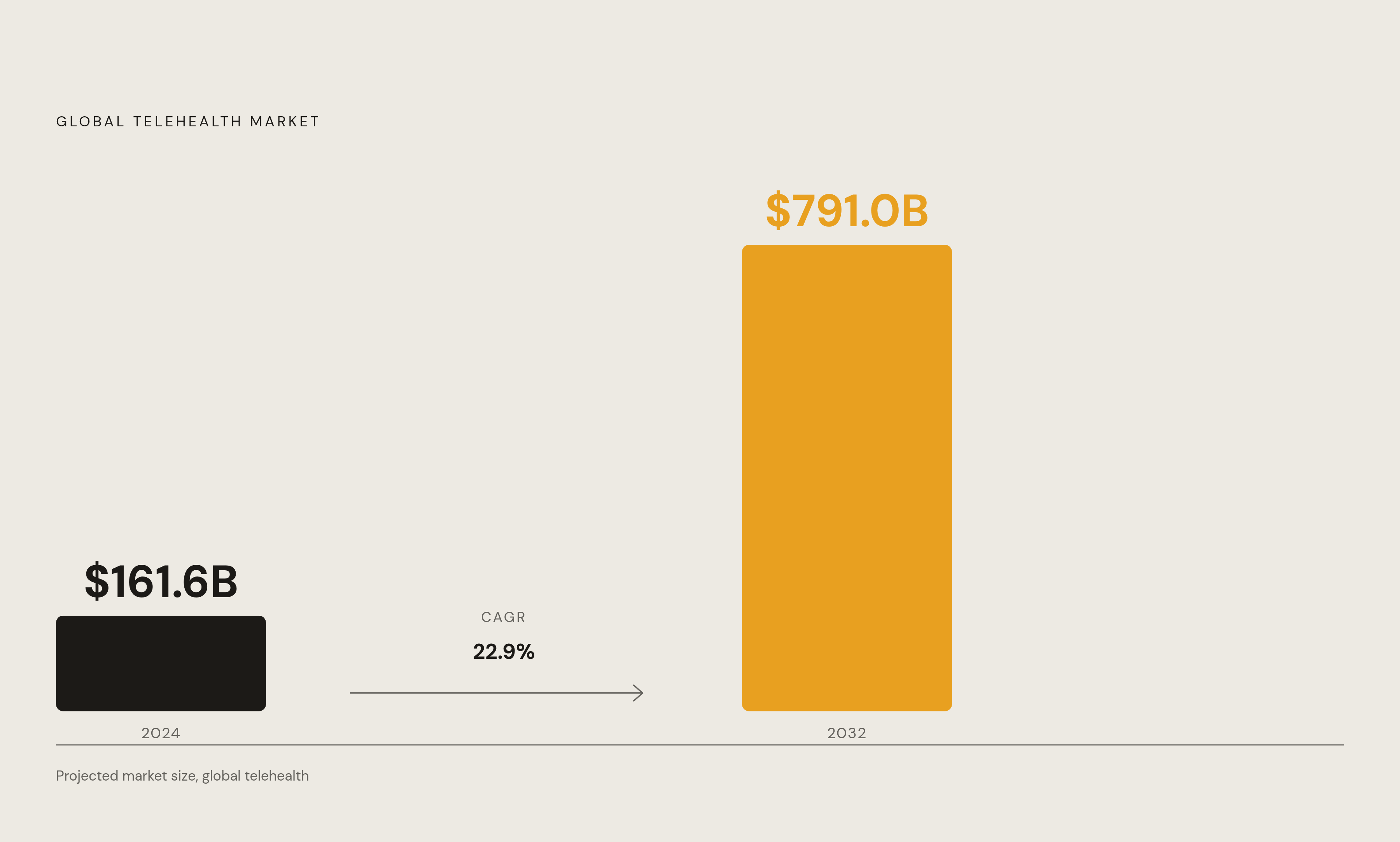
Telehealth sits at the sharpest edge of this shift. A patient picking a cardiologist down the street can lean on a waiting room, a referral from a neighbor, a building they drive past. A patient picking a virtual therapy platform or an online urgent care service has none of that. There's no proximity cue, no word-of-mouth loop, nothing but what the AI decides to surface. And the stakes are only getting larger: the global telehealth market hit $161.6 billion in 2024, according to Fortune Business Insights, and is projected to grow at a 22.9% compound annual rate to $791.0 billion by 2032. That's a lot of decisions being routed through a system most healthcare brands haven't thought to manage.
What AI is actually doing inside telehealth, and what it is not
Two separate things get lumped together under "AI in healthcare," and the conflation causes real strategic confusion. The first is clinical and operational AI: remote patient monitoring, ambient documentation that drafts clinical notes, triage assistants, tools that flag which imaging scan needs a radiologist's eyes first. This layer supports clinicians. It does not replace them, and it isn't talking to patients about which provider to choose.
The second layer is discovery and recommendation AI, the large language models and AI-powered search tools answering a patient's question about which telehealth platform, therapist, or specialist to use. That's a different animal entirely, trained on web content, reviews, and third-party mentions rather than on a health system's electronic health records or internal quality metrics.
The clinical side has real, measurable results behind it. Mayo Clinic's Continuous Vital Sign Monitoring system cut hospital readmissions by 40%, generating up to 26 tailored intervention recommendations per patient, and for high-risk patients the number needed to treat to prevent one readmission is just 11, according to figures reported by Netguru. More than 97% of healthcare professionals now use some form of telemedicine tooling. Devices like KardiaMobile let patients capture an ECG at home; platforms like Ada run digital symptom triage; Augmedix drafts clinical documentation from ambient audio; Artisight uses sensor and computer-vision technology for virtual nursing coverage.
None of that helps a patient find a provider in the first place. A health system can run the most sophisticated remote monitoring program in the country and still be invisible, or worse, misdescribed, the moment a patient types a question into ChatGPT. Optimizing for AI-mediated discovery is a separate discipline from deploying AI in clinical workflows, and treating them as the same problem is how healthcare marketing teams end up solving the wrong one.
Why the review ecosystem is now the raw material for AI recommendations
When an AI model answers "which telehealth provider should I use for anxiety treatment," it isn't consulting a licensing board. It's pulling from the same scattered pool of reviews, mentions, and reputation signals a human patient would dig through manually, except it compresses all of that into one confident-sounding answer.
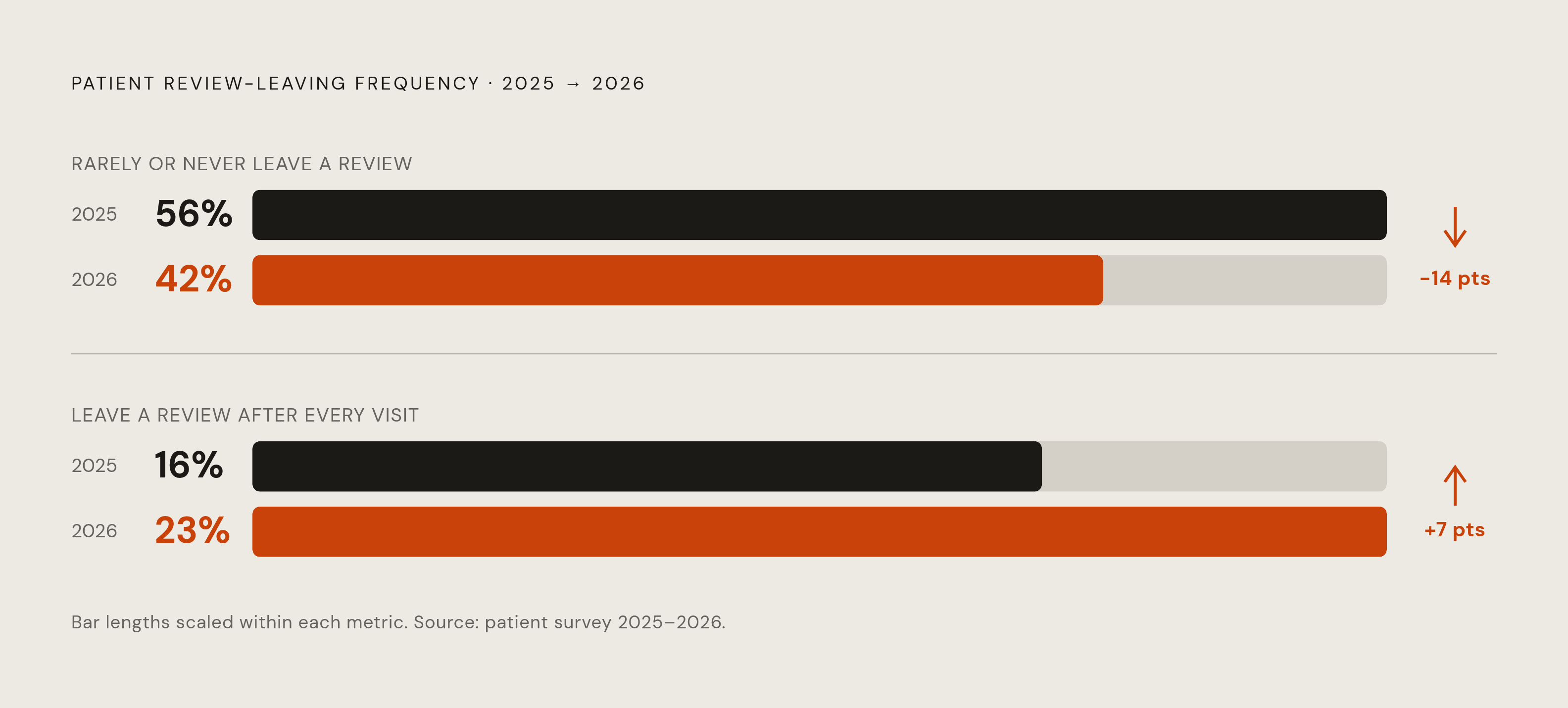
Patients have gotten pickier about the raw material feeding that pipeline. Per rater8's 2026 data, a large share of patients won't consider a provider below certain star-rating thresholds, and many won't book below 4.5. More than half, roughly half say they've avoided or canceled with a provider specifically because of what they read in reviews, a figure that has risen meaningfully over the past year. Review volume itself is climbing too: the share of patients who say they rarely or never leave a review dropped from 56% to 42%, while the share who leave one after every visit rose from 16% to 23%.
Here's the part that should matter most to a marketing director: research on AI citation patterns has found that brand web mentions are among the strongest predictors of whether an AI model cites a brand. Reviews aren't just a reputation exercise anymore. They're direct input into whether a patient asking an AI tool for a recommendation ever hears a provider's name. A clinic with excellent outcomes and a thin, inconsistent review footprint is likely getting passed over, or described inaccurately, by the exact systems increasingly deciding who gets found. Reputation management and AI visibility strategy aren't two departments. They're one pipeline wearing two names.
Where AI-mediated discovery breaks down: hallucinations and outdated information in healthcare contexts
AI gets things wrong, and in healthcare, wrong is expensive. AI tools have been observed giving patients incorrect office addresses and hours, the kind of basic factual error that happens at the exact moment a patient has decided to act.
The failure patterns repeat in a few predictable ways. Entity confusion, where a model attributes the wrong founder, wrong location, or wrong service line to a provider. Fabricated clinical claims or invented service guarantees, produced when the training data on a given provider is too thin for the model to work with and it fills the gap with something plausible-sounding. Fake citations, where a model references a clinical study or endorsement that doesn't exist. Outdated policy information, where insurance terms or telehealth availability get presented as current long after they've changed.
None of this gets blamed on the AI. A patient who shows up to a locked office because a chatbot gave the wrong hours blames the provider, not the model that misled them, and trust lost that way in healthcare is unusually hard to win back. The stakes compound because of how much ground AI now covers in medical search: by late 2025, roughly 44% of medical "Your Money or Your Life" queries triggered an AI Overview, per SE Ranking, meaning AI is actively summarizing health and provider information at enormous scale. Hallucination rates differ across models and how you measure them, and no major LLM has solved the problem outright. The practical lesson for a telehealth brand is straightforward: sparse, inconsistent, or contradictory information online gives a model more room to guess, and every guess is a chance to get something patient-facing wrong. The fix isn't reactive monitoring after the fact. It's making sure the source material is precise and consistent enough that the model has nothing to interpolate.
How AI search has structurally changed which healthcare providers get found
AI Overviews now show up in roughly a quarter of all Google searches as of early 2026, a sharp climb from a year prior, and, again, in a substantial share of medical queries specifically. That alone would be a big structural shift. What makes it more disruptive is how unstable the citations underneath those answers turned out to be.
When Google switched AI Overviews over to Gemini in January 2026, a large share of the domains previously cited in those answers got replaced. The overlap between a page's position in standard organic search results and whether that same page gets cited in the AI Overview weakened considerably. In plain terms: a telehealth provider that spent years earning a strong Google ranking can watch that ranking become irrelevant overnight, because the AI-generated answer above it is pulling from an entirely different set of sources.
Analysts had predicted meaningful declines in traditional search engine volume by 2026, and by the middle of this year that directional shift had become apparent. AI search traffic grew substantially year over year, and this isn't a fringe audience experimenting with a novelty tool. It's the main way a growing share of patients now research care.
The number that should concentrate the mind of every telehealth marketing team: the large majority of AI search sessions end without a click to a website. The AI-generated answer is the discovery moment, full stop. If a provider isn't named in that answer, no amount of polish on the landing page ever gets seen, because the patient never leaves the chat window. Research on AI citation patterns suggests average brands appear in only a small fraction of relevant prompts, while the strongest performers appear far more consistently. That gap, between one-in-five and one-in-two, is the entire opportunity.
What GEO and AEO mean specifically for telehealth and healthcare brands
Generative Engine Optimization, or GEO, is the practice of structuring content and brand presence so that AI systems actually cite and recommend a brand inside a generated answer. It's a different target than traditional SEO, which optimizes for a ranked link a human clicks. Answer Engine Optimization, or AEO, is closely related: making sure a brand's content is the source an AI engine reaches for when it needs a specific fact, a definition, or a direct recommendation, covering everything from featured snippets to knowledge panels to the AI Overview itself.
For a telehealth brand, this means publishing expert-reviewed content detailed enough that ChatGPT, Perplexity, Google's AI Overviews, and Gemini can quote it accurately when a patient asks about symptoms, treatment options, providers, cost, or insurance coverage.
Format turns out to matter more than most marketing teams expect. Large language models are observed to pull data out of tables more readily than out of prose paragraphs, so anything comparing conditions, insurance options, or service lines belongs in a table, not a paragraph describing the same information. FAQ blocks marked up with proper schema correlate with meaningfully higher odds of AI citation, according to a 2025 analysis from Relixir. A GEO study out of Princeton, conducted with researchers from Georgia Tech, the Allen Institute for AI, and IIT Delhi, and presented at ACM KDD 2024, found that simply adding citations, statistics, and direct quotations to existing content boosted AI visibility by 30 to 40%, without writing a single new page.
The practical version of this for a telehealth brand is service-line mapping: figuring out exactly what patients ask about each service (symptoms, costs, recovery timelines, insurance coverage) and building one expert-reviewed page per question set. That shrinks the surface area available for a model to hallucinate over. And because this is healthcare, compliance can't be an afterthought bolted on at the end. Legal and compliance teams need to review GEO content alongside marketing, checking that patient-facing pages respect privacy rules, avoid promising outcomes they can't guarantee, and stay current with clinical guidance, because outdated or overreaching content invites regulatory risk on top of the AI misrepresentation risk. GEO, at its core, is a strategic exercise in consistency across a website, a blog, third-party mentions, and reviews, not a narrow technical fix.
Measuring AI share of voice in healthcare: the KPI most telehealth brands aren't tracking yet
AI Share of Voice measures something a keyword ranking report never could: whether AI models actually trust and recommend a brand, not where that brand sits on some continuous ranking scale. Citation is binary. A provider either gets named in the AI's answer or it doesn't, and a provider sitting in position four on Google next to a provider with zero AI citations look identical once patients stop clicking through search results and start reading generated answers instead.
Measuring this well takes some structure. Define somewhere between 30 and 50 queries spanning category questions (telehealth, virtual primary care, online therapy), problem-based questions (specific symptoms, chronic condition management), and direct comparison questions. Pick out direct competitors plus one or two brands worth aspiring to. Run every query across ChatGPT, Perplexity, Claude, and Google's AI Overviews, and log a simple binary: mentioned or not, for each brand, on each engine. From there, calculate share of voice per engine and a blended score across all of them. Getting to a number that's actually reliable takes 50 to 100-plus query variations, and because AI answers are probabilistic rather than fixed, many brands that show up in one response do not reliably reappear in the very next response to the identical query. That volatility means a monthly measurement cadence with weekly spot checks, not a quarterly report that goes stale before anyone reads it.
Fragmentation across platforms is the risk most teams miss entirely. A telehealth brand can be well cited on ChatGPT and functionally invisible on Gemini, and a single blended score hides that gap completely unless it's broken out engine by engine. Sentiment matters just as much as frequency: an AI response can cite a brand while drawing from a bad review or an unflattering competitor comparison, so tracking whether a citation is favorable matters as much as tracking whether it happened at all, especially in a category where trust is the entire purchase decision. And visibility isn't a steady-state metric. Model updates, like Google's January 2026 switch to Gemini 3, can reorganize the entire citation landscape overnight. This isn't something to check once a quarter. It's ongoing infrastructure, the same way uptime monitoring is.
The content and brand signals that telehealth providers need to build now
Brand web mentions remain the strongest single predictor of AI citation, per the SE Ranking study of 129,000 domains, which means third-party coverage, industry directory listings, mentions in health publications, and earned media all function as the infrastructure a model draws on when deciding what to cite.
The practical priority list is short but demanding. Build expert-reviewed condition and service pages, structured with real headings, FAQ blocks, and comparison tables, each one mapped to a specific question patients actually type into a search bar or an AI chat window. Keep entity information (name, address, hours, services offered, insurance accepted) identical across every channel a brand controls, because those exact details are the ones AI tools most commonly get wrong. Implement FAQPage schema markup, which the Relixir 2025 analysis ties to meaningfully higher citation odds. Embed real statistics and primary-source citations directly into content, since a study on generative engine optimization found this among the highest-leverage tactics available for lifting AI visibility.
Physicians have already moved on this. Roughly two-thirds were using AI in clinical practice by 2024, according to an American Medical Association study of more than 1,000 physicians, nearly double the share from the year before. The clinical side of the profession has acclimated to AI at a pace the patient-facing marketing side hasn't matched.
Most telehealth brands haven't audited their AI citation profile even once, let alone built a program to manage it. That gap is the opportunity. Whoever moves first on structured, accurate, consistent content will entrench a citation advantage before competitors even understand what shifted underneath them. The end state worth building toward isn't a lucky mention in a chatbot's answer. It's a telehealth brand that AI models cite accurately, favorably, and specifically, every time, because the content and reputation signals behind it left the model nothing to guess at.