AI Shopping Journey Changes for Apparel and Accessories Brands
Brands must now choose between competing AI protocols to remain visible in shopping queries.

The apparel purchase journey no longer starts with a search bar. It starts inside a conversation with ChatGPT, Perplexity, Google AI Mode, or Gemini, and that single change breaks most of how fashion brands have built their discovery strategy up to now.
How the apparel purchase journey has structurally changed
The new path runs from a full sentence typed into an AI platform straight to a response that either includes a brand or leaves it out entirely. Shoppers now type complete requests, naming color, material, a price ceiling, and a delivery deadline, into ChatGPT, Perplexity, Google AI Mode, and Gemini, rather than typing broken-up keyword fragments into a search engine. That shift matters more for apparel than for most retail categories, because a query like that maps directly onto the structured attributes a product catalog already tracks: color, material, price, size. That clean mapping is why apparel has become one of the highest-converting categories for AI shopping traffic. Shoppers who arrive through an AI referral convert at notably higher rates than shoppers arriving through ordinary human-driven channels, and the volume of AI-driven retail traffic grew sharply year over year, numbers that rule out any reading of this as a niche behavior confined to early adopters. McKinsey's State of Fashion 2026 report says AI in fashion has passed the point where it offered a competitive edge, and it's now a basic requirement for running the business.
The infrastructure that now controls which brands get recommended
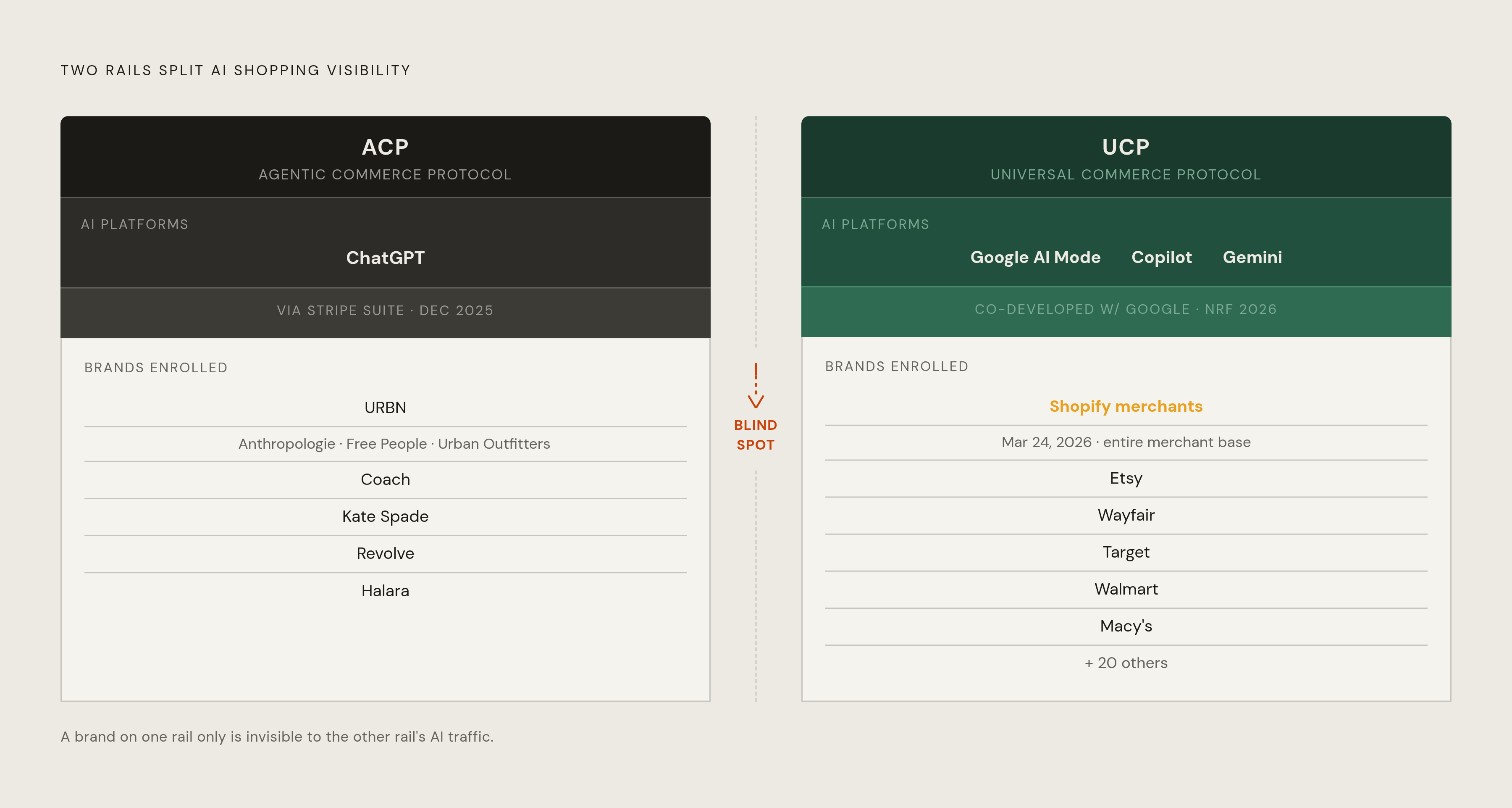
A plumbing decision drives that shift in shopper behavior, and it produces a split most fashion brands haven't resolved yet: which protocol rail to build on. Two competing protocol rails, the Agentic Commerce Protocol (ACP) and the Universal Commerce Protocol (UCP), now decide which fashion brands an AI agent can even surface, recommend, or transact with, and sitting outside both is functionally the same as being delisted from search. The URBN family of brands (Anthropologie, Free People, Urban Outfitters), along with Coach, Kate Spade, Revolve, and Halara, ship through the Stripe Agentic Commerce Suite, which launched in December 2025. Shopify extended its own Agentic Storefronts in March 2026, going live for all eligible US merchants on March 24, 2026, covering ChatGPT, Microsoft Copilot, Google AI Mode, and Gemini through one panel in Shopify Admin, enrolling merchants at scale without requiring them to build anything themselves. On the UCP side, Google named Shopify, Etsy, Wayfair, Target, and Walmart as co-development partners at NRF 2026, and Macy's endorsed UCP at launch alongside more than 20 other retailers. Enrollment and catalog quality together still don't guarantee a brand shows up once a shopper asks a question. Enrollment opens the door, but catalog quality decides whether an enrolled brand actually appears in the results an AI agent returns. A brand that optimizes only for ACP, the rail ChatGPT runs on, misses the traffic moving through Google AI Mode and Microsoft Copilot, both of which run on UCP. Microsoft itself adopted UCP in April 2026. A brand connected to only one rail is visible to only part of the AI shopping market, no matter how well its catalog performs on the rail it did join.
Gap Inc.'s "LLM-Layer" Investment
Gap Inc. is the clearest evidence that this is no longer a theoretical shift. The company became the first major fashion business to make checkout work inside a conversational AI interface, so a purchase can now start and finish without the shopper ever leaving the AI platform. At Shoptalk Spring 2026, Gap announced two new AI capabilities: personalized fit guidance through Bold Metrics' Agent Sizing Protocol, and support for Google's Universal Commerce Protocol. That second piece let Gap become the first major fashion company to launch checkout inside Google's Gemini. Gap's Chief Technology Officer, Sven Gerjets, described the project as a response to concrete customer problems, fit confidence and the difficulty of completing a purchase, rather than a novelty exercise. That framing lines up with how the company built the thing: on unified Google Cloud data, AI-ready architecture, and governance discipline, treating AI as part of how the business runs day to day rather than a side project bolted on for a press release. Gap isn't alone in moving on this timeline. Macy's and Frasers Group launched their own AI agents in the same window, and Levi Strauss launched an internal AI analytics platform in late April 2026, so this reads as an enterprise-wide wave, not one company's experiment. The competitive stakes are straightforward to state. When a shopper asks Gemini for a recommendation and Gap's products are ready for checkout inside that response, any competing brand that forces the shopper to leave the AI interface and click through to a separate website has already lost ground before the shopper even sees its product.
Catalog Data Quality as the Rate-Limiting Factor for AI Visibility
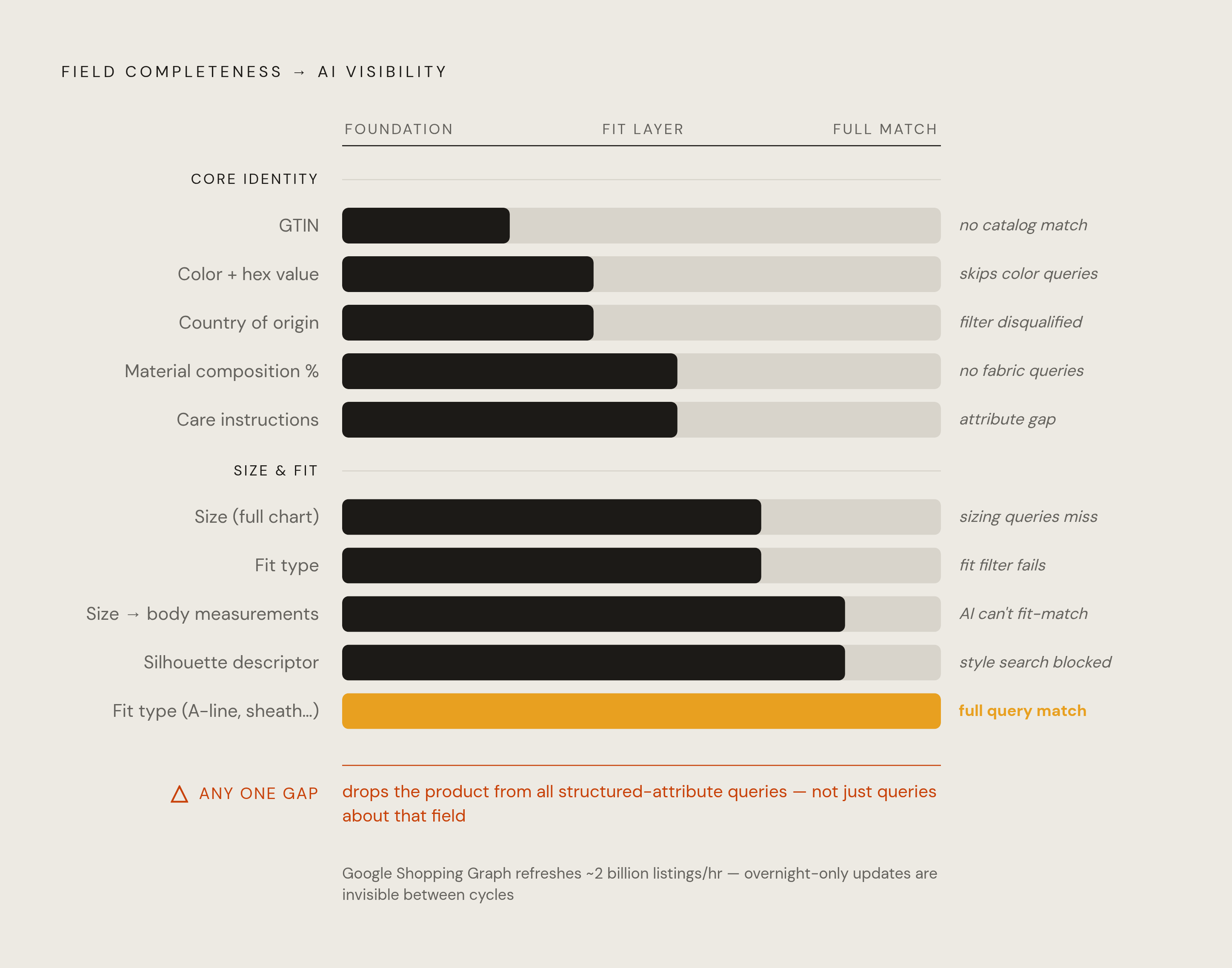
Getting onto a protocol rail is the easy part. Most brands that enroll in ACP or UCP still don't show up in AI responses, because thin or outdated catalog data keeps them out of the response even after the infrastructure connection is live, and apparel's data demands are steeper than almost any other retail category. An AI agent matching a shopper's request against a product catalog needs size listed as a full chart rather than a vague S/M/L label, color given with a hex value wherever possible, material composition broken down by percentage, a fit type, care instructions, country of origin, and a GTIN. Leaving any one of those fields blank drops the product out of matches for queries built around structured attributes. Freshness carries just as much weight as completeness. Google's Shopping Graph refreshes roughly two billion listings every hour, and AI agents weight that freshness heavily, so if a brand's feed only updates overnight, it is effectively invisible to any shopper searching during the hours between refreshes. Cleaning up structured attributes, fixing real-time inventory feeds, and validating that data distributes correctly across every protocol it touches takes most fashion brands two to four weeks, before any of this appears materially in AI agent results. Fashion's own sales patterns make inventory accuracy harder to maintain than in slower-moving categories. If a sold-out size still shows as available, or a seasonal item lingers past its sell-through window, that doesn't just hurt that one variant. It gets the whole product pushed down in AI agent rankings, and apparel's high SKU turnover makes stale inventory a sharper problem here than in categories that move at a slower pace. Product titles compound the issue. A title written for a lookbook, something like "Effortless Summer Statement," gives an AI agent nothing to match against a shopper typing "white linen midi dress." Titles need to be structured and literally descriptive of the product, with the marketing language moved down into the description field where it belongs.
How size and fit data shapes the AI narrative about an apparel brand
Fit sits at the center of both problems at once. It's the single most common reason an AI agent fails to match a product to a query, and simultaneously the dominant signal large language models use when they form an opinion about a brand's quality, which makes it the single highest-leverage fix available to any apparel brand. Fit and size make up the largest topic in apparel reviews by volume, and industry data puts 70% of online apparel returns down to size or fit problems, with most of the fit-specific reviews running negative. Large language models build their picture of a brand by aggregating exactly this kind of user-generated content, so a brand carrying a large volume of negative fit reviews is, without intending to, teaching AI systems to describe it badly. Bold Metrics built a response to this directly into the infrastructure layer: an Agentic Sizing Protocol, a lightweight, token-optimized protocol reachable through standard APIs, that lets an AI shopping agent ask a shopper a short set of questions and return a personalized size recommendation in real time. The catalog side of the problem is just as concrete. An agent trying to match "size 6 dress with hourglass cut" needs that size mapped to actual body measurements, a fit type such as A-line, sheath, or fit-and-flare, and a silhouette descriptor attached to the product. Most fashion catalogs stop at the surface size field and never build out the rest.
What content format AI platforms pull from, and what apparel brands are publishing instead
Most fashion brands are writing content in a format that large language models can't easily extract from. The narrative, emotive, image-led brand storytelling that fills most style editorials doesn't lend itself to citation. What gets pulled is structured lists, plain definition sentences, statistics stated directly, and FAQ blocks, formats that remain underused across fashion content even though they're the ones doing the work. The 2025 holiday shopping cycle showed how far that gap has gone: nearly every fashion citation appearing on Gemini during that period pointed to non-retailer sources, editorial sites and user-generated content, rather than anything brand-owned, a sign that most brand content simply isn't built in a form AI systems can extract. Freshness decays fast on top of that. If content goes untouched for more than a week or two, it shows a real drop in how often it gets cited, so core content needs updating on a short, regular cycle rather than being published once and left alone. The content gap in apparel concentrates in three specific places: fit and sizing, where structured FAQ content is the direct fix; editorial and style authority, where brands are losing ground to non-retailer editorial sources that are simply better structured for citation; and UGC reputation management, where LLMs are synthesizing review content that no one at the brand is actively shaping.
Why third-party authority signals determine whether AI trusts a fashion brand
AI platforms don't take a brand's word for its own credibility. They build it from an ecosystem of third-party signals, review platforms, Reddit, Wikipedia, Wikidata, industry directories, and fashion brands that treat those channels as secondary marketing real estate are losing authority in the exact place AI systems are actually looking. Domains with a presence on review platforms like Trustpilot show dramatically better odds of being cited by ChatGPT, and one study found that when brands actively managed those profiles, their citation rates climbed sharply. Brands with a substantial mention presence on Reddit and Quora have shown considerably higher citation probability in some studies as well, though ChatGPT's share of citations drawn from Reddit has dropped sharply since mid-2025 and varies a great deal by platform. Reddit, Wikipedia, and YouTube (through its transcripts) are sources large language models pull from heavily, and Reddit's enormous daily active user base keeps generating brand conversation that LLMs continuously index and fold into their sense of a brand. None of this runs on keywords. AI systems think in entities and the relationships between them, so for an apparel brand, that means consistent information across Wikidata, Wikipedia, and industry directories is what lets an AI system actually verify and trust the brand's data rather than guess at it. The technical layer matters too: homepage Organization schema needs to include, at a minimum, an @id, name, founding date, description, URL, and sameAs links out to authoritative profiles on LinkedIn, Google Business Profile, Crunchbase, and Wikidata, since conflicting information scattered across those sources raises the odds of an AI system simply hallucinating details about the brand. A Brand Facts page, published at one canonical URL and covering the legal company name, founding year, headquarters, product lines, pricing range, and what the brand explicitly does not offer, written in plain language an AI crawler can parse, works as a direct check against that kind of misrepresentation. Where a brand's entity confidence runs low, whether from a confusing website structure or inconsistent profiles scattered across third-party platforms, the brand loses the one thing every stage of this new journey depends on: an AI system's confidence that it knows who the brand actually is.