AI Search Influence on Financial Product Comparison Journeys
AI now dominates financial product decisions before consumers even search.

A consumer shopping for a credit card or an investment product used to move through a sequence: search, open a handful of tabs, compare rates and fees across them, return to search with a narrower question, and decide. That sequence has folded into a single exchange. A consumer now asks an AI platform something like "Which investment product suits a 30-year-old with moderate risk appetite?" and receives a synthesized answer in one pass, no tabs required. The shift is from keyword search toward nuanced, conversational financial questions put directly to AI platforms.
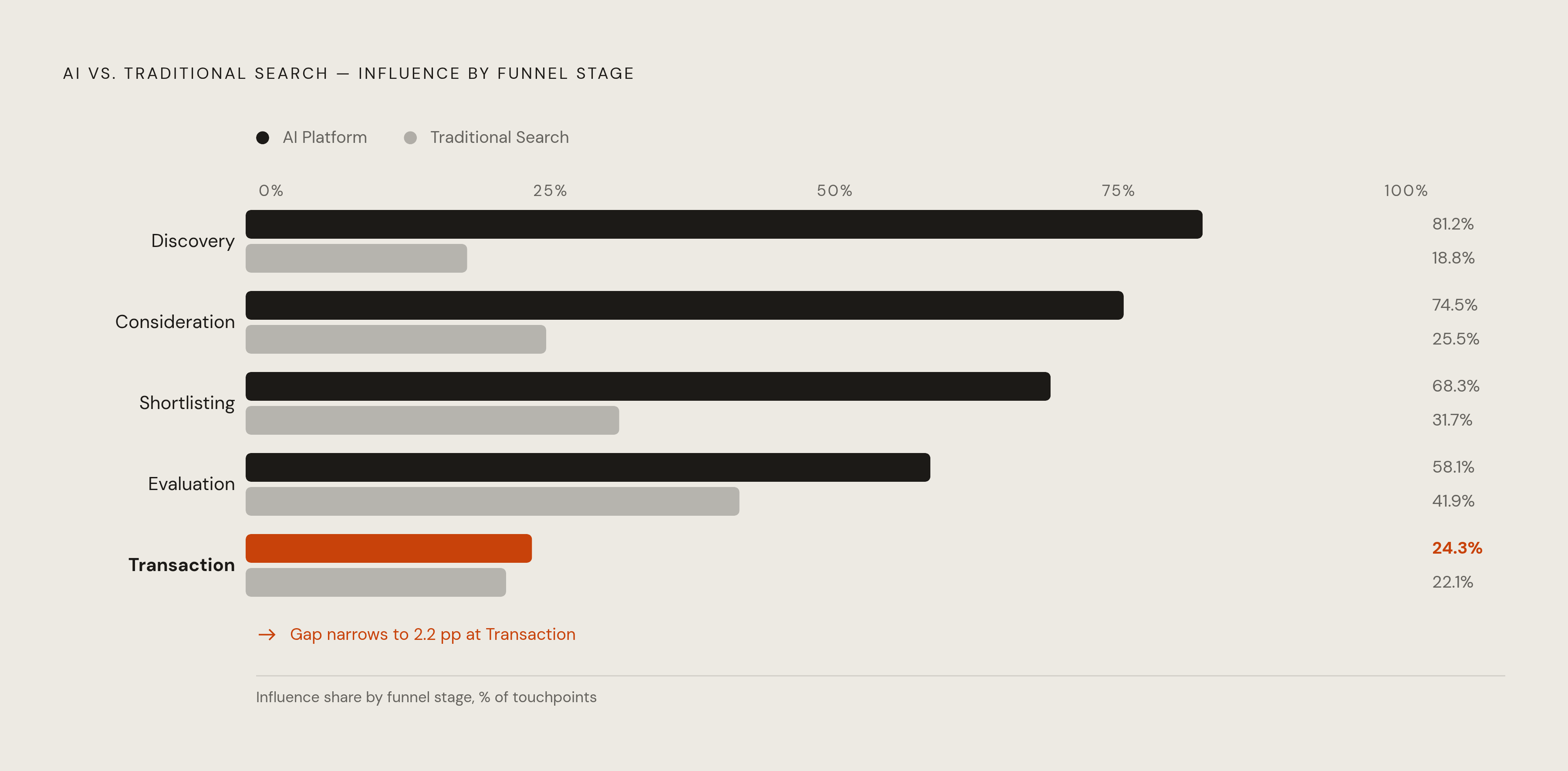
Similarweb's 2026 AI Brand Visibility Index finds that AI now leads traditional search at every stage of the funnel, including the final purchase step, though the margin there is thin: 24.3% for AI against 22.1% for search at the transaction stage, with discovery, consideration, shortlisting, and evaluation all now dominated by AI rather than by search or by brand sites.
The consequence for brands is structural. A financial brand absent from that single AI exchange does not lose a click the way it might have lost a search ranking a few years ago. It is excluded before the consumer's decision has even formed. Every section that follows works through why that exclusion happens, where it happens, and what a brand has to build to avoid it.
Why financial products are exposed to AI-driven funnel compression
Financial products sit at the extreme end of a pattern that holds across categories: the more complex and time-consuming the comparison, the more willingly a consumer hands that comparison to an AI. Consumer Finance Monitor notes that an AI agent could compare thousands of offerings in seconds and execute a transaction a consumer might never have attempted alone, simply because of the time and complexity the task demands.
Adoption data backs this up in a way that should unsettle anyone still treating AI chatbots as a secondary channel. Plaid's State of Intelligent Finance Report found that 35% of people now turn to general AI chatbots for financial guidance, more than turn to dedicated financial planning apps built for that exact purpose. That's a reversal of the hierarchy most financial brands still plan around, where purpose-built tools were assumed to beat general-purpose ones for anything this specific.
None of this means consumers have stopped checking AI's work. AI's purchase-influence rate in financial services runs lower than in retail, because these decisions carry more risk, so they still get a human look before money moves. That gap reflects a behavioral habit. The willingness to delegate the comparison itself, the hard part, is already present and growing, even while the final decision stays in human hands for now.
Switching cost turns delegation into real competitive pressure. Consumers stay with a bank, a card issuer, or an insurer for reasons that often have nothing to do with product quality: switching is tedious, paperwork-heavy, and easy to postpone. An agent that handles the comparison and the account switch on a consumer's behalf removes that inertia. Every incumbent that relied on friction to keep customers in place now faces a market where friction has mostly disappeared.
Where the funnel breaks: mid-funnel comparison content
The comparison guide, the buying guide, the feature-by-feature breakdown, the aggregator page: these formats built the financial content industry, and they are the formats under the most direct pressure right now. When a consumer can ask an AI platform to "compare the best no-fee credit cards for someone who travels monthly" and get a structured answer back immediately, the page that used to capture that visit gets bypassed before the consumer ever sees it.
The traffic numbers confirm that this isn't a marginal shift. Similarweb's Generative AI Landscape report puts Finance among the categories with the strongest AI-driven traffic growth, and AI referral visits are up 236.5% year-over-year. That looks, on its face, like a win for anyone publishing financial comparison content. AI platform visits have grown sharply, but referral traffic sent from those platforms back to brand and publisher sites has stayed flat. AI is absorbing more of the consumer's attention while sending less of it downstream. Financial brands are increasingly feeding a system that doesn't feed them back.
That single conversational exchange is where financial brands now win or lose visibility entirely, and tracking which AI platforms are surfacing a brand's content, and which are quietly excluding it, requires monitoring built for that purpose rather than a retrofit of old search analytics. Athenahq's AI search optimization tools are built to track brand mentions and citation presence across multiple large language models at once, which gives financial services teams a way to see where they show up in those recommendations and where they don't.
For aggregators and price-comparison platforms specifically, the pressure is closer to existential. They built their whole business case on synthesizing a confusing market for a confused consumer. Now AI performs that synthesis directly, without routing the consumer through a comparison site.
Search hasn't disappeared from the picture; it has moved to the end of it. Similarweb finds the AI-vs-search gap narrows sharply at the purchase stage, because consumers still return to a search engine to navigate to a specific provider, confirm a rate, or finish an application. But that search activity now executes against a shortlist AI already built. Brands left off that shortlist aren't competing for the final search click at all, because that click only exists for brands an AI system has already recommended.
Brand scale does not predict AI inclusion, the finance sector data shows
If funnel compression were simply a redistribution of attention toward the biggest, best-known brands, it would be a manageable problem: scale would still win, just through a different channel. The data says otherwise. Across every financial sub-sector examined, AI visibility does not track with brand recognition, marketing budget, or customer base, and the gap between the leader and its nearest competitor in each sub-sector is wide enough to count as a structural disadvantage, not a rounding error.
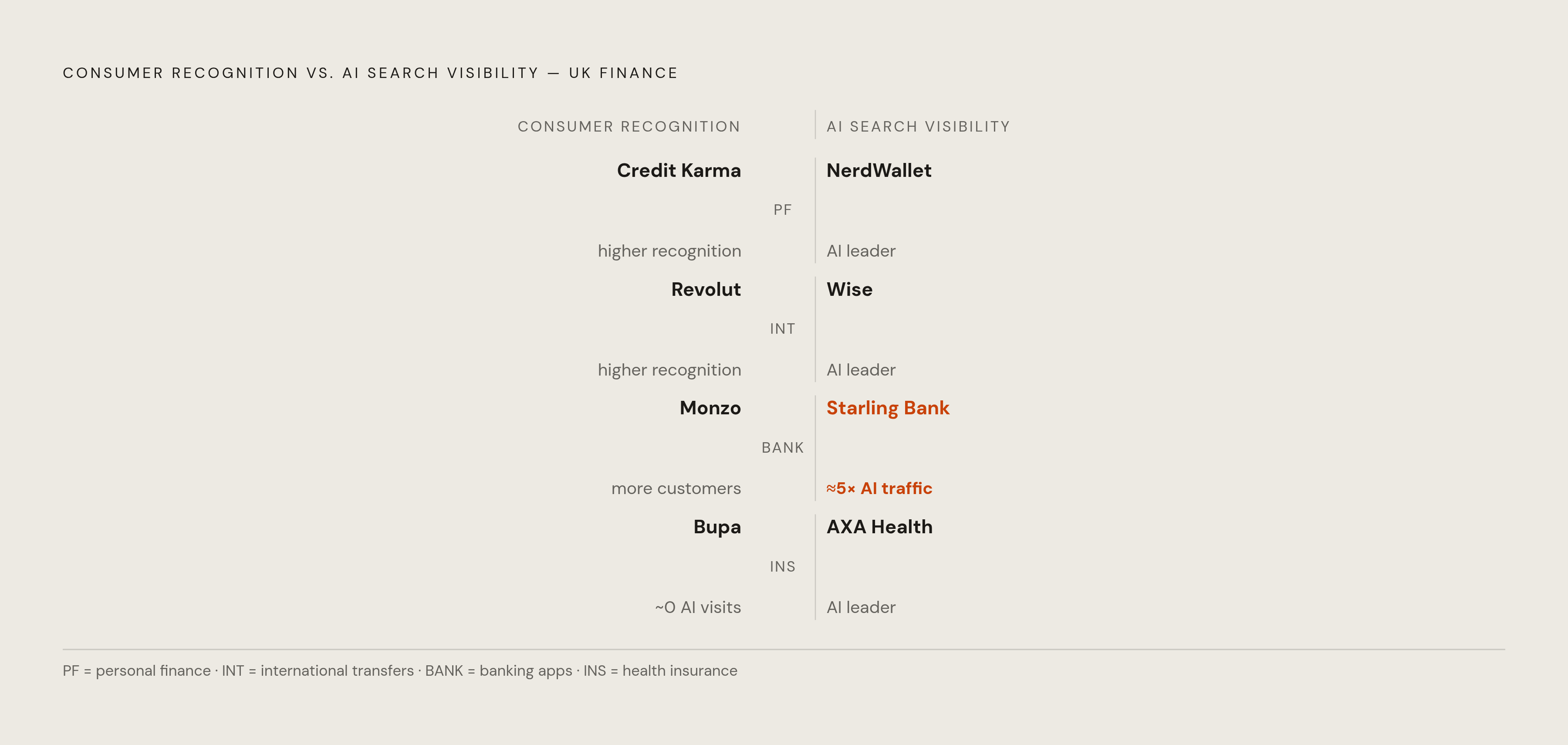
Exposure Ninja's analysis, covering eight UK finance sub-sectors using SE Ranking data, found that in every single sub-sector, one brand pulled substantially more AI search visibility than its nearest rival, and that visibility converted into more website traffic. The individual pairs make the pattern concrete.
In personal finance, NerdWallet draws dramatically more AI-driven traffic than Credit Karma, and the driver is NerdWallet's library of question-led editorial content. In international transfers, Wise shows the largest AI traffic gap in the entire dataset despite Revolut holding stronger consumer brand recognition across many markets. In banking apps, Monzo has more customers and more press coverage than Starling Bank, yet Starling generates nearly five times as much AI search traffic, which confirms that brand recognition simply doesn't carry over into AI citation.
The sharpest pair in the dataset involves health insurance. AXA Health generates measurable AI opportunity traffic, while Bupa registers approximately zero click-through AI visits. The likely explanation is that Bupa still appears as a name inside a list an AI system generates, but not as the specific recommendation the system puts forward, and a name buried in a list is functionally invisible at the moment a consumer actually decides.
The pattern repeats outside the UK. Similarweb's 2026 AI Brand Visibility Index documents NerdWallet's AI visibility accelerating sharply between April 2025 and January 2026, over the same stretch that PayPal, with far greater brand recognition, saw its own visibility decline. What's really happening is that specialist, education-led brands rank far higher in AI visibility than their branded search demand alone would predict, and across finance specifically, comparison and reference-led platforms consistently sit above the line that brand size would draw for them.
The mid-funnel comparison content that financial brands used to rely on to catch a consumer's attention is being bypassed systematically. Brands need to understand not just whether an AI platform cites them, but which specific gaps in their content let a competitor fill that comparison role instead. You can run content gap analysis across AI platforms to see which product attributes, comparison angles, or trust signals a given AI model pulls from a competitor's content rather than a brand's own, and that gives the brand a concrete target to build toward.
The agentic AI horizon: from compressed funnel to removed consumer
Everything described so far still involves a human being on the other end of the exchange: a consumer asks a question, an AI system answers, and the consumer decides what to do with that answer. Agentic AI removes that last step. An agentic system executes financial transactions on its own, based on instructions a consumer gave earlier, so it turns AI platforms from something that influences a financial decision into something that makes the decision outright.
In the AI path, a consumer asks a single natural-language question, such as which investment product suits a 30-year-old with moderate risk appetite, and gets back a synthesized recommendation. An agentic system searches, compares, negotiates, and transacts on its own, running on instructions the consumer gave once rather than approvals the consumer gives at every step. The use cases already under discussion are specific: a consumer tells an agent to find the best one-year CD with FDIC insurance, or a credit card with no annual fee and rewards that match actual spending, and the agent executes without checking back in.
The monitoring capability extends the pattern further. An agent could move funds the moment a CD matures, refinance a loan when rates drop, switch insurance carriers after a premium increase, or cancel a card once it stops offering competitive terms. These are exactly the switching decisions consumers have always been slow to act on, and agentic AI turns them automatic.
That automation raises a gatekeeping question the industry hasn't settled. Whichever company controls the agent decides which products get considered, how they get compared against each other, and whether a given provider ever sees the transaction. Consumer Finance Monitor frames large technology companies as potential gatekeepers that now stand between financial institutions and the customers those institutions used to reach directly. Legal and policy questions remain unresolved: who answers for an agent's error, what happens when an agent has a financial incentive to favor one provider over another, and whether existing fair-lending and disclosure rules even apply when the "consumer" making the request is an algorithm. Consumer Finance Monitor flags these as open questions, and so does a forthcoming William & Mary Law Review article by Professors Bartholomew and Becher.
For a financial brand, the practical point is this: if consumers are already mostly absent from the comparison stage today, agentic AI finishes that removal. If a brand hasn't built for AI inclusion now, it will be locked out structurally once agents start executing transactions on consumers' behalf.
How major AI engines source and surface financial brands
The four AI engines that matter most to a financial brand's visibility don't share a sourcing architecture. A single visibility strategy won't work across all of them. What gets a brand cited on Perplexity is not what gets it cited on ChatGPT or Gemini.
ChatGPT carries the largest citation surface of the four but is the hardest to trace back to a source. It tends to paraphrase content without naming where it came from unless SearchGPT is explicitly turned on, and Wikipedia along with other encyclopedic content accounts for a disproportionate share of what it does cite. Brands that show up inside encyclopedic or reference-style content stand to benefit the most here.
Content freshness matters, but it matters differently depending on which engine is doing the sourcing. Perplexity leans heavily toward recently updated content. ChatGPT draws from a broader window of recency. Google AI Overviews works across a wider range still. A financial brand needs a content refresh schedule calibrated to each platform's own sourcing habits, not one publishing cadence applied everywhere.
Google AI Overviews sits inside the search experience consumers already use, so it reaches billions of people globally. Brands already ranking on the first page of Google results carry some advantage here, but a first-page ranking doesn't guarantee the AI-generated summary above those results will include them. Claude, by comparison, reaches a smaller audience, but its users convert at the highest rate of any platform tracked, which makes it worth including in a cross-platform visibility effort even though its reach is narrower.
The implication across all four engines is the same: a brand cited on only one of them isn't meaningfully AI-visible. The only measure of AI presence that holds up is share of voice across multiple platforms at the same time. Financial products are vulnerable to AI delegation precisely because the complexity of comparison and the drop in switching costs together remove the friction that used to keep consumers anchored to an incumbent. A brand competing in this space needs to know not just that AI is shaping decisions, but how its own citation presence compares with competitors' across the specific platforms its target customers actually use, a measurement problem that calls for tools built for generative engine visibility rather than traditional search analytics.
What financial brands must build for AI-generated recommendations
Getting cited in financial services doesn't run on brand authority the way organic search ranking once did. It runs on the structural properties of the content itself: how specific it is, how verifiable its claims are, whether it's built around the questions consumers actually ask, and whether it gives an AI system a reason to treat the brand as a trustworthy source.
The clearest lever is specificity. A comparison page that states "starting at $99/month" gives an AI system something concrete and citable. A page that says "competitive pricing" gives it nothing to quote, so it gets passed over in favor of a competitor's page that did include the number. Of everything a financial brand can change about its content, replacing qualitative language with specific, verifiable values across comparison tables, rate sheets, and fee breakdowns is the single highest-impact change available.
Question-led content structure matters for the same reason NerdWallet's editorial library outperforms Credit Karma's in personal finance: AI systems are answering questions, and content built as a direct answer to a specific question, "which CD rate beats inflation right now," "what no-fee credit card suits someone who travels monthly," gets pulled into the response more readily than content organized around a product category instead. Wise's advantage over Revolut in international transfers and Starling's advantage over Monzo in banking apps both point to the same underlying mechanism: specialist, education-first content that teaches a consumer how to evaluate a decision beats brand reach that was built for a different, pre-AI kind of discovery.
None of this is a one-time fix. It requires a refresh cadence tuned to how each engine sources content, a content library built around the actual questions consumers put to AI platforms, and a way to see, across engines, where a brand is being cited as the recommendation and where it's merely a name inside a list, the gap that separates AXA Health's visibility from Bupa's near-invisibility in AI search. Financial brands that treat this as a measurement problem as much as a content problem are the ones positioned to still be in the conversation once agentic systems start making the decisions themselves.