Internal Business Case Template for AEO Budget Approval
AI search now intercepts buyers before they click, and most marketing budgets don't account for it.

AI search now decides which vendors get seen before a buyer ever visits a website, and most marketing budgets have no line item for it. This piece lays out the internal case for Answer Engine Optimization and Generative Engine Optimization, or AEO/GEO, built the way finance actually evaluates spend: a cost of inaction, a measurement plan, and a specific ask. The most common mistake in that internal case is treating AEO as SEO with a new coat of paint. Pitching it that way is why these proposals stall in the first meeting.
AEO is the practice of structuring content so it wins direct answers inside AI-generated responses. GEO covers the adjacent goal of getting AI systems to cite or recommend a brand by name while someone is researching a purchase. SEO earns a rank on a results page; AEO and GEO decide whether a brand gets named at all when a buyer asks an AI assistant a purchase-intent question. There's no ranking to appeal to if a brand isn't part of the answer.
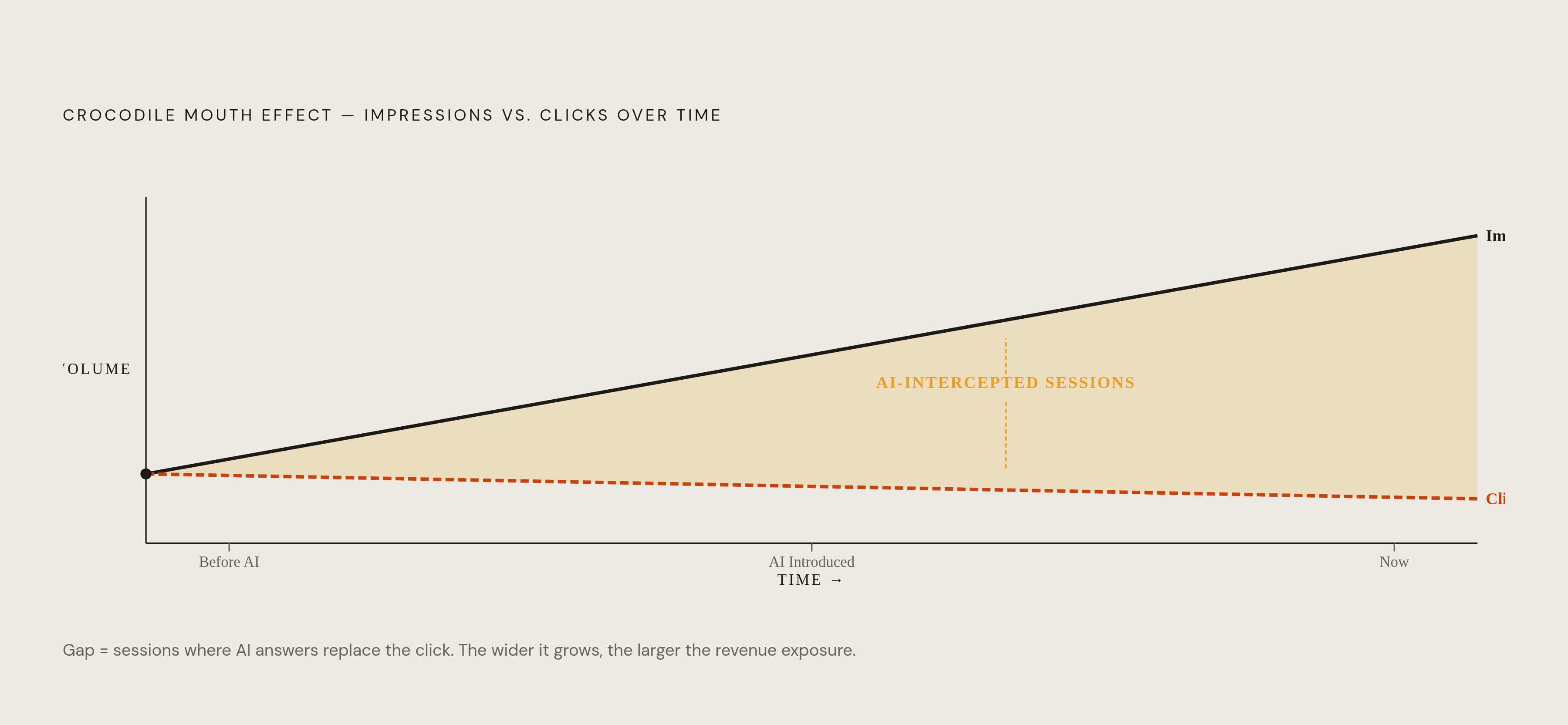
Here's a chart that lands with leadership fast: pull up Search Console and look for rising impressions next to falling clicks and falling click-through rate. Some teams call this the Crocodile Mouth Effect, since the two lines splay apart like an open jaw. That gap is the budget case in one picture. It means people are seeing a brand's content summarized inside an AI answer and never clicking through, because the answer already satisfied them. This is the mechanism by which buyers now find vendors, and most brands have no visibility into whether they're part of that mechanism at all.
The scale of the shift already underway, and what it means for pipeline
Gartner's Predicts 2025 research put a number on the shift: 25% of search volume is expected to move to AI engines by 2026. That falls inside the current budget cycle, which means any plan built on last year's search behavior is already out of date.
B2B isn't lagging behind the consumer curve, either. A 2026 Wynter B2B Buyer Survey found that 84% of B2B CMOs now use AI or large language models for vendor discovery. That's the decision-maker, not an early-adopter fringe testing a novelty tool. When the person signing the check is asking ChatGPT or Gemini who the credible vendors are in a category, the AI's answer is doing pre-sales work no one on the marketing team approved or reviewed.
Layer in the zero-click problem and the picture sharpens further: the vast majority of AI search sessions end without a click to any website. If a brand isn't named inside the AI's answer, the session ends and that brand never existed in the buyer's mind for that query. There's no second chance on that page, no retargeting pixel fired, nothing. This is a present-tense revenue leak. The next question is how much it's costing, and that's answerable.
Translating AI invisibility into a dollar figure leadership will recognize
None of this needs perfect data to build a credible estimate. It needs a model built from numbers finance and marketing ops already have on hand, wired together in a way anyone in the room can follow.
Four inputs make the model work: monthly organic search sessions, pulled straight from Search Console; current click-through rate from search; average pipeline value per converted session, sourced from the CRM; and an estimate of what share of category queries are now flowing to AI channels, using Gartner's 25% figure as a conservative stand-in until better data exists.
Run those four numbers through one sentence: "If 25% of our current search-sourced pipeline is now being intercepted by AI search sessions where we have zero visibility, we are forfeiting an estimated $Y in annual pipeline." Swap in the real figures and Y becomes a number a CFO can sit with.
A second angle belongs next to the dollar estimate: competitive displacement. If a competitor gets named in AI responses for a category query and a brand doesn't, the buyer's shortlist forms without that brand on it, full stop. That's lost membership in the set of vendors even considered, on top of a lost click. Quantify it as lost share of category awareness, and the zero-click figure becomes the multiplier that sharpens the point: even a session with no click is a session where brand preference gets shaped, and staying invisible in it is never neutral.
Present this as a starting estimate, not a forecast carved in stone. Finance trusts a model that admits its own rough edges and offers to refine them with better data far more than it trusts a number presented as gospel.
Where buyers are actually asking questions — the platform landscape the budget must cover
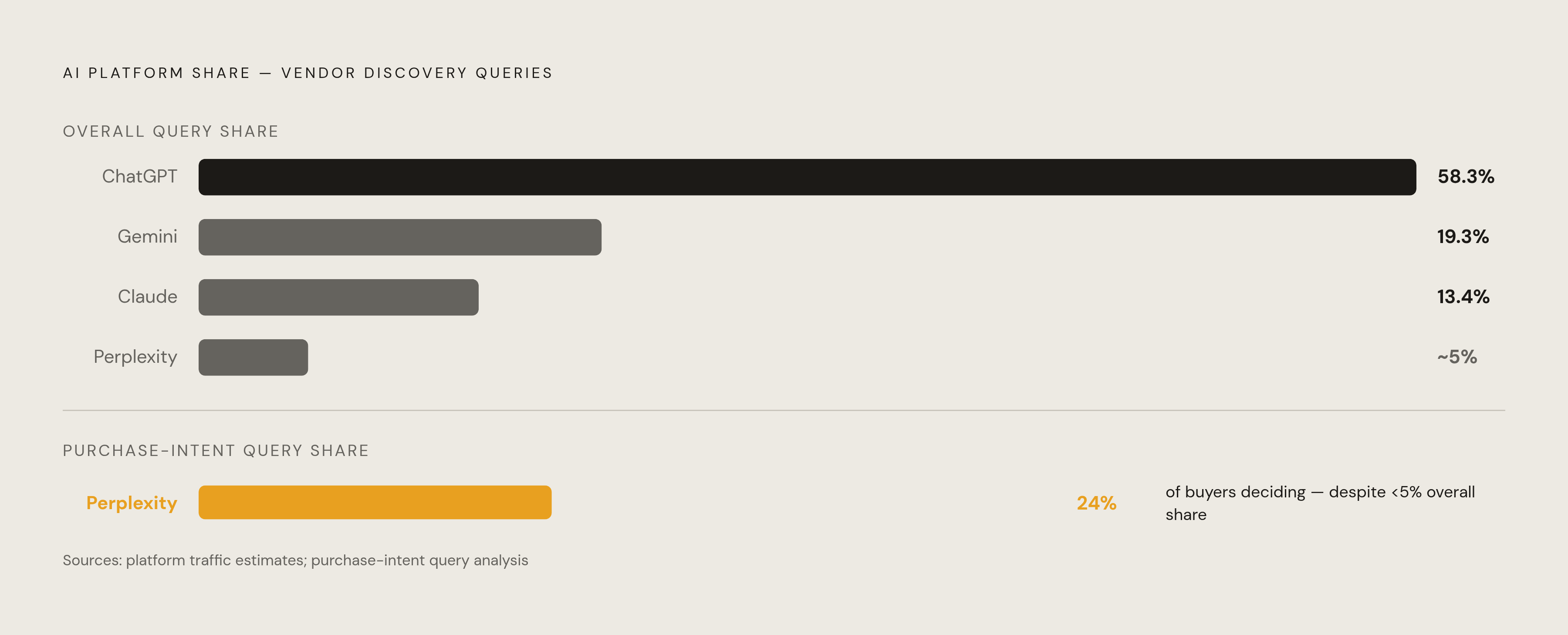
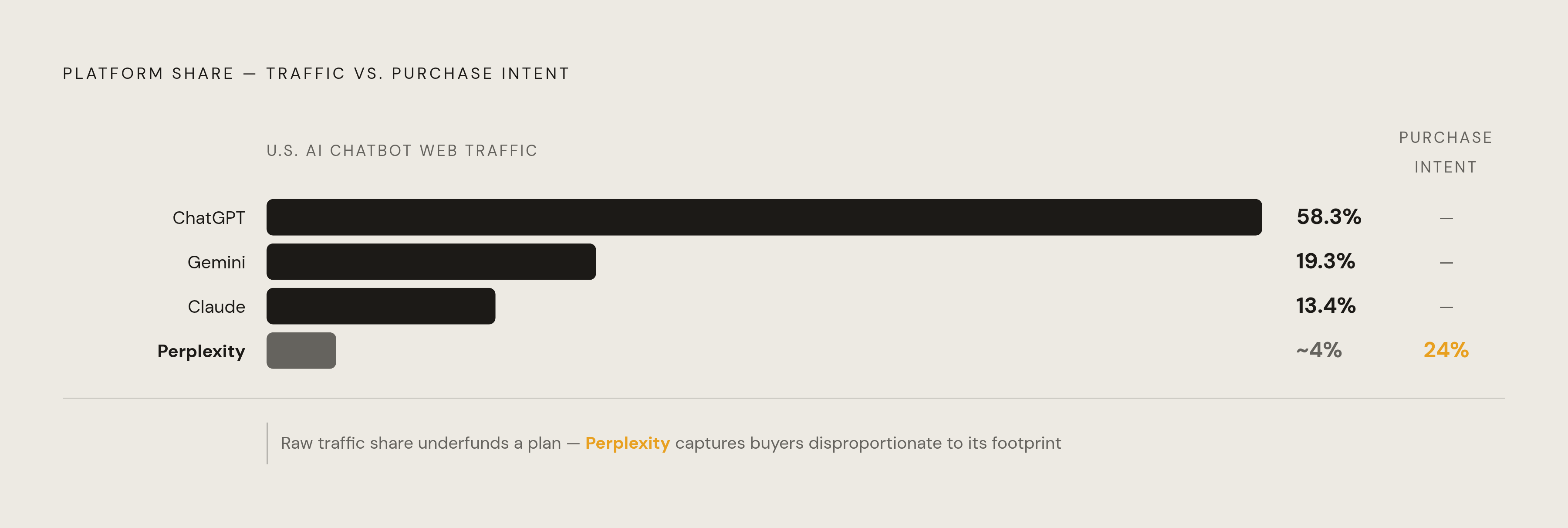
This isn't a single-platform problem, and any proposal that treats it as one will underfund itself. ChatGPT holds the largest share of U.S. web-visit traffic among AI chatbots, at 58.3%, with Gemini at 19.3% and Claude at 13.4%. No one platform dominates every query type, and buyer segments split across them in ways that don't track neatly with overall market share.
Google AI Overviews deserves its own line in the plan, separate from the chatbot conversation. It reaches roughly 2 billion monthly users by sitting directly inside standard Google Search results, which makes it the highest-volume surface most teams will touch.
Perplexity punches above its size. Despite holding the smallest share among the major players, its users lean heavily toward purchase-intent research, and Perplexity accounts for 24% of purchase-intent queries across the category, a share well out of proportion to its overall user base. A brand absent from Perplexity is absent from a disproportionate slice of people actively trying to buy something.
Fragmentation is the real budget risk here, and it's the part most proposals underweight. A brand can be prominently cited on ChatGPT and completely invisible on Gemini for the identical query, with the gap between how one platform represents a brand versus another can be dramatic, with some measurements showing a 615-fold difference in visibility. Claude adds its own wrinkle: it grew 112% year-over-year and now carries an 18.5% share of B2B AI referral traffic. Any proposal targeting enterprise buyers that ignores Claude is leaving a real slice of the audience unaccounted for. Cross-platform coverage is the floor, not the stretch goal.
What AI systems actually use to decide which brands to cite
None of this works as a budget argument unless citation is shown to follow identifiable patterns rather than chance. The research backs that up with specifics, not hunches.
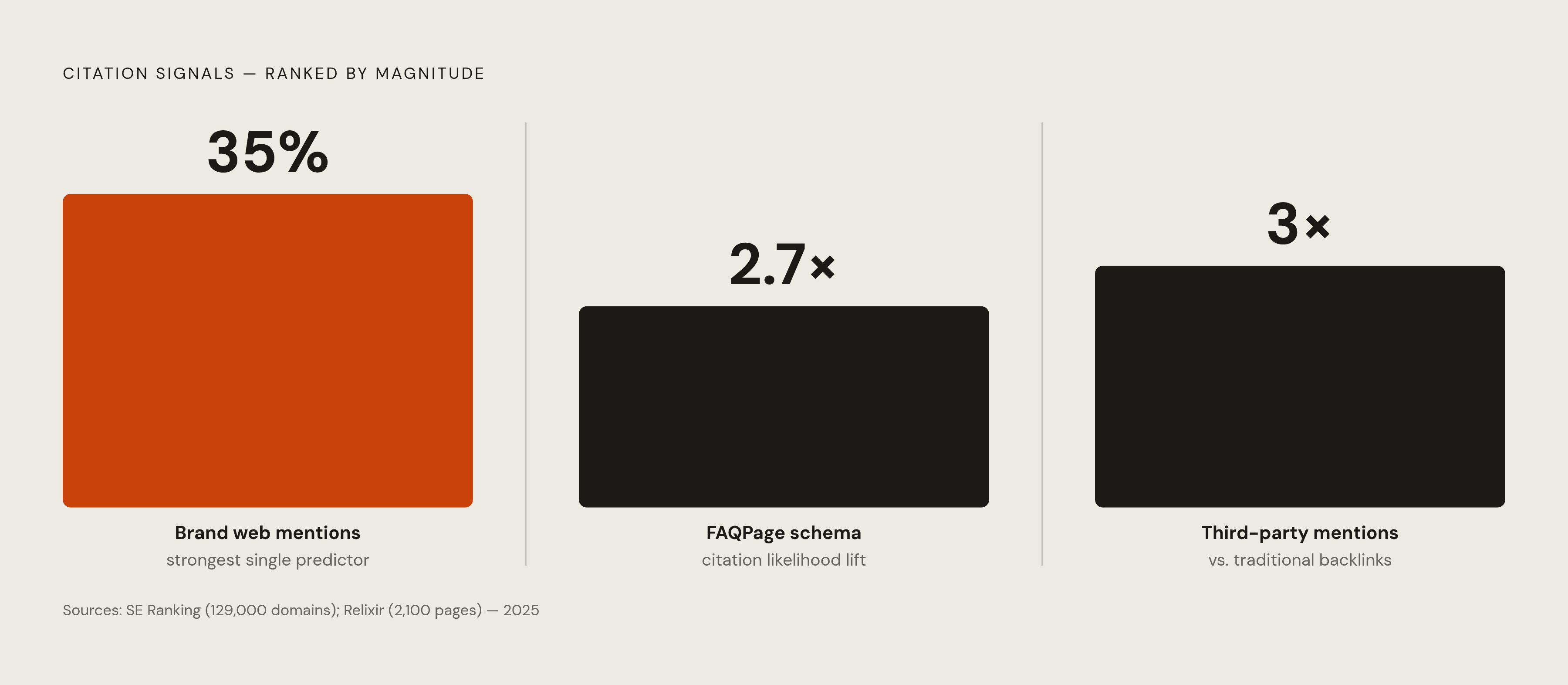
Dedicated AEO and GEO platforms for enterprise brands are built precisely to track these citation signals across models.SE Ranking studied 129,000 domains in 2025 and found that brand web mentions are the single strongest predictor of AI citation, carrying 35% weight, more than any other factor measured. Separately, Relixir's 2025 research across 2,100 pages found that pages using FAQPage schema markup were 2.7 times more likely to get cited by AI systems. That's a structural, buildable content decision tied to a measurable outcome.
Third-party mentions matter roughly three times more than traditional backlinks for AI visibility. That single point should shift how a content budget gets allocated: away from pure link-building and toward earned coverage, digital PR, and getting mentioned on the sites AI systems already treat as trustworthy sources.
The pattern across these signals holds together: factual density, clear associations between a brand and the specific problems it solves, question-based headings, structured formats like lists and FAQ blocks, and claims specific enough to be checked. Vague marketing copy, the kind full of "industry-leading" and "world-class," works against citation likelihood. AI systems are built to extract verifiable facts, and fluff has nothing to extract.
There's a risk worth budgeting for on the other side of this, too. If an AI system is already citing a brand, but with outdated or wrong information, the cost isn't a missed opportunity; it's active misrepresentation reaching buyers in real time. The work this budget funds maps directly onto signals that have already been measured and documented, not onto guesswork about what AI systems might reward someday.
The metrics that make AI search investment legible to finance and leadership
The metric that matters here isn't keyword rank. It's what's increasingly called Share of Model, or SoM: the percentage of relevant AI-generated answers in which a brand gets named at all.
The formula is simple enough to put on one slide: Share of Voice equals a brand's mentions divided by total mentions of all brands across a set of category queries, multiplied by 100. Building the measurement behind that formula takes a defined process, not a tool subscription. Define 30 to 50 queries spanning category questions, problem statements, and head-to-head comparisons. Pick three to five direct competitors as the comparison set. Run every query across ChatGPT, Perplexity, Claude, and Google AI Overviews, and record a simple binary for each brand on each platform: cited or not cited. Calculate a per-engine score and a blended score weighted by platform importance to the buyer base. Set a monthly cadence, with weekly spot checks on the queries that move fastest.
Benchmarks give the number context. Top-performing brands capture 15% or more AI share of voice across their core query sets, and enterprise leaders in specialized verticals push that figure to 25% or 30%. Those numbers give a proposal a target that sounds achievable rather than aspirational.
Connect the SoV trend line to existing reporting wherever possible: pipeline sourced through AI referral traffic, a quarter-over-quarter comparison against organic search decline, and competitor SoV shown side by side to frame the effort as a share-capture race rather than a vanity metric.
One caveat belongs in the proposal explicitly: citation is volatile. Roughly 30% of brands visible in one AI response for a given query show up again in the very next response to that same query, phrased identically. That instability is exactly why ongoing measurement has to be a standing budget line rather than a one-time audit that gets filed away. Once AI SoV gets linked to referral traffic and conversion data, it functions as a leading indicator of top-of-funnel pipeline, which is the language that gets budget approved.
The budget sections, headcount, and tooling a credible AEO proposal needs to include
Three categories carry the weight of the proposal, and each needs its own justification, not a bundled line item.
Measurement and monitoring comes first: ongoing tracking of AI share of voice across platforms. Without it, there's no way to prove the investment worked, so this is the accountability infrastructure the rest of the budget depends on.
Content and signal development comes second: structured content builds, schema implementation, FAQ architecture, and programs aimed at earning third-party mentions. These map directly to the citation signals covered above.
Brand integrity and hallucination prevention rounds out the three: auditing and correcting inaccurate AI-generated brand descriptions, plus structured data work for entity disambiguation, things like Organization Schema and sameAs properties linking a brand's own site to its Wikidata and Crunchbase entries. Frame this as risk management, the same category budget owners already fund for data security or compliance.
On headcount: if no one owns AEO or GEO today, the proposal needs to either expand an existing role, an SEO manager or content lead, with explicit added scope, or make the case for a dedicated AEO manager hire. Either way, frame the cost of that headcount against the pipeline already being forfeited without anyone owning the function. An empty seat costs more than a filled one here.
Timeline shapes how the ask gets received. The first 90 days should be positioned as measurement and baseline-setting, with no ROI claims made yet. Days 90 through 180 cover optimization execution. The six-month mark is the first formal ROI review. That pacing makes an open-ended-sounding investment feel bounded and accountable.
One more line belongs in the document: what this budget replaces or reduces. As AI referral traffic grows, some portion of paid search spend, particularly on high-cost keywords that AI now answers for free before a click ever happens, can get reallocated rather than piled on top. That turns the ask from pure incremental spend into a reallocation, which is a much easier conversation with finance.
Anticipating the objections that kill budget requests before they reach approval
"This is just SEO with a new name" is the first objection, and it's wrong on the mechanics. AEO and GEO target a separate, parallel discovery system running on different rules. Optimizing for Google's ranking algorithm doesn't produce a citation inside ChatGPT or Perplexity, full stop. A near-total zero-click rate on AI sessions proves the two channels don't operate the same way at all.
Next comes "We don't have enough AI referral traffic yet to justify this," and it's the weakest objection on the list. Waiting for the traffic to show up in a dashboard before acting means sitting out the window when citation patterns are still forming and competitors are already moving into it. By the time the traffic is undeniable in the dashboard, the citation habits that AI systems build toward specific brands will already be set.
"We can't measure it" doesn't hold up either. The share-of-voice methodology outlined above produces a trackable, reportable number every month, and enterprise leaders already hit 25% to 30% AI SoV targets using exactly this kind of tracking.
"What's the actual revenue tie?" deserves a direct answer: 84% of B2B CMOs use AI for vendor discovery. A brand absent from those AI responses is absent from the buyer's shortlist before a sales rep ever gets a call. That's a pipeline formation problem.
Last is "Let's wait until the space matures," the objection worth taking most seriously, and rejecting hardest. Citation isn't neutral or random; models build brand associations from the data available at training time and from what they crawl on an ongoing basis. Brands establishing citation presence now are building an advantage that compounds. Brands waiting for the space to settle are building a catch-up problem that gets more expensive to close every quarter they sit still.
Assembling the one-page executive summary that actually gets the meeting
The executive summary isn't a shortened version of the full proposal. It stands on its own, and it answers four questions in order, nothing more.
What's changing: AI has become a primary channel for buyer discovery, with Gartner projecting 25% of search volume shifting to AI engines by 2026. What is it costing right now: the fill-in cost-of-invisibility estimate built from the model earlier in this piece, with real numbers substituted in. What's being asked for: the three budget categories, the timeline, and the named owner. How will success get measured: a share-of-voice baseline, a six-month target, and the pipeline attribution method tied to it.
One line of competitive framing does more work than a page of narrative: name two or three real competitors and state plainly whether they're currently cited in AI responses for the category's top queries. If they are, and the brand in question isn't, the cost of doing nothing becomes visible without needing a spreadsheet to prove it.
Write the summary the way finance writes memos, not the way a marketing deck reads. Use the vocabulary finance already trusts: pipeline, attribution, ROI, risk mitigation. Save any enthusiasm about the channel itself for the hallway conversation afterward.
Close with a specific number and a specific date: "Requesting approval of $X by [date] to begin a 90-day measurement and baseline phase, with a formal ROI review at six months." That kind of specificity tells the room the hard thinking already happened and the team is ready to move the moment the answer is yes.