AI Search Disruption of Student Enrollment Funnels in Higher Education
Two-thirds of students now ask AI before Google, forcing colleges to rethink how they reach them.
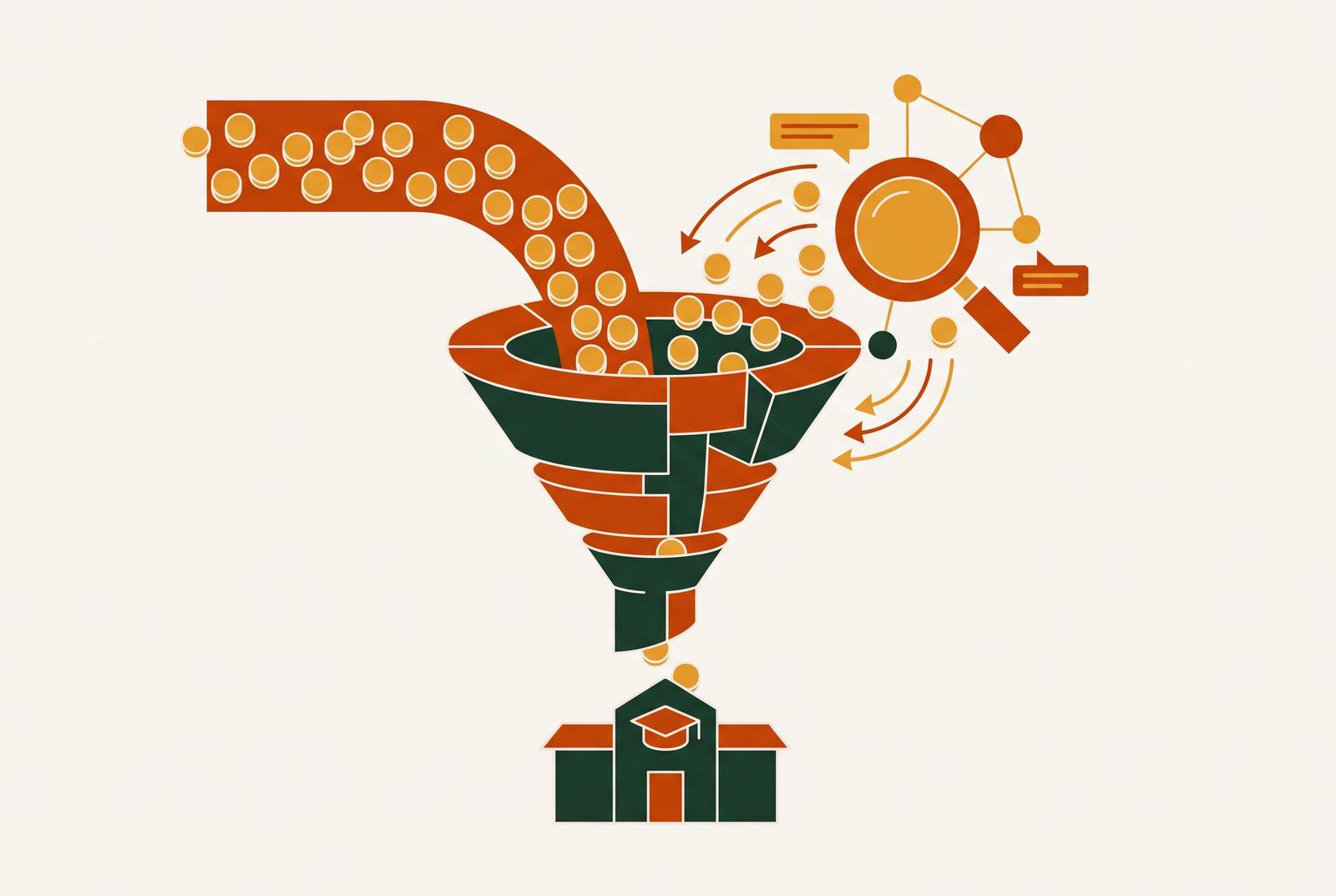
The enrollment funnel used to run one direction: a student searched Google, clicked a.edu link, filled out a form. That sequence is breaking down. Everspring's 2025 AI Search Trends Report, drawn from more than 450,000 real student interactions across 60-plus programs, found that two-thirds of prospective students now turn to AI tools like ChatGPT before they ever open Google. UPCEA and Search Influence, surveying 760 adult learners between 18 and 60, found that half of them use AI tools weekly, the way older generations used a search bar, and that shift alone should reorder how enrollment teams spend their time.
Students haven't abandoned the old channels, though. UPCEA's data shows 84% still use traditional search engines and 61% treat YouTube as one too, so the new tools are stacking on top of the old ones rather than replacing them. But 36% of students across undergraduate, graduate, and adult learner segments now use AI search specifically to guide their college search, and more than 88% of them use at least two platforms during their college search. The funnel hasn't vanished. It's moved up a level, into interfaces students never have to leave to get an answer, and a university that isn't cited when the AI responds is absent before consideration even starts. That's the part most marketing teams still haven't priced in. Absence at this stage isn't a ranking problem, it's a disappearance.
AI Interception Points at Each Funnel Stage
Awareness now happens inside the AI conversation itself. A student typing "best colleges for psychology in the Midwest" into ChatGPT, Perplexity, or Gemini gets a direct answer, and that answer, not a results page, is the institution's first branded impression.
Even when students land on Google, the page underneath them has changed. AI Overviews now show up across the majority of searches phrased as questions, and Everspring's data shows click-through rates to top-ranked university pages fall by 70 to 90% once an AI Overview appears. Strong SEO stops producing site visits if the institution never makes it into the summary. Ranking well isn't the finish line anymore. Being named inside the answer is, and that distinction is the one most institutions still get backwards, chasing position ten on a results page while ignoring the paragraph sitting above it.
Trust gets built here too, mostly before a student clicks anything. Per Everspring, 79% of prospects read an AI-generated overview before clicking a result, and 56% say they trust schools more when those schools show up inside the summary. At the same time, 77% still call the institutional website their most reliable source. Trust starts with the AI answer and gets confirmed on-site afterward. A strong website can no longer save an institution that never gets mentioned in the first place.
Short-listing has quietly turned into a synthesis problem. Ask an AI tool to compare degree options, program outcomes, and tuition in one conversational query, and it synthesizes an answer on the spot. Institutions left out of that synthesis get dropped from consideration without a student ever consciously deciding to exclude them. It just never comes up. Everspring also found that 82% of students say they're more likely to consider a program that shows up on page one of search results, and as AI Overviews swallow more of that page, "page one" increasingly means "inside the AI's answer."
The downstream effect appears in speed. Roughly 72% of online learners enroll at the first institution that admits them. Whichever school an AI tool surfaces earliest in a student's research is claiming a measurable edge in who actually enrolls, not just who gets considered.
The demographic pressure that makes the visibility problem more urgent, not less
Traditional college-age enrollment is projected to drop by roughly 15% between 2025 and 2029. Institutions are being asked to compete harder for a shrinking pool of 18-year-olds while also building out programs for adult learners, and the adult learner population shows strong and growing adoption of AI search. That overlap is the reason UPCEA and Search Influence targeted that population, since it's a leading indicator, not a side note.
Adult learners are busy, employed, and researching on compressed schedules. They ask AI tools the same questions that used to send traffic straight to a program page. What does this cost? What's the schedule? What happens to graduates? All of it gets answered in a single AI query, with no need to ever land on a university's site.
Put the two trends together and the cost of AI invisibility compounds instead of averaging out. There are fewer students to recruit, and the ones still in the pool are the most likely to use AI to cut an institution before anyone in admissions makes contact. It's already shaping this year's recruiting cycle, a current reality rather than a future risk. It's already shaping this year's recruiting cycle.
How institutions are actually responding
Higher ed hasn't ignored AI. A Four Kitchens whitepaper found that 65% of institutions used AI in marketing and enrollment in 2025, up from 40% the year before, and 48% of respondents believe AI is helping their enrollment funnel. But using AI tools and being optimized for AI search are two different things, and most institutions have only done the first. Producing content faster with AI, or cleaning up a workflow, does nothing to guarantee that ChatGPT or Perplexity will actually cite that institution when a student asks a relevant question. Confusing the two is the single most common mistake in this transition, and it's an expensive one: schools making it believe they're ahead of a problem they haven't actually touched.
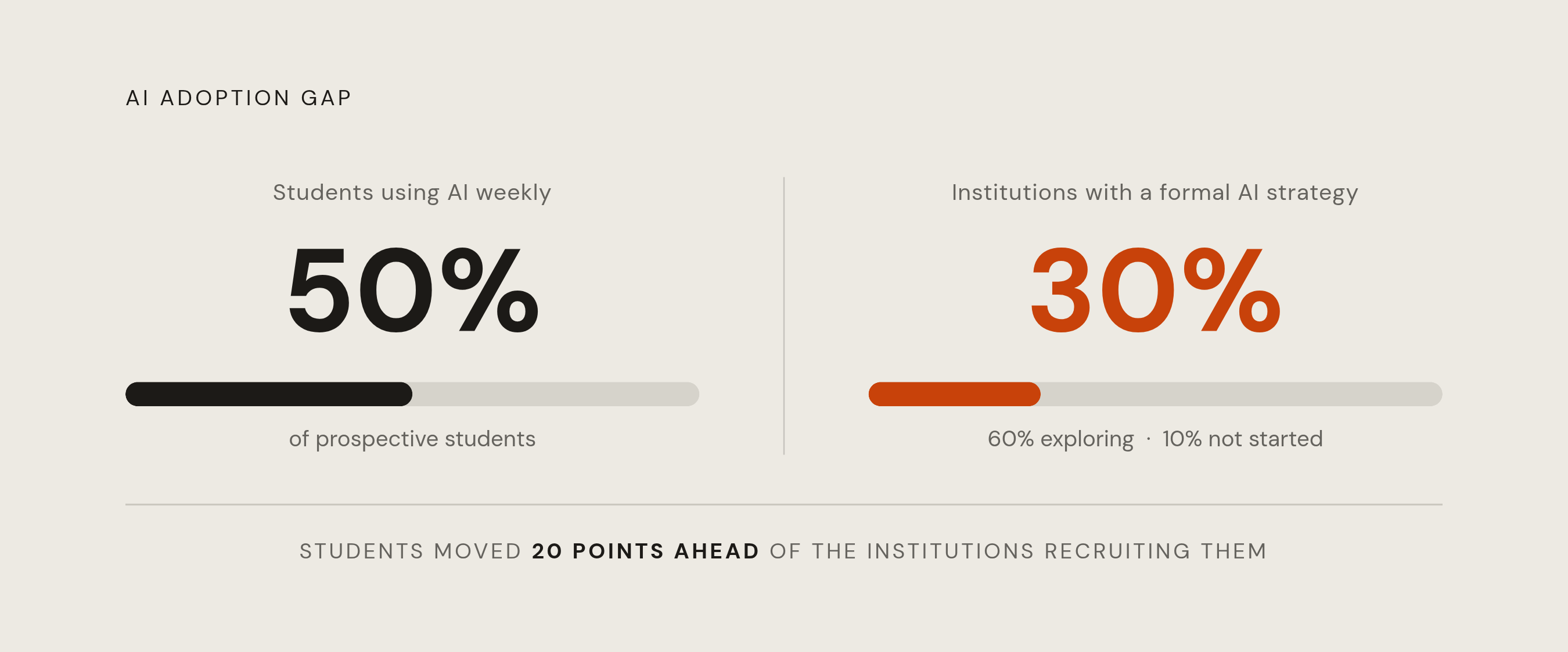
A UPCEA snap poll of 30 member institutions found that only 30% have a formal AI search strategy in place, 60% are still in early exploration, and 10% haven't started, or don't believe AI will affect student discovery at all. Asked why, 70% cited competing priorities or limited bandwidth, and roughly a third pointed to a lack of in-house expertise.
Tracking is just as thin. Only 56.7% of institutions say they've even appeared in AI-generated results, and of those, just 64.29% use any formal tool to track it. Most schools have no reliable read on whether AI is citing them correctly, citing them at all, or quietly getting their program details wrong. That gap should worry a provost more than a low ranking ever did, since a wrong tuition figure repeated by ChatGPT doesn't get corrected by a better meta description.
The wait carries a cost that compounds quietly. Institutions already showing up in AI answers accumulate an advantage over time, while the ones sitting on the sidelines fall further behind without doing anything differently at all.
What AI systems evaluate when deciding whether to cite an institution
Generative engine evaluation is broadly understood to rest on three pillars: Authority, meaning content that's credible, current, and technically sound; Relevance, meaning content that answers the exact question being asked; and Trust, meaning consistent messaging across channels, backed by mentions from sources outside the institution itself.
Most of the actual work here isn't technical, and that's the part institutions keep getting wrong. Writer.com estimates that roughly 80% of generative engine optimization is strategic, driven by positioning, ecosystem presence, and brand authority, with only about 20% coming down to technical implementation like markup or page structure. Institutions that treat this as an IT ticket, something to hand to whoever manages the content management system, are solving the smaller fifth of the problem and calling it done.
That "ecosystem" framing matters because AI citation spans far more than a website. It's built from the university's site, its social channels, its video content, forum mentions, and third-party press, all feeding into how a model understands the institution. The real risk is straightforward: if a generative engine finds conflicting information about a program's cost, format, or outcomes across those sources, it may misrepresent the institution in its answer, or leave it out of the response. That's a direct, mechanical consequence of inconsistent content sitting in the public record, a matter of plain cause and effect rather than an algorithmic mystery.
SE Ranking's 2025 research across 129,000 domains found that brand web mentions are the single strongest predictor of AI citation, carrying a weight of 35%. What gets said about an institution elsewhere on the web matters roughly as much as what the institution publishes about itself. A communications team that ignores earned media and third-party directories is underweighting what SE Ranking's research identifies as the strongest single predictor of AI citation, which gives PR a direct and measurable role in AI search visibility.
UPCEA describes the resulting gap as "visibility debt." The less an AI model encounters an institution's authoritative content, the further that institution fades from the model's working knowledge of the category. Early investment compounds, and delayed investment creates a deficit that gets harder to close the longer it sits.
The specific content and structural changes that improve AI citation rates
Students don't type keywords into AI tools. They ask full questions: "Which universities offer strong internships for marketing majors?" Program pages built around keyword density fail that kind of query. Content needs to answer the question the way a student actually phrases it, in plain conversational language matching the clipped phrasing SEO teams optimized for a decade ago.
Some fixes move fast. FAQ sections with proper schema markup can show measurable results within weeks, and featured snippet gains can follow relatively quickly. Building durable AI citation authority across a broader set of queries takes longer, a longer-term investment of sustained work, and institutions expecting a quick win on that front are setting themselves up to abandon the effort too early.
Technical precision matters more than it used to. An ID anchor, something like #tuition-2026 attached to a specific block of text, lets an AI system point to a dateable, specific fact rather than guessing at one. That precision matters most exactly where errors are most damaging: tuition figures, admissions requirements, program deadlines.
Prompt stress-testing should become a standing practice. Pick the roughly 20 questions where a wrong answer is unacceptable, tuition, requirements, outcomes, and run them across ChatGPT (with and without web search enabled), Gemini, and Perplexity. Where the answers diverge from reality, trace the divergence to its source: is a third-party directory publishing outdated information, or is the institution's own page just ambiguous?
Consistency across channels is a citation prerequisite, not a nice-to-have. If a program's name, start date, or cost differs between the university site, a third-party directory, and a piece of earned media, that inconsistency reads to an AI model as a trust problem, and trust problems produce omissions or misstatements. Since 61% of students already use YouTube as a search engine, video content explaining programs and outcomes extends an institution's AI-indexable footprint well past its own domain.
All of this feeds a loop. The AI tool surfaces authoritative content, the student clicks through to confirm it, and since 77% of students rate the institutional website as their most trustworthy source, that on-site verification behavior signals credibility back into the system over time.
Measuring AI Search Visibility for Enrollment Reporting and Budget Allocation
Rankings and clicks don't capture what matters anymore. The relevant metric is AI share of voice: how often an institution actually gets cited in AI-generated answers for the questions that matter to its category. The formula is simple, brand citations divided by total category citations, multiplied by 100, run across a defined set of program-relevant prompts on the target AI platforms.
Two different numbers deserve separate tracking: citation rate and mention rate. An AI answer might name an institution without linking to a source page, or cite a page without naming the institution in the text. Tracking these separately actually diagnoses the problem, since one points to a brand recognition gap and the other to a content authority gap. Collapsing them into a single number, which is what most schools do when they track this at all, hides which fix actually applies, and enrollment teams that skip this distinction end up fixing the wrong thing.
Most institutions aren't doing even this much. Only 64.29% of the UPCEA institutions that track AI appearances use a formal tool to do it, so the majority have no systematic view of whether they're being represented accurately, inaccurately, or not at all.
A workable cadence: run prompt-based checks weekly, since AI answers shift more often than classic search rankings ever did, roll results up monthly for trend analysis, and revisit content and positioning strategy quarterly. Report citation frequency across platforms, the accuracy of AI-generated program descriptions, the sentiment of those summaries, and visibility relative to named competitors, alongside the enrollment KPIs leadership already tracks.
One caution belongs in every board conversation about this data. Some vendor share-of-voice tools measure against a hidden denominator, meaning share within a curated prompt set the vendor built. Understand how a tool constructs that denominator before treating a single percentage as gospel, because two vendors can report wildly different "share of voice" for the same institution and both be technically correct.
Track presence across ChatGPT, Perplexity, Gemini, Claude, and Google AI Overviews at minimum. Showing up across platforms, not dominating one, is what actually signals institutional visibility. A strategy built around a single platform is a strategy built on borrowed time.
The institutional posture that separates early movers from late adopters as AI search matures
AI models keep learning from whatever they encounter. Institutions publishing clear, consistent, well-structured content now are actively teaching those systems to treat them as reliable sources, and that head start gets harder for competitors to close with every passing month.
Put the numbers side by side and the gap is stark: half of prospective students already use AI tools weekly, while only 30% of surveyed institutions have a formal strategy for AI search. That distance between how students actually behave and how institutions have organized to meet them is holding steady, or growing, on its own. It's widening, and every quarter of inaction lets the AI models currently forming their impression of the category do so without the school in the room.
None of this replaces traditional SEO, and treating the two as competitors is a mistake. Search Influence frames SEO as the connective tissue linking every discovery channel a student uses, AI included, producing reinforcement between the two rather than competition for the same budget line. Institutions that frame AI visibility and SEO as rival line items tend to underfund both.
A real strategy has identifiable parts, and it looks the same regardless of institution size. It requires someone accountable for AI search visibility, a running prompt-monitoring program, a content audit measured against the Authority, Relevance, and Trust criteria AI systems actually use, consistency standards enforced across every channel, and a dashboard that shows up in the same reporting as traditional enrollment metrics. Institutions invisible during the zero-click stage are losing student attention before a single website visit happens, in a market where the pool of traditional students is already shrinking. That's a compounding disadvantage, and the institutions treating AI visibility as a measurable growth channel now, with traceable ROI and real executive reporting, are the ones building a citation advantage the rest of the field will spend years trying to close.
Sources
- New From Search Influence - AI Search in Higher Education: How Prospects Search in 2025
- The AI Search Gap: What Students Expect vs. What Institutions Are Doing - UPCEA
- Beyond the hype: How AI can transform higher education websites and digital experiences - Four Kitchens
- How AI Search Is Changing Student Discovery in Higher Education
- How to rebuild the higher education marketing funnel for 2026 - Launchcodex
- writer.com