AI Search Optimization Platforms With Proven Healthcare Vertical Results
Healthcare brands must earn AI Overview citations, not just rankings, to capture traffic.

Healthcare has become the most saturated vertical in AI search, with AI Overview coverage on clinical queries now effectively total. The baseline competitive terrain has shifted beneath every organization that publishes medical content, and most have not caught up to the new rules, changing what "visibility" even means for a health brand.
The hardest terrain for AI search visibility: healthcare queries
Healthcare's AI Overview coverage runs higher than B2B tech or education, though education has nearly closed the gap, and the growth over the past year has been substantial. The AI-generated summary is now the default interface through which most people encounter health information online, not an occasional layer sitting above the search results.
The saturation follows a clear pattern. Treatment and procedure queries reach full AI Overview coverage. Pain-related queries reach near-full coverage. Symptoms and conditions queries follow close behind. This matters because it inverts a strategy health content teams have relied on for years: building long-tail clinical pages specifically to avoid head-term competition. Those long-tail pages turn out to carry more AI exposure than the head terms they were built to sidestep, not less, because they sit squarely inside the categories Google synthesizes most aggressively.
Google's policy framework for content that can affect a person's health, finances, or safety drives this pattern. Google rolls out AI Overviews fastest where informational, consensus-based answers can be synthesized cleanly and where users are seeking guidance. Health queries meet both conditions more completely than almost any other category online: a person asking about symptoms wants a synthesized answer, and the underlying medical consensus is usually stable enough for a model to summarize with confidence. That combination is precisely what pushes healthcare to the front of the AI Overview rollout queue, and it is why every capability discussed in this piece exists to answer one condition: an environment where the AI summary, not the ranked list of links beneath it, is the primary interface patients use.
AI Overview saturation and healthcare traffic: why citation is now the only position that pays
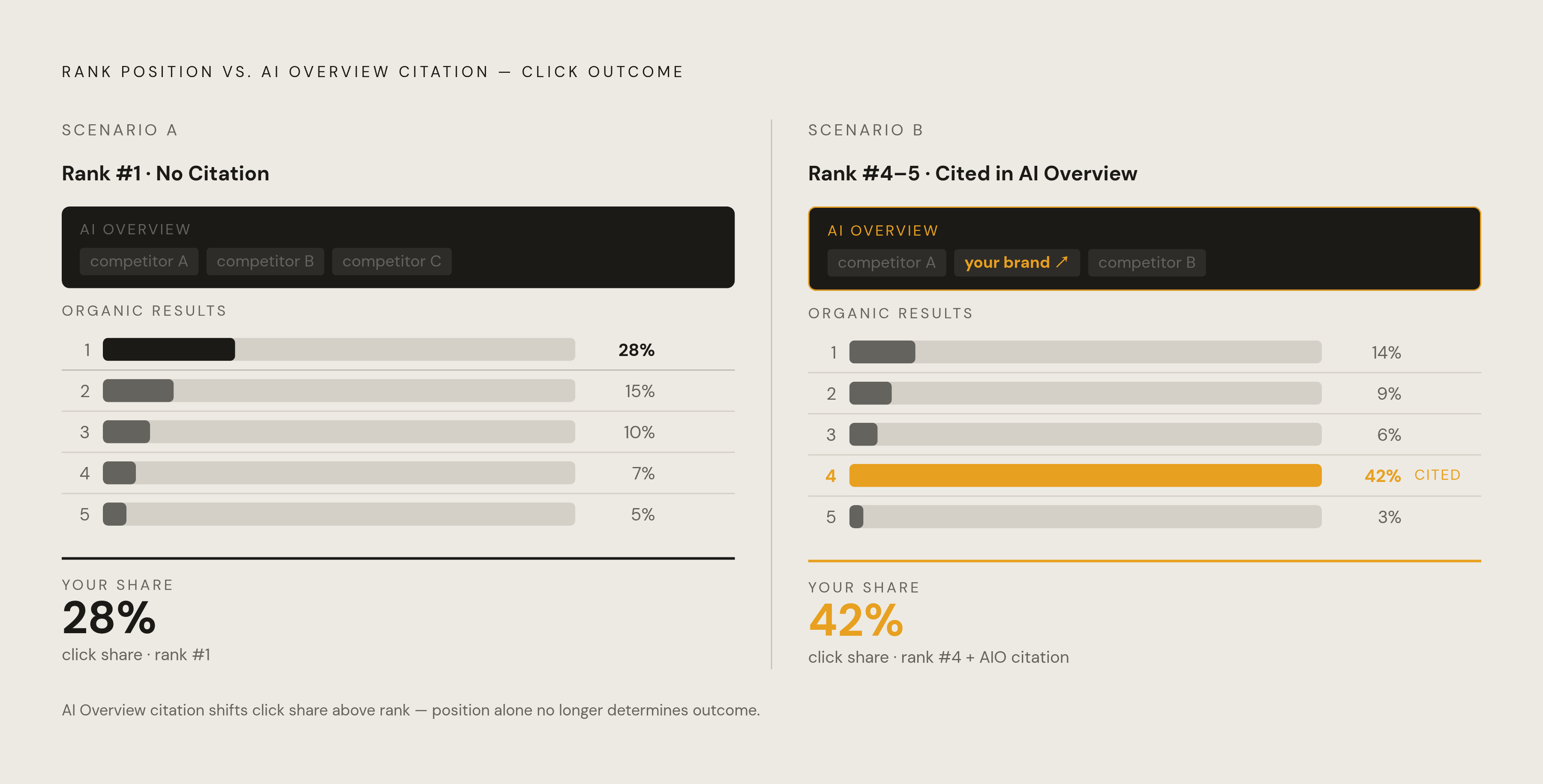
When an AI Overview appears on a query, organic click-through rate falls sharply. That much is now a well-established pattern across search behavior generally. What distinguishes healthcare is what happens next: being cited inside the overview delivers meaningfully more clicks per impression than failing to be cited on those same queries. Citation, not rank, is what recovers traffic once an AI Overview occupies the space above the fold.
This reframes the entire objective for healthcare marketing. Ranking first on a query that triggers an AI Overview, without earning a citation inside that overview, produces far less traffic than being cited from a lower organic position. A health system or publisher can hold the top organic slot on a high-volume symptom query and still see traffic collapse, while a competitor cited inside the AI Overview from position four or five captures the clicks that remain. Rank position has not stopped mattering, but it has stopped being the variable that determines outcome on queries where an AI Overview is present.
The implication is structural. In a vertical where AI Overview coverage is near-universal, optimizing for rank position without separately optimizing for citation inclusion means optimizing for a signal that no longer determines the result. Citation inclusion has to be treated as its own discipline, with its own technical requirements, measured separately from traditional rank tracking. Every capability described later in this piece, from schema markup to cross-engine measurement, exists to serve that one objective: getting the brand's content inside the synthesized answer itself.
YMYL filters and healthcare's structurally different citation competition
AI engines apply a YMYL filter to health queries, and that filter compresses citation share into a small number of institutional domains. This is not a content-quality problem that better writing solves on its own. It is closer to an oligopoly problem, where a limited set of sources, largely academic medical centers, government health agencies, and a handful of consumer health publishers with long-established editorial authority, absorb a disproportionate share of citations across the entire category.
Mayo Clinic's presence across AI-generated health answers illustrates what compliance with this filter looks like at the institutional end of the spectrum: decades of editorial consistency, physician authorship, and domain authority built long before AI search existed. A newer entrant from a different position in the market, such as a direct-to-consumer telehealth brand, illustrates that it can still earn citation presence, but only by explicitly building the credibility signals that established institutions accumulated organically over time.
A documented agency case study makes the underlying mechanism concrete. The lesson is that medical accuracy is necessary but not sufficient for AI citation: the signals that communicate credibility to a language model have to be explicitly architected into the page.
The specific technical capabilities that determine whether a healthcare brand earns citations at all
Citation architecture in healthcare rests on four categories working together: structured data implementation, entity authority, content freshness, and third-party signal management. Generic SEO tooling, built for ranking factors that predate generative search, was not designed to handle this combination, and that gap is the primary reason so many well-resourced health organizations remain invisible in AI-generated answers.
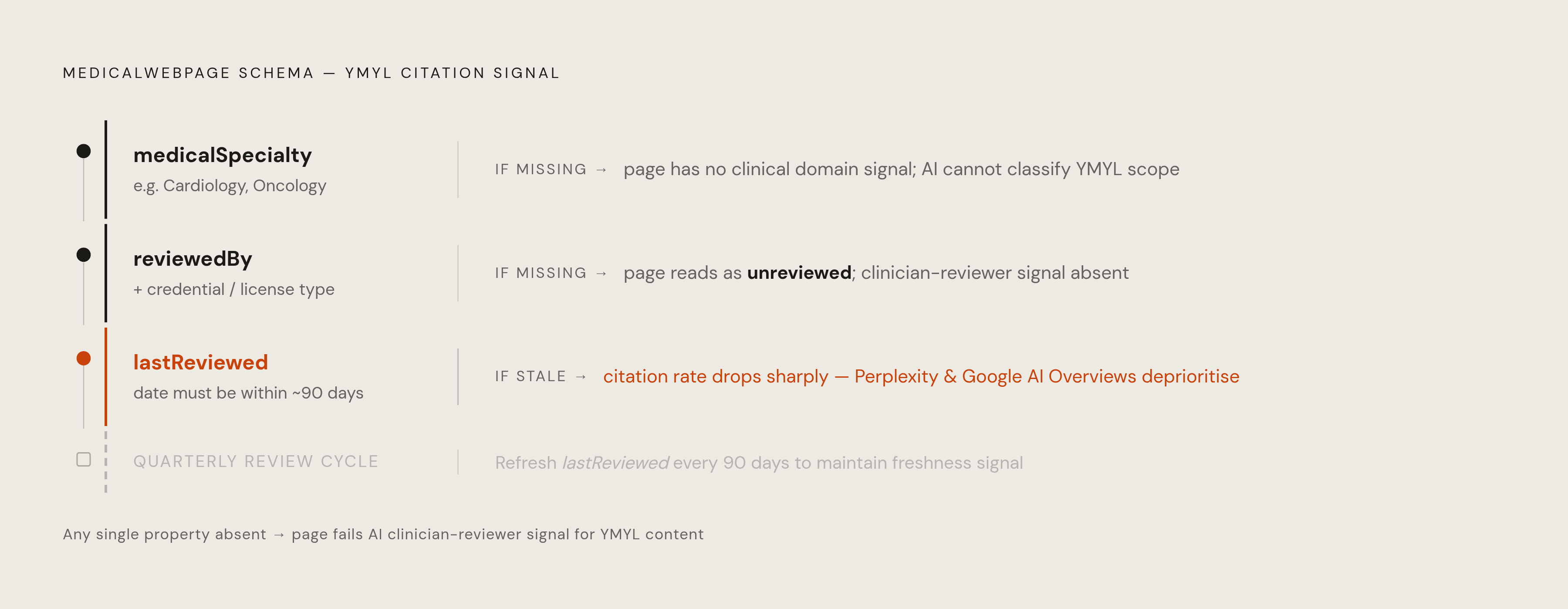
Structured schema is the foundational signal in that stack. MedicalWebPage schema needs three specific properties to function as intended: medicalSpecialty, reviewedBy with the reviewer's license type attached, and lastReviewed. Omit any one of the three and the page fails to produce the clinician-reviewer signal that AI engines weight heavily for YMYL content. A page with excellent writing and no reviewedBy field reads, to the model doing the synthesis, as unreviewed.
Freshness operates as a second, independent requirement. AI engines carry a strong recency bias, and when content ages beyond roughly a quarter without a revisit, citation rates to that page drop sharply, especially on Perplexity and Google AI Overviews, though pages that have already accumulated high authority appear to absorb some of that penalty more gracefully than newer pages can. That maintenance cadence, a quarterly review cycle across an entire clinical content library, is a resourcing commitment most healthcare organizations are not structured to sustain at scale. Content teams built around an annual or biannual review schedule are, by design, out of step with what the current citation environment requires.
Entity authority and third-party signal management round out the stack. Research from a pair of university research teams identified the specific generative engine optimization tactics that carry the strongest documented citation lift: adding quotations from credible sources, including clear statistics with named sources structured as standalone quotable sentences, improving readability, and adding inline citations. Keyword optimization, the tactic most legacy SEO programs still default to, produced a negative result in that same research. The takeaway for healthcare content teams is direct: the writing habits that earned rank in the old search environment are actively counterproductive in the new one, and the habits that earn citation (quotability, sourcing, clarity) have to be built in deliberately, before publication.
Single-platform measurement and false confidence in healthcare AI search exposure
A healthcare brand tracking AI visibility on a single engine is blind to the majority of its own citation landscape. Analysis from 2026 found that 89% of brands fall into this position, carrying what amounts to an invisible citation landscape across the platforms they are not measuring. Citation overlap between major AI engines runs extremely low, so a brand can hold strong citation share on one engine and vanish on another for the exact same set of queries.
The variance documented in practice is severe enough to change strategic decisions. A brand optimized entirely around one engine can be functionally invisible on another, and because different patient populations gravitate toward different platforms to research conditions and providers, that invisibility means a real population of patients never encountering the brand at the exact moment they're searching for care.
Category leaders in healthcare achieve AI share of voice in the range of roughly a quarter to nearly half of responses on their strongest engine. Challengers reach a much smaller fraction of that. New entrants are effectively invisible for the first several quarters of any sustained effort. Because these benchmarks vary substantially by engine, reporting that covers only one platform will systematically misstate a brand's true competitive position, sometimes flattering it, sometimes understating it, but rarely getting it right.
Google's Generative AI performance report inside Search Console, rolled out to every website worldwide as of August 31, 2026, gives organizations native access to Google AI Overview citation data for the first time. That is a genuine improvement in measurement capability. For organizations reporting AI visibility to executive and board audiences, relying on Search Console alone produces a measurement artifact: a brand can present strong AI presence data while remaining absent from the platforms where large patient populations are actually doing their research. That gap between reported confidence and actual exposure makes cross-engine measurement a requirement rather than a nice-to-have, and it's the problem purpose-built platform support exists to solve.
What agencies and platforms with documented healthcare AI search results do
Agencies and platforms that have produced documented, measurable AI search results for healthcare clients share an operational profile that treats structured data, entity authority, content freshness, third-party citation management, and cross-LLM measurement as one integrated system rather than a set of separate workstreams handed to different teams. The organizations worth evaluating in this category share healthcare-specific structured data expertise, a methodology tied to measurable patient engagement outcomes rather than impression counts alone, and integration of AI search with analytics frameworks capable of surfacing revenue impact for executive reporting.
One agency, founded in 2007 and based in the Washington, DC metro area, holds a 4.8 Clutch rating and counts a weight-loss surgery clinic, a pain and spine care center, and a nutrition coaching company among its clients. Its approach combines structured data implementation, entity clarity, and semantic content alignment with GEO optimization, integrated with paid media, conversion rate optimization, and advanced analytics, and it is notable for connecting AI visibility directly to appointment requests and service line revenue in board-ready reporting.
Cardinal Digital Marketing, founded in 2009 in Atlanta and holding a 5.0 Clutch rating, works with multi-location healthcare groups and specialty providers, including LifeStance Health and Canadian Orthodontic Partners, building AI search capability on top of established healthcare SEO, paid media, and analytics programs focused on appointment volume across locations.
Direction.com, founded in 2016 in Austin and also holding a 5.0 Clutch rating, serves specialty medical providers and growth-focused practices such as Elevate Holistics and American Services Pets, offering content and technical SEO alongside strategy and implementation. Another agency serves healthcare organizations including Keet Health and Casamba with integrated content, technical SEO, and paid media support. Wisevu, founded in 2008 in Toronto, focuses on technical SEO depth for healthcare brands like Alinea Medical Spa and SOMA Breath, pairing that with conversion rate optimization.
1Point21 Interactive, founded in 2005 in San Diego, serves specialty healthcare providers and niche medical practices including Elite Pediatric Dentistry. Peaks Digital Marketing, founded in 2014 in Denver, serves independent medical practices such as Polaris. Edna Digital Marketing, founded in 2014 in Chicago, serves community-based healthcare providers including Skin Perfect and Southern Oregon Medical Aesthetics. Straight North was founded in 1997 in Chicago, holds a 4.7 Clutch rating, and serves healthcare brands prioritizing lead generation and measurable ROI, including Neurologic Wellness Institute and Lamar Dental. GMR Web Team represents a healthcare-focused AI SEO service addressing patient acquisition through AI-driven visibility across content, technical optimization, local search, and authority building, further evidence that the agency category as a whole is actively developing methodologies specific to healthcare rather than applying generic AI search tactics to a sensitive vertical.
Evaluating whether a platform's healthcare AI search results are proven
Claims of "proven results" in healthcare AI search need to be measured against specific criteria. The combination of YMYL filtering, cross-LLM variance, and the gap between citation and ranking makes it easy for a platform to report metrics that sound impressive while reflecting little about actual citation performance.
Citation evidence has to be engine-specific. A citation rate on Google AI Overviews and a citation rate on ChatGPT measure two different competitive landscapes, and aggregating them without weighting produces a number that means less than it appears to.
Structured data implementation should be verifiable. MedicalWebPage schema with the full required property set, medicalSpecialty, reviewedBy with credential type, and lastReviewed, is either present on a page or it is not, and a platform claiming healthcare citation results should be able to produce schema audit outputs as evidence.
Entity authority claims should trace back to the external editorial record, not to internal metrics. Wikipedia presence, listings in recognized medical directories, and named mentions in articles already cited by the target AI engine are the signals that carry weight here, not domain authority scores generated by conventional SEO tools.
Freshness protocols should be explicit and auditable. A quarterly content review cadence is the minimum standard for maintaining citation rates in this vertical, and if a platform cannot surface content aging alerts, it is not operationally equipped to meet healthcare's recency requirement.
ROI reporting has to connect to patient acquisition outcomes, not stop at impressions. Appointment requests, service line inquiry volume, and qualified patient demand are the pipeline metrics that make AI search investment defensible in front of healthcare executives and boards.
Hallucination risk adds a dimension that citation metrics alone do not capture. Healthcare brands need to audit whether AI engines are accurately representing their services, credentials, and clinical claims, because misrepresentation in a YMYL context carries compliance and reputational consequences that brands in other industries simply do not face at the same severity.
The organizations most likely to sustain durable results in this vertical treat citation architecture, entity authority, and cross-LLM measurement as an ongoing operational function. Healthcare's near-total query saturation means the competitive pressure behind all of this is permanent, a condition to operate inside rather than a phase to get through before returning to business as usual.