Multi-Location Retail Brands and AI Local Recommendation Gaps
AI systems silence locations with inconsistent data rather than ranking them lower.

Multi-location retail brands are facing a structural problem in how AI platforms recommend local businesses: the same data inconsistency that traditional search engines have always tolerated is now the reason AI systems leave individual locations out of their answers entirely. Fixing it means rebuilding how these brands manage local data and content, not patching what already exists.
Why AI recommendation engines work differently from traditional local search
Traditional local search and recommendation-based systems solve a similar problem, but the mechanics are entirely different. A search engine like Google builds a list. Even a mediocre business profile, so long as it clears a basic bar of relevance and proximity, earns a spot somewhere on that list, and a consumer scrolls past dozens of options before deciding. AI platforms don't build lists. They synthesize signals pulled from multiple sources and converge on one or two answers they're willing to state with confidence. A location an AI system can't confidently vouch for simply doesn't appear.
That distinction matters because it changes what failure looks like. In traditional search, a weak profile produces a lower ranking. On a platform like ChatGPT, Gemini, or Perplexity, the same weak profile produces silence: the system treats uncertainty as a reason to leave a business out of the answer rather than rank it lower. These platforms pull from Google Business Profile, Yelp, Facebook, and brand websites all at once, cross-checking each against the others, and a brand can't make up for a shaky listing on one platform by having a strong one somewhere else.
A business either earns enough confidence from an AI system to be named, or it does not exist in that conversation at all.
The AI recommendation gap for multi-location retail brands
The gap between how multi-location brands perform in traditional local search and how they show up in AI recommendations is a collapse, not a modest shortfall, and being a top performer on Google Maps offers no protection from it.
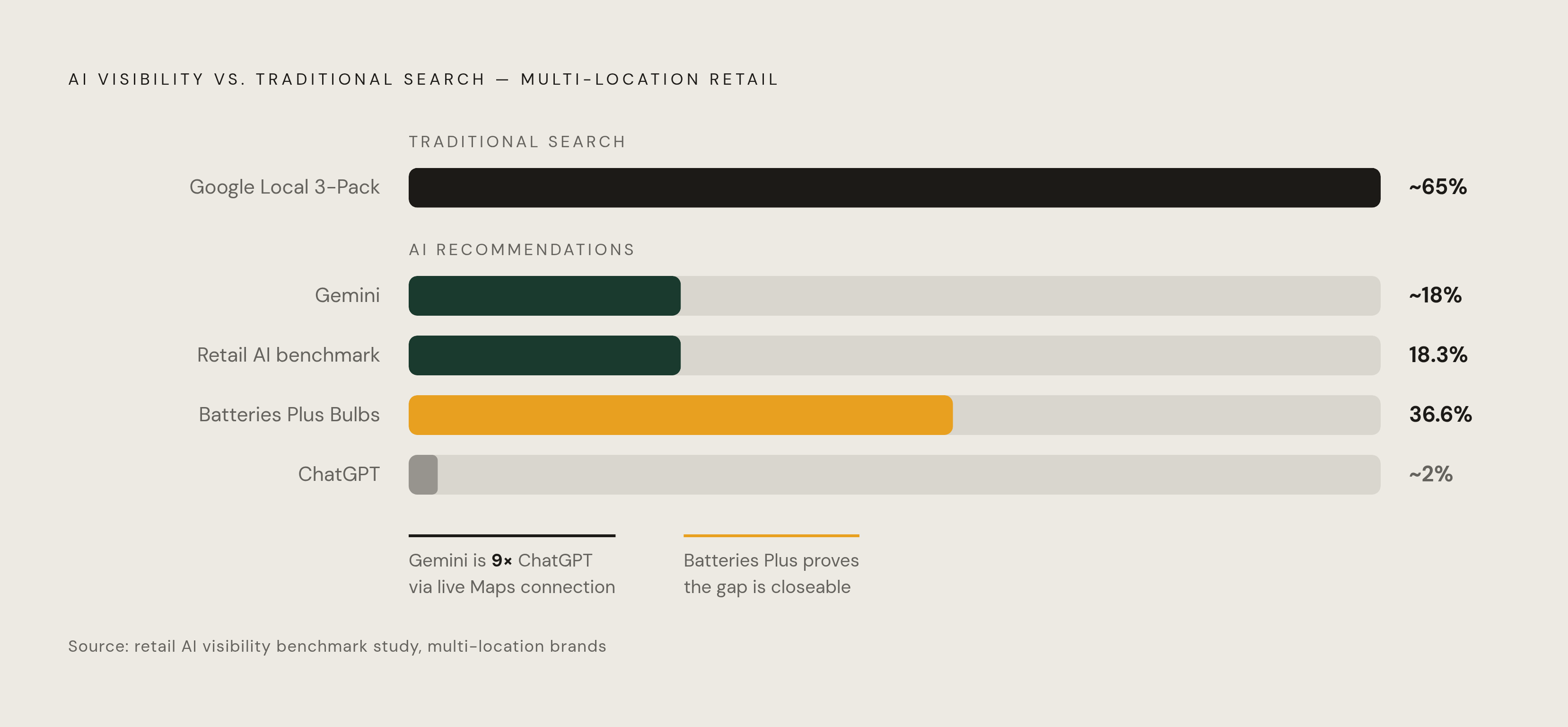
SOCi's 2026 Local Visibility Index studied a large sample of locations across thousands of multi-location brands and found that while those brands show up in Google's local 3-pack at a meaningful rate, ChatGPT recommended only a small fraction of those same locations. Earning a spot in an AI recommendation turns out to be a fundamentally harder achievement than earning a strong traditional search ranking. In retail specifically, fewer than half of the brands leading in traditional local search also ranked among the most recommended by AI platforms. Most of the brands currently winning on Google Maps are invisible to the growing number of shoppers asking an AI assistant where to go.
Gemini stands out as a partial exception, and the reason why is instructive. Its recommendation rate runs roughly nine times higher than ChatGPT's because it draws directly from live Google Maps data. That advantage only helps brands that already maintain complete, accurate Google Business Profiles, and it doesn't carry over to ChatGPT or Perplexity, which rely on a different mix of sources. Some brands have already closed much of the gap: Batteries Plus Bulbs posts a Gemini recommendation rate roughly double the retail benchmark of 18.3%, proof that the problem responds to deliberate, sustained work rather than remaining fixed by category or size.
Some marketing leaders still treat AI visibility as a future concern, something to address once AI search reaches mainstream adoption. That framing misreads where adoption already stands. Among high-income, high-intent consumers, the segment where the bulk of purchasing decisions concentrate, AI search is already the default starting point, not an emerging one.
Why strong Google performance no longer predicts AI visibility
A brand that ranks well in traditional local search can still be functionally invisible to AI assistants, and the explanation lies in what each system actually measures. The data infrastructure most multi-location brands have spent years building was designed for a search system that no longer dominates discovery on its own.
Google's local algorithm scores proximity, category relevance, and profile completeness as separate inputs, and a location can do well on each one independently of whether its data matches across other platforms. AI systems don't work that way. They need every signal, from every source, to line up before they'll recommend a location. A brand can have a polished Google Business Profile and still fail this test if its Yelp hours contradict its website or its Facebook address is outdated.
The accuracy gap between platforms makes the stakes concrete. Business profile information on ChatGPT and Perplexity is accurate at only a fraction of the rate Gemini achieves through its live Google Maps connection. That gap isn't abstract: a consumer who follows a bad AI recommendation ends up at a wrong address, calling a disconnected number, or showing up to a location that's already closed.
Review quality works as a gate in AI discovery rather than a factor that nudges a ranking up or down. SOCi's research found that brands with low star ratings and poor review response rates were shut out of AI recommendations entirely, regardless of how well they performed in traditional search. Coverage gaps across platforms make the problem worse: fewer than half of franchise locations that exist on Google also have a matching Facebook presence, leaving a meaningful share of locations absent from a source AI systems actively draw on. None of this reflects negligence on the part of marketing teams running competent, well-resourced local SEO programs. It reflects a mismatch between what those programs were built to optimize and what AI systems are actually evaluating.
How aggregated performance reporting hides failing locations
Most multi-location brands have no clear view of their own AI visibility problem, because the way they measure local performance obscures it by design. Aggregate reporting lets strong locations mask weak ones, and the specific metrics that would reveal an AI recommendation gap are missing from the dashboards most marketing teams check every week.
Street Fight has pointed to this as the core reporting failure: blended rankings, network-wide traffic trends, and overall review scores make two locations under the same brand name look like equivalent data points, even when one is fully eligible for an AI recommendation and the other has no chance of earning one. In a traditional search environment, that blending does little damage, since strong locations effectively subsidize weak ones in the aggregate number leadership sees. AI changes that math, because each location gets evaluated on its own, and a brand-wide average means nothing when the underlying system either names a specific address or leaves it out.
Compounding the problem, standard analytics tools like GA4 or Google Search Console don't track AI share of voice, so brands have no built-in alert telling them that a growing slice of consumer discovery is happening somewhere they can't currently measure and likely aren't winning. AI recommendation isn't a spectrum a brand climbs gradually. At the moment a consumer asks, a location is either named in the answer or it isn't, either cited as a source or left out entirely, which makes it a binary outcome rather than a position on a ranked list.
The organizational root of this goes back to how most brands divide responsibility for local data. Website content sits with one team, listings management with another, review responses fall to local store or franchise operators, and service details live with operations, each working from its own platform on its own schedule. That fragmentation produces inconsistency that stays invisible until an AI system tries to reconcile all those signals at once and finds they don't agree.
The specific signals AI systems use to decide whether a location earns a recommendation
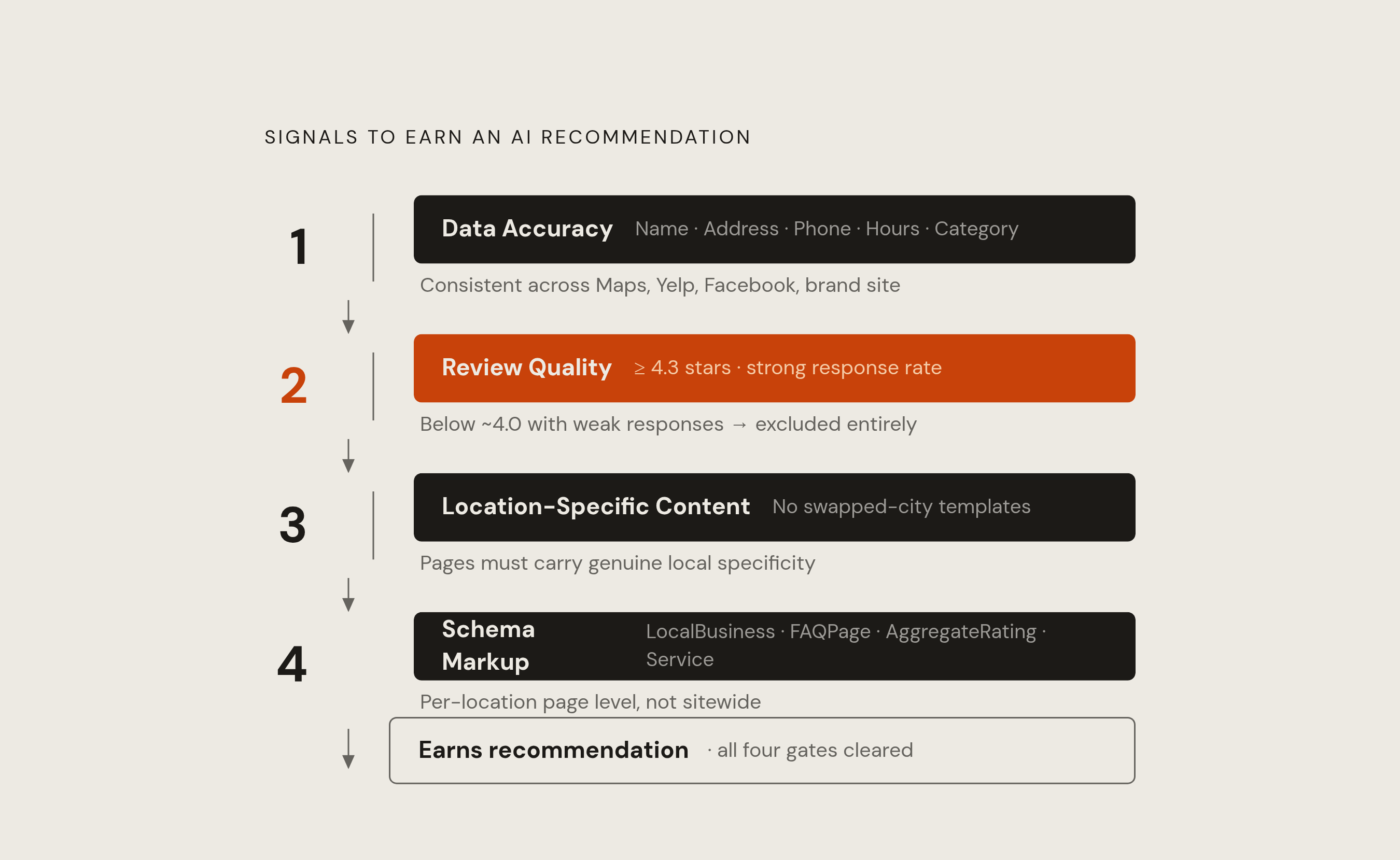
AI recommendation eligibility rests on four documented signals, and most multi-location brands are underinvesting in at least two of them.
The first is data accuracy and consistency across platforms. AI systems cross-check name, address, phone number, hours, and category attributes across Google Maps, Yelp, Facebook, and brand websites, and any conflict between those sources lowers confidence and raises the odds a location gets excluded. A stale address or a disconnected phone number doesn't knock a location down a few spots the way it might in traditional search. It tells the AI model the data can't be trusted, and the model simply moves to a different answer.
The second signal is review quality, which functions as a threshold rather than a gradual scale. SOCi's research found that locations recommended by ChatGPT averaged 4.3 stars, and locations falling below roughly 4.0 stars with weak response rates were excluded no matter how strong their other signals looked. Yext's 2026 research adds a consumer-facing dimension to this: review signals account for five of the top six factors that turn an AI recommendation into an actual store visit, so the same signals AI uses to judge credibility are what shoppers use to confirm the recommendation was worth acting on.
The third signal is structured, location-specific content. If a templated page just swaps in a city name but otherwise repeats the same boilerplate across hundreds of locations, it doesn't give an AI system enough to confidently recommend that particular address. Depth and specificity at the individual location level matter more now than at any earlier point in the history of local search, because AI systems are actively looking for detail, what a given location offers, who it serves, and in what context, and frequently can't find it anywhere on the brand's own website.
The fourth signal is schema implementation. Most multi-location brands have some version of LocalBusiness schema in place somewhere on their site, but very few have it built out at the individual location page level with the depth AI systems actually need. The schema types that make the biggest difference include LocalBusiness schema (or the relevant subtype) carrying name, address, phone, hours, geo coordinates, and a map link on every location page; FAQPage schema answering location-specific service questions; AggregateRating schema pulling in live review data; BreadcrumbList schema that makes the brand-to-region-to-location hierarchy clear; and Service schema spelling out what each specific location actually offers. These aren't cosmetic improvements. They tell an AI system a location is what it claims to be, where it claims to be, and open when it says it is, and most brands have simply skipped this layer.
The AI Visibility Gap in Independent and Smaller-Format Retail
Inside a single multi-location brand, the locations with the weakest, most incomplete data are also the ones AI systems are most likely to skip over, and that overlap concentrates AI invisibility in exactly the locations that can least absorb the lost traffic.
This plays out consistently within franchise networks. A flagship store in a major market, with a fully filled-out profile, active review responses, and content written specifically for that location, will reliably outperform a newer or lower-traffic store that's left running on whatever defaults the network provides. Research from Lightspeed found that a single word, "independent", dramatically reduced AI's tendency to default to recommending large national chains instead, which shows AI systems do respond to specificity when it's actually present in the data. The problem for most franchise locations is that the specificity capable of overriding AI's default preference for big chains is missing from their profiles in the first place.
That gap compounds over time rather than staying fixed. AI systems recommend the locations they can represent with confidence, those locations pick up more foot traffic and more reviews as a result, and that activity further strengthens their eligibility for future recommendations, while locations without strong documentation keep falling further behind. The pattern isn't random. It follows data quality directly, so the fix is available to any location willing to invest in it, regardless of size or market.
Requirements for a Different Approach to Local Content and Listing Signals
Closing this gap calls for a different kind of local data operation rather than a round of improvements to the one most brands already run. The practices that built strong traditional local SEO programs were designed to satisfy Google's algorithm, not the confidence-based evaluation AI systems now perform, and that mismatch is the actual problem.
The first requirement is unified listing management across every platform AI systems draw from. Google Maps, Yelp, Facebook, and the smaller directory sites are the combined source layer AI systems pull from at the same time, and every one of them has to be accurate for the confidence signal to hold together. Most multi-location brands have claimed close to all of their Google Business Profiles by now, but SOCi's 2026 Local Visibility Index found Facebook coverage is just 53.4% of Google coverage, and Yelp presence leaves a meaningful share of locations missing from a platform that actively feeds AI citations. Keeping that data consistent at scale takes continuous monitoring rather than a quarterly audit, since the discrepancies that build up between one audit and the next are precisely the conflicting signals AI systems use to rule a location out.
The second requirement is treating review management as a standing operational function rather than something left to whichever local manager happens to have time for it. Meeting the AI review threshold, roughly 4.0 stars with active, consistent responses, across hundreds or thousands of locations takes a systematic structure built for that purpose, not an informal expectation layered on top of a store manager's other responsibilities. Brands that treat this work as infrastructure, built, maintained, and monitored the same way they'd treat any other core system, are the ones already closing the gap between where they rank on Google and where they get named by an AI assistant.
Sources
- Why AI Is Raising the Cost of Inconsistency for MULO Brands
- AI for Local SEO: How Agents Improve Rankings for Multi-Location Brands - SOCi
- AI Gap: 98.8% of Franchise Locations Need Better AI Visibility
- Local Listings Benchmarks for Franchises: What Good Looks Like in 2026, and What It Now Takes to Be Found - SOCi
- AI Favors Big Retailers Over Local Stores 9 Out of 10 Times, New Study Finds - Lightspeed