Enrollment and Lead Volume Benchmarks for AI Search in Higher Education
Three schools now dominate AI search results for online degrees.

AI search now works as the front gate of college admissions, and most schools don't know the gate exists. Students build shortlists from AI-generated answers before an admissions site ever loads, and a school left out of those answers isn't in the running. This goes beyond a marketing gap. What's happening is a structural exclusion taking place upstream of anything an enrollment office currently measures.
How fast students adopted AI search, and how far institutions are behind
The speed of this shift matters more than the shift itself. EAB research found generative AI use in the college search rose from 26% of college-bound students in spring 2025 to 46% by late 2025, nearly doubling in under a year. Half of prospective students now use AI tools at least weekly, and most read Google's AI-generated overviews when those overviews show up. More telling: 56% say they trust institutions cited in AI-generated responses more than ones left out. Citation carries real weight here, functioning as credibility delivered in the same motion as discovery.
A question that doesn't have a clean answer keeps arising: why would the departments closest to this data be the ones moving slowest on it? Ellucian's 2025 survey found Marketing, Admissions, and Enrollment teams among the most cautious groups on campus about AI adoption, alongside Financial Aid offices, which ranked among the most cautious departments in the survey. Colleges have access to the same content platforms, the same schema markup tools, the same analytics stacks as anyone else, so the caution can't be explained by lack of access. A prioritization failure fits the pattern here far better than a technology gap does. The longer enrollment teams wait to understand how these systems decide who gets mentioned, the more entrenched the early movers become in the training data those systems draw from.
WICHE projects U.S. high school graduates, having peaked in 2025, will decline roughly 13% through 2041. Sit with those two numbers side by side, a shrinking applicant pool and a citation gap institutions can't yet see into, and the arithmetic gets uncomfortable fast. A funnel narrowing at the top and blind at the entrance doesn't correct itself, and it narrows further from here.
What the first AI citation benchmark study for online universities actually measured
The 5W Online Universities AI Visibility Index 2026 is the first attempt to rank major U.S. online universities by how often they get cited inside Claude and Google AI Overviews. It answers, for the first time with a shared metric, the question that actually matters: who shows up when a student asks an AI tool for help, and who doesn't.
The methodology tracked citation frequency across a defined set of prompts, covering the top 25 online universities by enrollment size and paid-search presence, measured across both Claude and Google AI Overviews. Supplementary research has explored how different AI engines weigh different source types when generating institutional recommendations.
Working through both studies side by side surfaces the finding that should reshape how any institution builds strategy around this data: AI recommendations shift by prompt intent, geography, and model. A subjective query like "best online college for working adults" pulls heavily from user forums and expert commentary, while a query about salary outcomes pulls from structured financial reporting instead. Citation share moves depending on what a student is actually asking. The result is a profile spread across many variables, one that resists collapsing into a single number an institution can point to and defend, and the old idea of one search ranking doesn't map onto that. What these studies track is reference rate: how often an institution gets named in a generative response — a measure that matters on an answer layer where clicks no longer reliably drive conversion.
The concentration at the top: what WGU, SNHU, and ASU's citation shares reveal
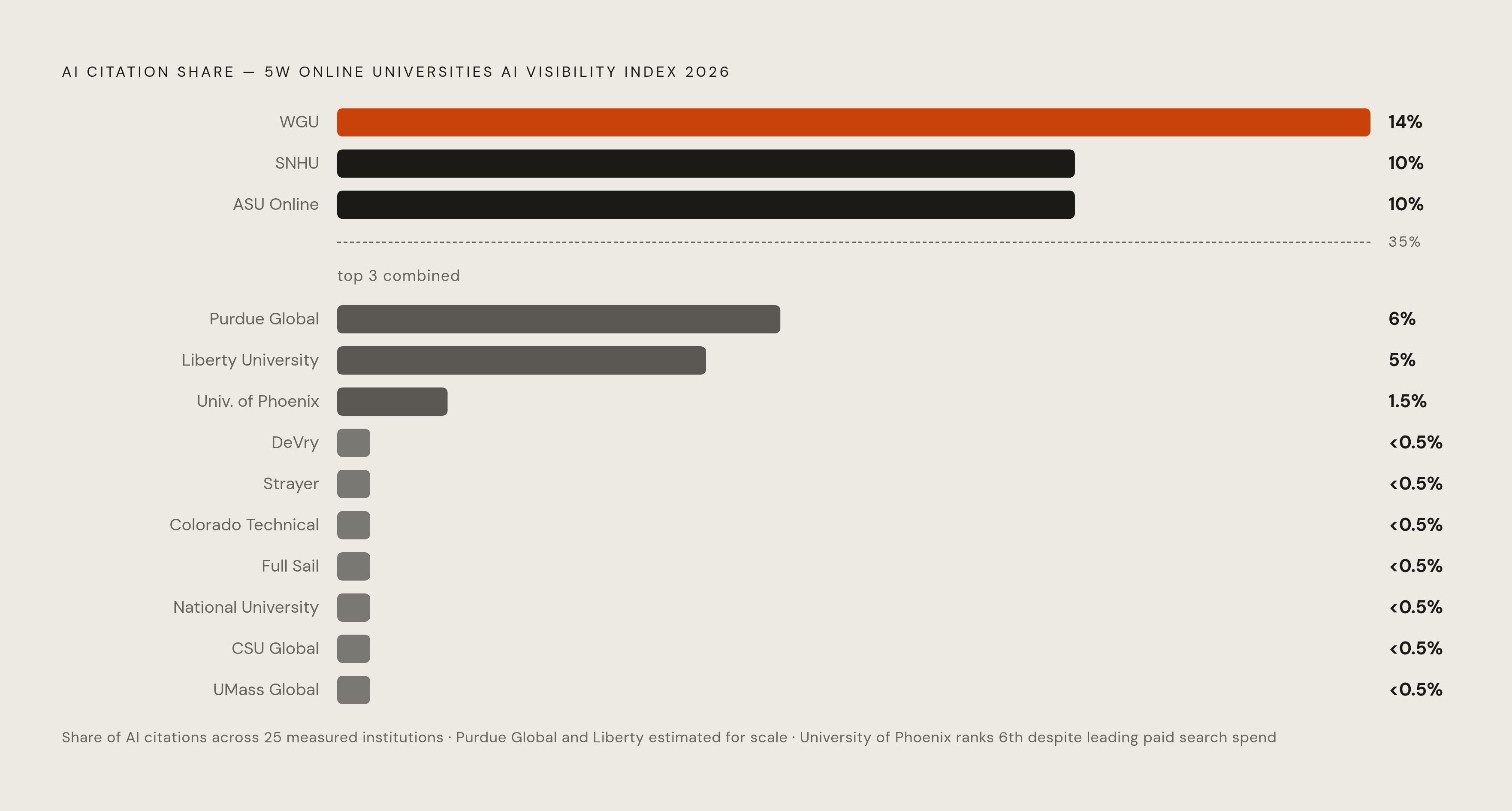
Three schools account for 35% of all measured AI citations in the online university category. Western Governors University leads at 14%, followed by Southern New Hampshire University at 10% and Arizona State University Online, also at 10%. That's a startling concentration for a category with 25 competitors in the measured set, and the gap widened further in early 2026: Early advantage compounds here; nothing in the data suggests it reverses on its own.
Digging into why these three specifically pulled ahead, each school's position traces back to a distinct, legible content strategy rather than luck or brand size. WGU built its share around its competency-based degree model paired with aggressive content on employer recognition, and it effectively owns AI responses to queries like "cheapest online bachelor's" and "best online college for working adults." SNHU runs the broadest program catalog in the category and backs it with a disciplined presence across U.S. News, Niche, and Forbes Advisor, giving AI systems a dense, consistent third-party record to pull from alongside SNHU's own site copy. ASU Online carries the research authority of an R1 institution directly into its online programs, with no separation in its entity profile between campus and online, so the university's full institutional weight transfers to every online-specific query.
Each made its core differentiator visible and repeatable across the outside sources AI systems actually cite, building well past its own domain. That's the same shape seen in other AI-indexed categories: a small number of authoritative entities pull ahead early, and the gap hardens rather than closes as more training data accumulates around them.
Why the University of Phoenix's 1.5% citation share is the sharpest proof point in the dataset
University of Phoenix spends more on paid search than nearly any competitor in the category, yet it captures just 1.5% of measured AI citation share. Sitting with that gap for a moment, between what gets spent and what gets returned, it becomes the clearest evidence in the dataset that dollars poured into traditional digital advertising don't transfer into AI visibility. Any enrollment leader still budgeting as if they do is working from a broken model.
The scale of the spend makes the mismatch harder to explain away. Total digital media spend across higher ed passed $2.77 billion in 2025, while non-brand paid search costs per click climbed 30.9% year over year. Institutions pay more each year for placement in an auction that fewer students even finish, since a growing share of searches now end at an AI Overview instead of a results page.
The reason, once you trace it through, turns out to be mechanical rather than mysterious. Paid search buys a spot in an auction, while AI citation gets earned through content authority, consistent entity descriptions across the web, and corroboration from outside sources, a process no ad budget can shortcut. Seven other established online universities in the dataset, DeVry, Strayer, Colorado Technical, Full Sail, National University, Colorado State Global, and UMass Global, each hold under 0.5% citation share. That's functionally invisible on the layer where a growing share of prospective students now do their first round of comparison shopping.
There's a broader exposure worth flagging for compliance and communications teams: how an institution is described across the web affects whether it gets cited at all. The larger point holds: a school can spend heavily, rank well in paid search, and still be absent from the actual decision conversation happening one layer above it.
What AI search benchmarks should sit alongside traditional enrollment metrics
Cost per inquiry, cost per application, cost per enrollment, yield rate: enrollment offices have leaned on these for years, and all of them measure what happens after a student lands on an institution's own website or fills out a form, without capturing whether the student ever considered the school in the first place. AI citation benchmarks fill that gap, and treating them as optional is the mistake most institutions are making right now.
Breaking the measurement problem down, the layer needs four things, and they don't substitute for each other. Citation share broken out by prompt intent (program discovery, cost and value, outcomes, geographic fit) shows where an institution wins or loses the conversation by query type rather than as one blended number. Citation share by engine matters just as much, since Claude, Google AI Overviews, Perplexity, ChatGPT, and Copilot each surface institutions differently; a single-engine ranking misses the fuller picture entirely. An entity consistency score, tracking how uniformly an institution gets described across ranking sites, editorial coverage, forums, and structured data, flags where the third-party record runs thin or contradictory. Citation velocity, whether share is rising, flat, or falling between measurement periods, is arguably the most important of the four: the Big Three's concentration at the top is a momentum story as much as a share story.
Reference rate maps to funnel position more cleanly than click-through rate does now, given how much traffic AI Overviews have already displaced. Board-ready reporting goes one step further: connecting movement in citation share to actual changes in inquiry volume from AI-referred sessions. Establishing that correlation, even a rough one, is what earns AI search its own line item in next year's budget instead of a side experiment nobody owns.
How institutions that are winning AI citations built the content signals that earn them
The term "generative engine optimization" comes from a research paper out of Princeton, Georgia Tech, and IIT Delhi. The practice has since split into two related disciplines: GEO, optimizing to be the source an AI system cites, and AEO, structuring content so it can get pulled directly into a generated answer. Generative engines weigh content against three things: authority, whether it's credible and current; relevance, whether it answers the specific question asked; and trust, whether the institution gets described consistently across channels and mentioned by reputable outside sites.
For a college or university, GEO reaches well past the.edu domain. AI systems pull from institutional websites, social channels, video, community forums like Reddit and College Confidential, ranking sites like Niche, U.S. News, and Forbes Advisor, and alumni media, often at the same time. Polishing one of those surfaces while leaving the others inconsistent creates exactly the kind of gap that keeps a school out of citations, even when its own website looks sharp.
Numbers from the Princeton, Georgia Tech, and IIT Delhi research put weight behind these tactics. Adding statistics to a page improved AI visibility by 41%, a substantial lift the researchers measured for that content change. Structured data, meaning schema markup, is the most effective technical lever available in 2026, since large language models lean on it even more heavily than traditional search engines do. FAQ schema produces a measurable citation lift on its own, and pages updated within the past few months earn noticeably more citations than pages left untouched for a year or longer.
Because visibility varies so much by what a student is actually asking, institutions need content built around distinct prompt categories: cost-and-value questions, program-specific discovery, geography, and salary outcomes each pull from a different layer of source material. Comparison queries ("SNHU vs. WGU for working adults," "ASU Online vs. Purdue Global for MBA") rank among the fastest-growing prompt types in 2026, and no single publisher has locked down that territory yet. Whichever institutions or third-party sites produce credible comparison content first will likely hold those citations for a long stretch, the same way WGU, SNHU, and ASU locked in their current lead. The EdTech AI Visibility Index, also from 5W in Q1 2026, shows the identical pattern in an adjacent category: Brilliant sits at just 1.0% and rank 15, a reminder of how fast citation share can collapse without sustained effort behind it.
Treating AI citation share as a first-class enrollment metric, not an experimental add-on
There's now a stage of the enrollment funnel sitting in front of everything institutions currently measure: the AI discovery and shortlisting phase, and 46% of college-bound students are already living in it. Most enrollment teams have no visibility into this stage at all, and that blind spot is the actual story here, well beyond some future risk waiting to materialize.
Institutions that start tracking citation share next to cost per inquiry, cost per application, and yield rate gain something the old metrics can't offer: the ability to see where prospective students drop off before they ever reach an inquiry form. That diagnostic value alone justifies building the measurement now, before the gap widens further.
The acceleration among WGU, SNHU, and ASU through early 2026 points to a pattern that should worry any school not already in that top tier. Early movers shape the training signals AI systems rely on, which earns them more citations, which builds more third-party authority, which makes them harder to displace next quarter. The window for catching up narrows with each measurement cycle, and it does not widen.
Layer the demographic decline on top of that, and the cost of sitting out stops being theoretical. Every institution competes for a shrinking pool of prospective students, and AI invisibility removes candidates from consideration before a single recruitment email goes out. That shows up in inquiry volume, a number every enrollment office already tracks, carrying weight well beyond some abstract measure of brand equity.
Getting this into regular reporting doesn't require a research department. Set a baseline citation share across the major engines (ChatGPT, Perplexity, Claude, Google AI Overviews, Copilot) for the query types that matter most to enrollment, then track citation velocity quarter over quarter next to the lead volume numbers already on the dashboard. Connect shifts in citation share to inquiry volume from AI-referred sessions, and the case for giving AEO and GEO their own budget line builds itself. Put AI citation share in front of academic leadership in the same dashboards as everything else. That's how a new metric stops being an experiment and starts being infrastructure.
Institutions that hold AI citation share to the same standard as paid search or email yield, measured, reported, defended in budget meetings, will know exactly where prospective students get won and lost. Schools waiting for AI search to "mature" before investing have already made their choice, whether or not the enrollment numbers have caught up to confirm it yet.