AI Search Visibility ROI Compared to Paid Search Investment
AI visibility compounds over time while paid search rents short-term clicks at rising cost.

Paid search and AI visibility are different kinds of investment. One is rented, the other built. Grading both against the same yardstick is a category error before you've even opened the spreadsheet.
Click-through rates on paid ads have taken a real hit on queries that trigger AI Overviews, dropping well below what those same queries used to deliver before Google started summarizing answers at the top of the page. Advertisers pay similar rates, sometimes more, for a smaller slice of the clicks. Even paid searches that never trigger an Overview have seen click-through rates slide over the same stretch. This pattern shows up well beyond some narrow subset of informational queries, appearing almost everywhere.
Cost per click has climbed at its steepest pace in years. Some of that is ordinary auction competition. Some of it is brands scrambling for placement in a results page where AI Overviews have physically shoved ads further down. Neither explanation fully accounts for the pattern alone, which is what makes me think it's both at once. The same ad budget buys fewer clicks than it did twelve months ago, and the shape of the decline looks structural, not seasonal. AI Overviews are absorbing the informational intent that used to drive a lot of upper-funnel paid volume, so advertisers lose position and audience at the same time.
Rising cost per click, falling click-through rate, and a cost-per-lead that keeps creeping upward across most major verticals. For anyone building an ROI model, the cost side keeps growing while the clicks and leads on the other side keep shrinking, and the two problems feed each other. Expecting that ratio to reverse as AI Overviews expand into more query types would be wishful thinking.
Why AI-referred visitors convert differently than paid visitors
Visitors who arrive from AI search convert at meaningfully higher rates than visitors from paid search or traditional organic listings. Multiple independent studies have found this. In some cases the gap is wide enough to change a media plan on its own.
Why would this be true? Someone who clicks through from an AI Overview has already read a synthesized answer to their question. They show up with more context, higher intent, and a shorter remaining path to a decision than a visitor who clicked a paid ad and landed mid-funnel, still trying to work out whether this is even the right product category.
The exact conversion lift varies a lot across studies, industries, and how each one defines a conversion in the first place. I wouldn't hang a budget decision on any single number here. But the direction holds across every study examining this question, and that consistency is worth more than any one headline figure.
There's a volume story underneath the conversion story, too. The share of total organic traffic coming from AI referrals has grown a lot for top-performing sites since early 2025. Brands with strong AI visibility are starting to track this as an actual line item worth its own row in the report. If AI-referred visits convert better and cost less on the margin than paid clicks, the cost-per-acquisition math starts tilting in AI's favor. That upside applies only to brands that did the work to earn the visibility. Nobody gets this channel for free.
The citation effect: where AI visibility and paid search stop competing and start compounding
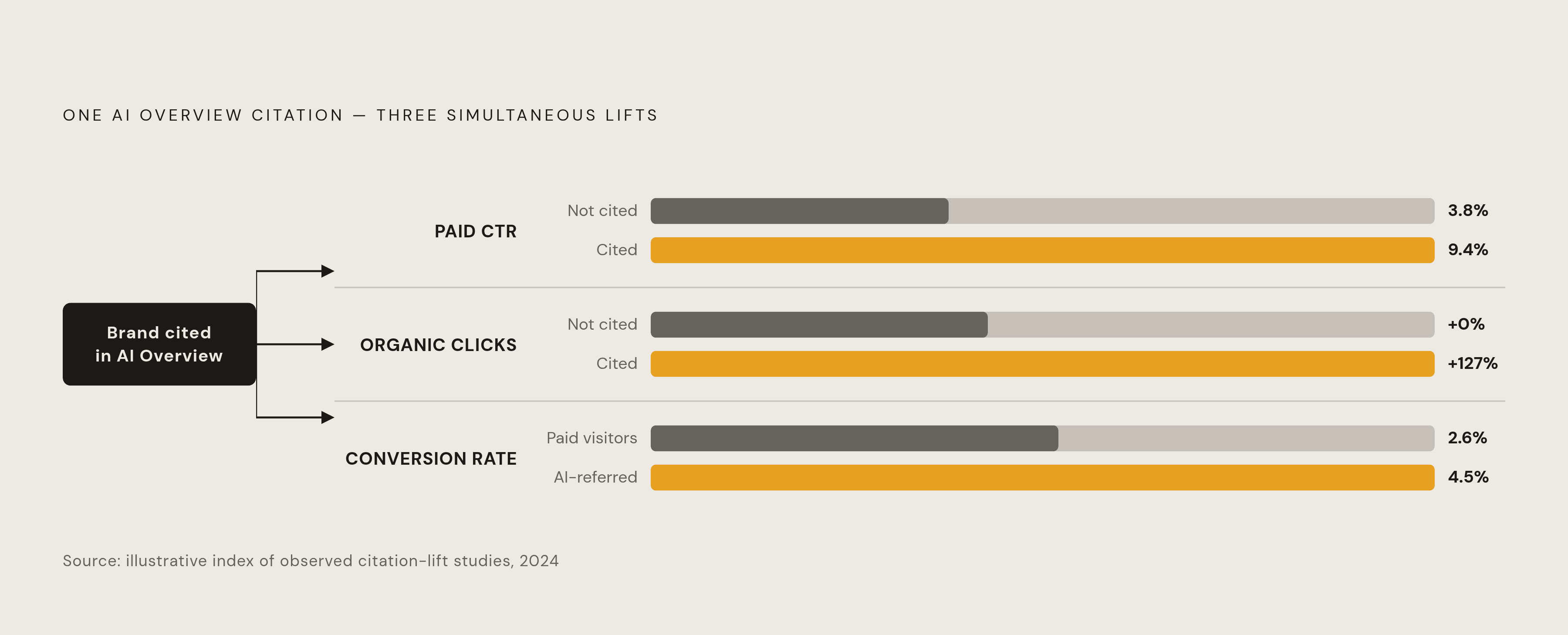
Seer Interactive ran an analysis across dozens of client accounts and found something that should reshape how marketing leaders think about these two channels. When a brand gets cited inside an AI Overview, its paid click-through rate on the same query jumps compared to when the brand isn't cited. Not a small bump. A real gap.
The effect extends to organic performance as well. The same research found cited brands also pull in meaningfully more organic clicks. One citation lifts both channels at once, which cuts against how most marketing teams still think about SEO and paid: separate budget lines, competing for the same finite dollars.
Getting cited by name inside an AI Overview works as social proof delivered at the exact moment a user has the highest intent to act. If the AI just told someone that Brand X is a leading option, and Brand X's paid ad or organic listing shows up right below that summary, the user is far more likely to click it. The AI did the trust-building work before the person even reached the results page.
That changes what GEO investment (generative engine optimization, the practice of earning citations inside AI-generated answers) actually does. It makes paid search budget work harder, adding a benefit on top of existing spend rather than pulling dollars away from it. A brand's AI presence sits on top of every paid impression served in that same query environment. This might be the strongest financial case for treating AI visibility as a primary investment: it throws off returns across multiple channels at once, not just its own isolated metric.
Here's the catch: most marketing teams have no way today to trace that citation lift back to GEO spend. The cross-channel benefit is real, Seer's data says so, but it stays largely invisible inside the attribution tools most teams run right now.
The fundamental ROI mechanics that make these two channels structurally different
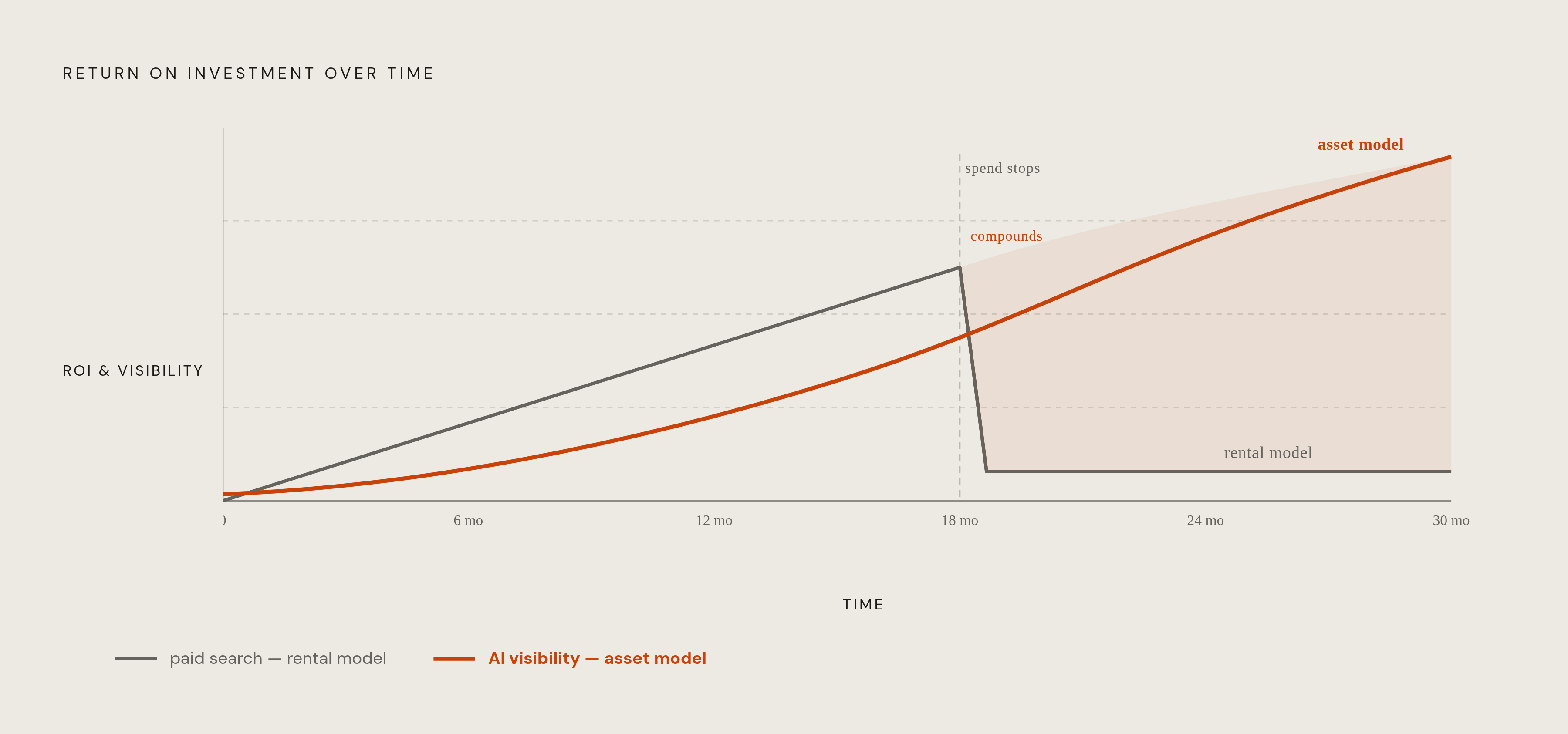
Paid search runs on a rental model. Visibility exists exactly as long as the budget keeps flowing; turn off spend and the presence disappears by the next auction cycle. Every bit of efficiency a team earns has to get re-earned the following month, the following quarter, forever, with no equity building up in the background.
AI visibility works more like an asset. Citation authority, entity clarity, earned media mentions, all of it stacks up over time. A brand that earns consistent citations in its category builds a position that gets progressively harder for a late-arriving competitor to knock loose. That's a different growth curve entirely.
Paid search ROI scales roughly in a straight line with spend. More budget buys more impressions, which buys proportionally more leads, assuming the auction dynamics hold steady. AI visibility ROI compounds instead: a strong citation footprint drives organic traffic, paid performance, and direct traffic all at once, and each new citation reinforces the authority signal that large language models use to decide who to recommend next time.
The time horizons don't match, either. Paid search delivers measurable results within days of turning campaigns on. AI visibility builds over months, sometimes longer, depending on how competitive the category is. These two channels belong in different parts of a planning calendar, judged on their own timelines rather than crammed into one budget line and reviewed on the same quarterly clock.
The risk profiles diverge too, and untangling them is worth the effort. Paid search risk sits on the spend side: auction competition, rising CPCs, a platform changing its ad policy overnight. AI visibility risk sits on the content side: hallucination exposure, entity confusion when a brand's identity signals are muddy, losing a citation because a competitor published a better-sourced piece of content. Which combination produces the best risk-adjusted return depends on a brand's competitive position and how much runway it has left.
Why current attribution tools obscure the true cost and value of each channel
A large share of marketing leaders can't currently trace a discovery event inside AI search through to a downstream conversion. The session breaks the moment a user leaves the AI answer and lands on a website, and the referral chain that attribution software depends on doesn't survive that hop.
Most analytics stacks weren't built to treat AI-referred traffic as its own channel. It often lands in the "direct traffic" bucket instead, which inflates how much credit direct gets and understates what AI visibility is actually contributing. Paid search, by contrast, benefits from decades of attribution infrastructure. Last-click models, linear models, data-driven models: they all default to treating a paid click as a clean, measurable event. AI citations don't have an equivalent tracking layer yet, not one with wide adoption.
The practical result is a distorted picture on both sides. Paid search ROI gets overreported, because some of the lift it's actually receiving comes from AI citations and gets credited entirely to paid instead. AI visibility ROI gets underreported, because its contribution shows up through channels that carry no fingerprint pointing back to the citation that caused it.
So what should marketing leaders actually do? Start treating AI referral traffic as its own tracked segment instead of letting it hide inside direct. Set baseline citation metrics across the major AI platforms before drawing conclusions about ROI. And accept, plainly, that a missing number on a dashboard doesn't mean a missing effect in the real world.
Seer's citation-effect finding matters here for a specific reason: some portion of what dashboards currently report as paid search ROI is actually a return on AI visibility investment. Trace the lift back to its source, and the paid channel looks a lot less impressive in isolation.
The GEO disciplines that build AI citation authority
Content strategy has to shift from keyword-first thinking to prompt-first thinking. AI engines synthesize answers to questions rather than ranking pages against search terms, so content needs to be built so it can get pulled apart and extracted, not just crawled and indexed.
Information gain matters more than most content teams currently realize. Forrester's 2026 research found that content offering genuine information gain, proprietary data, original research, direct quotes from subject-matter experts, ranks a lot higher in AI-generated responses than content that just restates the existing consensus. That's the structural investment that builds a durable citation advantage instead of a fleeting one.
Entity clarity is foundational, not optional. When a brand's identity signals are weak or inconsistent, AI engines fill the gaps with hallucinated details, sometimes badly wrong ones. Rigorous schema markup, consistent entity data across the web, a clearly maintained brand facts page: this is protective infrastructure, the same way a company keeps its own books straight.
E-E-A-T (experience, expertise, authoritativeness, trustworthiness) remains the trust architecture underneath both traditional search rankings and AI citation decisions. These principles carried weight before AI Overviews arrived, and if anything, they matter more now.
PR and earned media deserve a serious re-rating here. Third-party mentions, analyst citations, unpaid press coverage: these are among the strongest signals large language models use when deciding which brands to recommend. Research across large sets of domains has found that brand web mentions are among the strongest predictors of AI citation. PR now carries real weight in the citation math, functioning as infrastructure rather than sitting off to the side as a soft brand exercise.
Recency counts, too. Large language models tend to favor the most recently updated version of content that matches a given query, so regular content refreshes aren't just good housekeeping. They're a direct citation tactic with a measurable effect.
Cross-platform consistency can't get overlooked. ChatGPT, Perplexity, Gemini, Claude, Copilot, and Grok don't weight the same sources the same way, and a brand well-cited on one platform might be invisible on another. Real AI share of voice takes deliberate work spread across every major platform a brand's customers actually use, not effort piled onto whichever one gets the most headlines this month.
How to measure AI search visibility on financially meaningful terms
The core unit of AI visibility is the citation. Traditional search rankings sit on a continuous scale, position one through position ten and beyond, but AI search is much closer to binary: a brand either gets cited in a given response or it doesn't. That binary quality is actually a gift for measurement, since it makes share of voice a genuinely clean metric to track.
The formula itself is simple: AI Share of Voice equals brand citations divided by total category citations, times 100. Getting that number means picking a set of prompts relevant to the category, running them systematically across the major AI platforms, and counting how often the brand shows up in the responses.
Three sub-metrics are worth tracking apart from the composite score. Mention rate measures the share of AI responses that name the brand at all, a pure visibility number. Citation rate measures the share of responses that actually link to or reference a brand-owned domain, and it can move independently of mention rate, since an AI might name a brand in prose without linking to it, or link to a page without ever naming the brand directly. Share of voice measures brand citations against a defined competitive set, and it's the most useful of the three for making actual positioning decisions.
A framework well established in traditional marketing effectiveness research applies here without much modification: brands whose share of voice exceeds their current market share tend to grow, and brands whose share of voice trails their market share tend to shrink. AI share of voice works the same way. It's a leading indicator of where a brand's competitive position is heading, useful for strategic decisions well beyond a slide-deck statistic.
Monitoring needs a rhythm to mean anything: daily scans for the highest-priority topics, weekly checks on overall brand trend, monthly competitive analysis to catch positioning shifts before they turn into real trouble. That cadence is what turns AI visibility into a channel a team actively manages, shaping outcomes rather than just watching what happens to the brand from the sidelines.
Marketing leaders already speak a financial language for paid search: cost per click, cost per lead, ROAS. AI visibility needs the same vocabulary: cost per citation, citation-influenced conversion rate, AI-attributed pipeline. Once both channels speak that same dialect, they can finally get judged on the same terms.
A framework for allocating budget across paid search and AI visibility investment
Whether to shift budget from paid search into AI visibility is the wrong question. The citation-effect evidence makes clear these channels boost each other rather than compete for the same dollar. The real question is what mix of the two produces the best combined return for a specific brand in a specific category.
Four variables should drive that split. Competitive AI citation position comes first: a brand sitting at a low AI share of voice in a category where competitors get cited constantly has an urgent catch-up problem, while a brand that already leads on citations has more of a maintenance job. Sales cycle length matters next: longer B2B cycles benefit more from compounding AI authority, since buyers tend to run multiple AI-assisted research sessions before ever picking up the phone, while short transactional purchase cycles may still justify weighting the budget toward paid for the sake of speed. Category query concentration is third: categories where a large share of discovery-intent searches trigger AI Overviews face the steepest paid click-through erosion, and that's exactly where the ROI case for AI investment is strongest. Attribution maturity closes the list: any team that can't yet trace AI traffic through to conversion needs to fix that measurement gap before it draws final conclusions about where the budget should go.
A practical starting point looks like this: segment AI referral traffic as its own tracked channel, set baseline citation metrics across the major platforms, then run a controlled test. Pick one category, invest in content aimed at lifting citations there, and build in conversion tracking from day one before scaling anything further.
There's also a defensive argument that applies even to marketing leaders who stay skeptical of AI visibility ROI on the numbers alone. Weak entity signals leave a brand vulnerable to being misrepresented or ignored by AI tools, and that damages the very brand recognition that paid search performance depends on. That's the floor case for some minimum GEO spend, regardless of where anyone lands on the bigger strategic question.
At the executive level, AI search visibility deserves a seat in the same performance review as paid search, evaluated alongside it as a standing agenda item rather than a separate report glanced at once a quarter. Citation rate, AI share of voice, and AI-attributed pipeline belong next to cost per click, click-through rate, and cost per lead, so leadership ends up managing a portfolio instead of optimizing two channels in isolation from each other.
Waiting has a price, and it goes up the longer a brand puts this off. AI authority compounds, so the brands building citation footprint now will be that much harder to displace once the discovery patterns in their category settle into place. Platforms like AthenaHQ, an enterprise AEO and GEO platform that tracks brand citation presence and share of voice across eight or more major large language models simultaneously, exist precisely to help brands measure and manage that compounding before competitors do.