AI Visibility Platform Comparison for Enterprise Brand Teams
Enterprise brand teams no longer get to file AI search under "watch and wait." Search behavior has already moved past the pilot-program stage, and the platforms built to measure that shift split into two camps: tools built for a marketing team running one experiment, and tools built for a brand operating across a dozen markets and several AI engines at once. This piece lays out how to tell the two apart, and why picking the wrong one costs more than a subscription fee. The wrong choice doesn't just waste budget. It leaves a brand measuring the wrong thing while its actual visibility problem compounds underneath the dashboard.
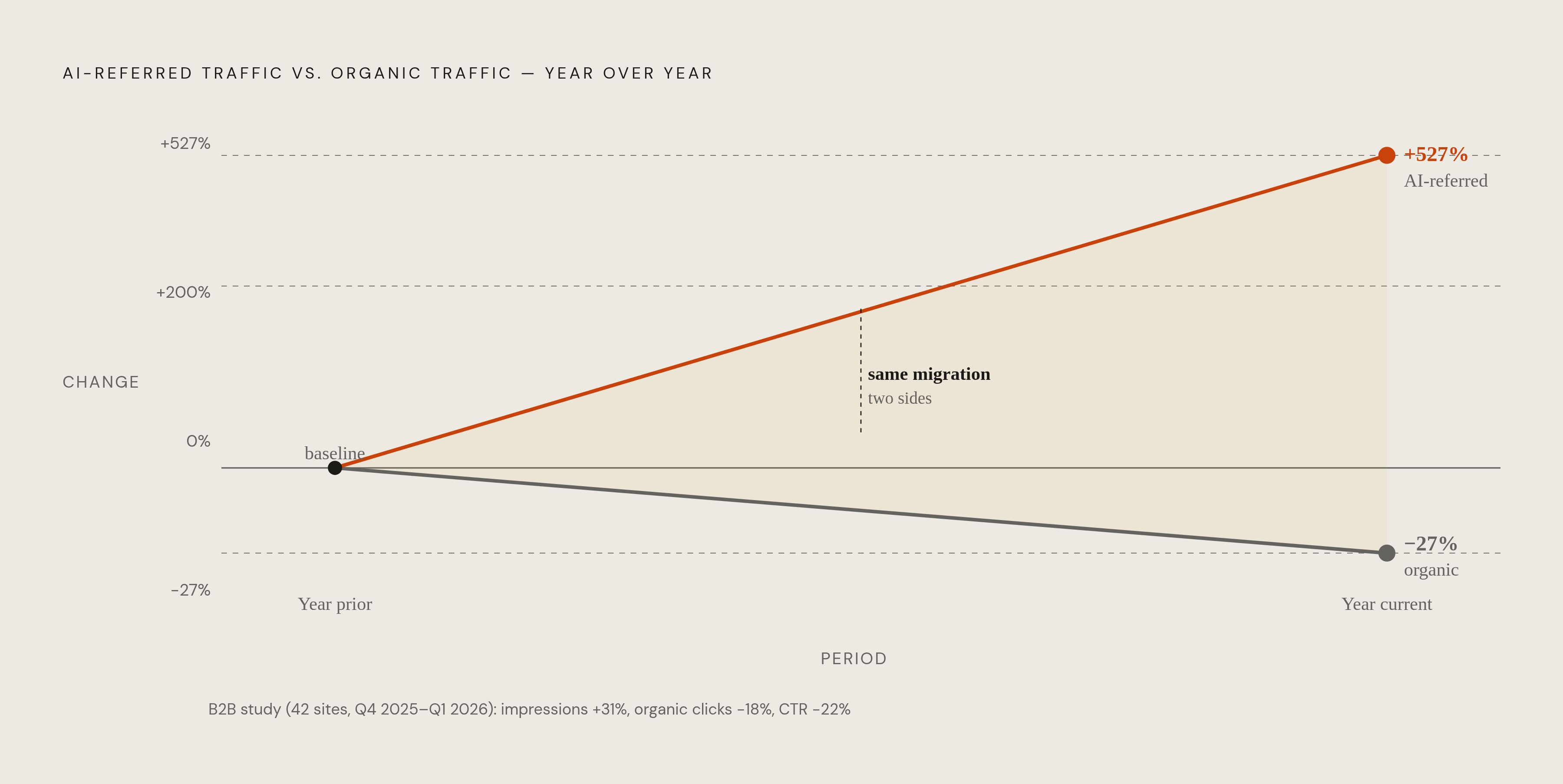
Over half of search queries, 58.5% of them, now get resolved inside an AI assistant with no click to a website. McKinsey projects roughly $750 billion in US consumer revenue will move through AI-powered search by 2028. AI-referred traffic to sites grew 527% year over year while traditional organic traffic fell 27% over the same stretch, and those two lines are moving together because they're the same behavioral migration, seen from two sides of the same fence.
A study tracking 42 B2B websites from Q4 2025 through Q1 2026 put a name to a pattern brand teams had been describing anecdotally for months: impressions rose 31% year over year, while organic clicks dropped 18% and click-through rate fell 22%. Brands show up more than ever in searches and AI summaries, and get clicked less than ever, because the AI answer already gave the user what they came looking for. Visibility and reachability have split apart, and most legacy SEO reporting still treats them as one number.
That's the mistake to name directly: most enterprise teams read a traffic dip as a budget problem when it's a measurement problem. A brand losing a fifth of its organic traffic needs a budget conversation. One losing half of it needs a strategy conversation. Most teams can't tell which side of that line they're on, because the dashboards they inherited were built to count clicks, not to explain why a page gets cited by an AI model and never visited.
What AI visibility platforms measure, compared to SEO metrics
Three disciplines get lumped together in vendor decks: SEO gets a page discovered in a ranked list of results, AEO gets an answer pulled directly into a featured snippet, a knowledge panel, or an AI-generated summary. SEO gets a page discovered in a ranked list of results. AEO, Answer Engine Optimization, gets an answer pulled directly into a featured snippet, a knowledge panel, or an AI-generated summary, structured so it can be lifted out whole without anyone clicking through. GEO, Generative Engine Optimization, is the newest and most consequential of the three: it means getting a brand recommended and cited inside an AI-generated response. The term came out of a Princeton University research paper and, by 2026, had turned into a line item on enterprise marketing budgets rather than an academic curiosity.
Gemini, ChatGPT, and Perplexity don't just generate text from a trained model. They run Retrieval Augmented Generation, pulling live web content, summarizing the most relevant passages, and citing sources as they go. AEO and GEO work resembles SEO in some structural ways (keyword relevance and content clarity still matter), but the behaviors that get rewarded diverge sharply from there. A page tuned to rank well in Google's ten blue links is not automatically a page that gets quoted mid-answer by a model that never shows the user a link.
So the metrics that matter here look nothing like a rank tracker's output. Citation share measures how often a brand's own content gets pulled into an answer. Share of voice tracks presence across a defined set of prompts. Entity recognition asks whether the model understands what a brand is and does, as opposed to confusing it with a competitor or missing it. Source attribution traces which pages the model pulled from to build its answer. None of that appears in a search console or a legacy analytics dashboard, because those tools were built to count clicks and visits, not to answer these questions.
The category has converged on one primary number: AI Share of Voice, a ratio of brand mentions to total tracked mentions across a defined prompt set. Two flavors of this metric exist, citation-based and entity-based, and they answer different questions: one about sourced references, the other about raw brand recognition inside generated text. A vendor that can't explain which variant it's reporting, or why, is a vendor whose numbers don't deserve trust yet. That distinction sounds technical until a brand realizes it's been comparing entity-based numbers from one tool against citation-based numbers from another and drawing conclusions from noise.
The four criteria that separate enterprise-grade platforms from the rest
Homepage to homepage, this category looks nearly identical. Tracking, citation alerts, competitive benchmarking: nearly every vendor promises the same three things in close to the same words. The differences that matter to an enterprise buyer surface only once you get past the marketing page, and they cluster around four dimensions. Get these four wrong, and the rest of the evaluation doesn't matter.
Breadth of engine coverage sits at the top of that list, and for good reason. Citation overlap across engines runs remarkably low, and even within Google's own products, different AI surfaces frequently cite different URLs despite often landing on similar conclusions. That's a structural fact about how these systems retrieve and weigh sources, and it means single-engine tracking misses most of the picture by design, not by oversight. Market share has also shifted fast enough to make single-engine tracking actively dangerous: engine share has shifted fast enough that a leading model's dominance of B2B AI referrals has eroded meaningfully, while Claude, Gemini, Perplexity, and Copilot have each taken on greater share. A brand watching only one engine today is blind to a substantial share of its measurable AI referral traffic. Any enterprise RFP should demand the vendor's full engine matrix in writing, not a marketing line about "leading AI platforms." Read the fine print on which engines sit behind which pricing tier before signing anything. Vendors have been known to bundle multi-engine tracking into a mid-tier plan while holding back some of the harder-to-cover engines for the enterprise contract.
Sampling rigor is the second criterion, and it's the one buyers skip past most often, usually because it's the least visible on a sales call. AI model outputs are non-deterministic: run the same prompt once, then run it fifty times, and the citation set won't repeat. A single snapshot query is one result among many possible outcomes, not a measurement anyone should build strategy on. Few vendors publish real numbers on prompt database depth, which makes this the easiest thing to demand in a procurement conversation and the fastest way to separate serious vendors from the rest. Some platforms report multi-billion-prompt corpora with hundreds of millions of tracked conversations. Others build sampling directly into the product, running a fixed number of sessions per query instead of leaving methodology up to the buyer's guesswork. Most of the category publishes no dataset size at all, and that silence is itself the answer: findings drawn from tens of millions of real prompts carry a different evidentiary weight than findings drawn from a set nobody will disclose.
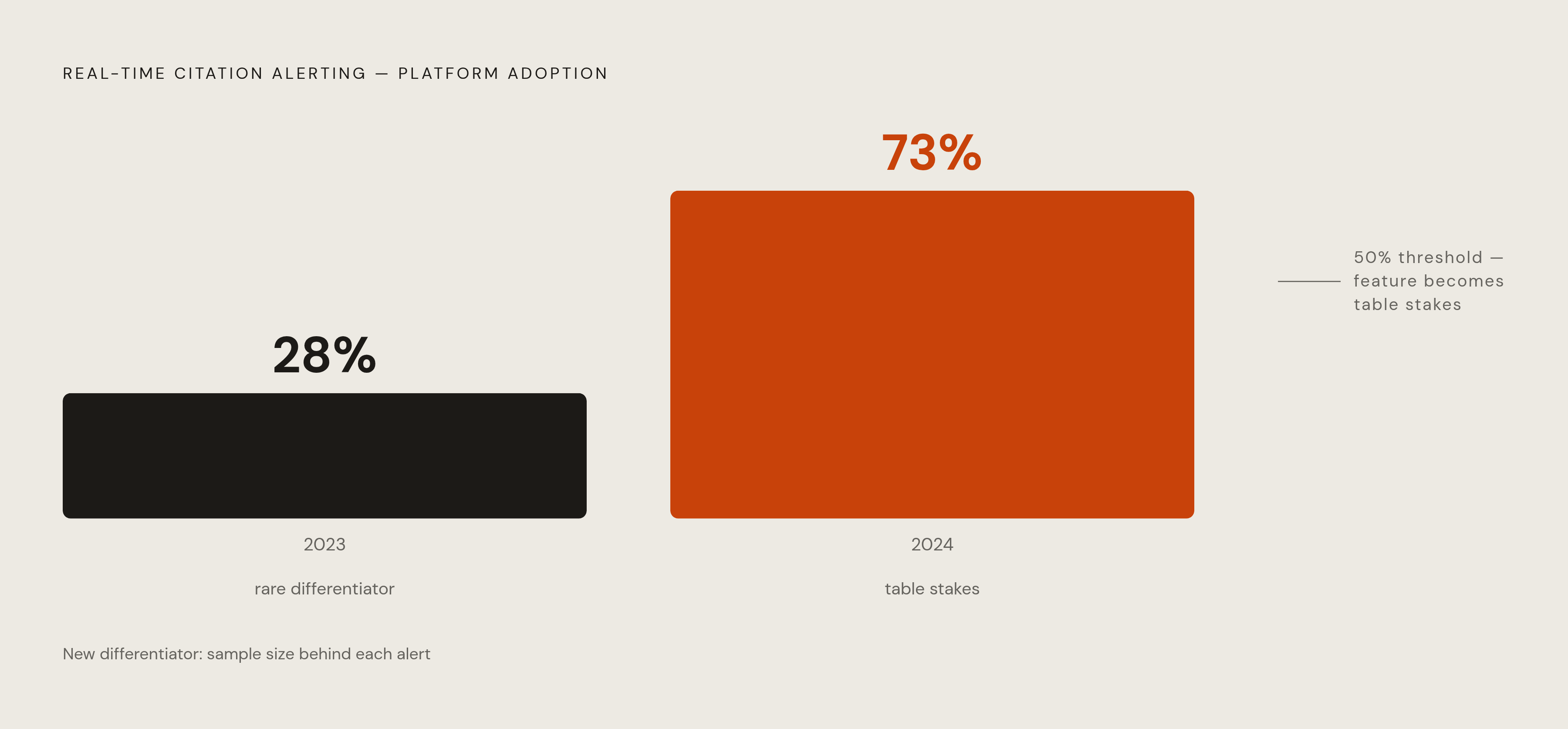
Real-time citation alerting used to be the differentiator that separated serious platforms from side projects. Real-time citation alerting used to be the differentiator that separated serious platforms from side projects, but that stopped being true as the feature spread. The share of platforms offering it jumped from 28% to 73% in about a year. The feature has become table stakes rather than a reason to choose one vendor over another. What separates vendors now is how many sampled sessions sit behind that alert before it fires; an alert built on a sample of one is not meaningfully different from no alert.
Platform profiles: strengths and limits of each tool
No platform in this category does all four things at the enterprise level yet, and buyers should stop waiting for one that does. The honest way to evaluate a vendor is to ask which of the four criteria it was actually built around, and which ones it treats as an afterthought bolted on for the sales deck.
Some platforms lead on funding and enterprise credibility: SOC 2 Type II certification, single sign-on, role-based access, the whole compliance checklist a large procurement team requires. They'll show a brand how often it's cited across a wide matrix of engines and hand over boardroom-ready dashboards. What they won't do is close the loop. There's no content pipeline, no built-in way to act on a visibility gap once it's found. For a team that needs airtight reporting up the chain and already runs a separate content operation to fix what the reporting turns up, that tradeoff works fine. For a leaner team that needs the platform to also do something about the problem it flags, the gap becomes obvious fast, usually right around the first quarterly review.
Other platforms take the opposite bet and build the full workflow: monitoring, auditing, content optimization, and delivery, often across multiple brands, markets, and languages inside one system. A smaller number go further still, serving AI-optimized content directly to AI agents at the infrastructure layer, so the version of a page an AI crawler retrieves can differ from what a human visitor sees, without degrading either experience. That's a fundamentally different architecture than a dashboard that flags a problem and hands the fix to someone else's roadmap. For a brand managing visibility across many properties at once, that's the sharpest dividing line in the category, and it's the one most sales decks work hardest to blur.
Enterprise teams evaluating this space should treat transparency itself as a qualifying test. Request the published engine matrix. The number of sessions behind each data point determines how much confidence anyone can place in the result. Ask whether the vendor's own research claims rest on a sample size large enough to trust. A vendor that won't answer on engine coverage, sampling method, cross-LLM measurement, or execution depth has already answered by dodging the question. Any platform worth shortlisting should be willing to publish its engine matrix and sampling methodology, on the reasoning that an enterprise buyer shouldn't have to take a vendor's word for what fraction of the AI search landscape it actually covers, platforms such as AthenaHQ, which tracks brand visibility and citations across eight or more LLMs, make that cross-platform scope explicit as a baseline. Whichever platform a brand team signs with, that's the bar to hold every vendor to before the contract, not after.