Revenue Impact of AI Search Invisibility in Financial Services
AI search engines are erasing financial brands from customer discovery before prospects ever click.

Financial services brands are losing the discovery phase of the buying journey before a prospect ever lands on a website, and the cause is structural rather than seasonal or cyclical. The old client acquisition model in banking, wealth management, and fintech ran on organic Google rankings that drove inbound leads through a sequence of clicks: a prospect searched a term, visited several competing sites, compared products or advisors across those visits, and eventually converted through a form, a call, or a branch visit. That sequence gave financial brands several chances to earn trust along the way, since each click was an opportunity to demonstrate expertise, show proof points, or simply be remembered.
That sequence is breaking down. Organic search traffic for financial services has declined year over year, and McKinsey finds that brands unprepared for the shift could see traffic from traditional search channels fall by 20 to 50 percent. The traffic has not vanished so much as it has relocated: a majority of U.S. adults now use AI tools, including ChatGPT, Gemini, Claude, Perplexity, and Copilot, to search for information, a shift AP-NORC has documented across the broader population. AI-generated summaries now resolve queries completely enough that the person asking never needs to click further, producing what the industry calls zero-click behavior: the prospect reads the AI's synthesized answer and stops there. Discovery, comparison, and selection now happen inside the AI response window, not across a set of visited websites. A brand that does not appear in that window is absent from the prospect's consideration set.
Financial services is exposed to this shift more than most industries because of what its organic traffic was built on. The query types that historically drove inbound visits for banks, fintechs, and advisors, things like product explanations, platform comparisons, and regulatory information, are precisely the query types AI systems now answer directly and without ambiguity. Fintech in particular shows the largest search volume decline of any measured vertical, well above the dataset average and significantly worse than SaaS or insurance, a gap that reflects how dependent the category has always been on informational queries that AI can now resolve without sending anyone anywhere. The result raises an unavoidable question for every bank, fintech, wealth manager, and insurer still measuring success by click-through rate: if AI engines have become the new discovery layer, what happens to the brand that the AI never mentions?
The prospects who do arrive at a financial services website by way of an AI engine are not casual browsers comparing early-stage options. They arrive further along in the decision process, and they convert at rates that dwarf what traditional organic search ever produced. A missed citation is not a missed impression but a missed deal. The scale of that referral channel is already large enough to matter: Adobe's 2026 data shows AI referral traffic to financial services growing dramatically year over year during the 2025 holiday season, evidence that the channel has moved well past its early, experimental phase and into one that is both sizable and still accelerating.
The economics of financial services make this gap harder to absorb than it would be in a lower-ticket category. A single new M&A advisory engagement represents the kind of lifetime value that makes even a handful of missed citations meaningful at the pipeline level, not a rounding error to be addressed later. A new RIA client who brings substantial assets under management generates years of recurring advisory fees, so when an AI citation surfaces the firm at the exact moment a prospective client is researching advisors, that citation works as a pipeline event, not a brand impression. The same arithmetic holds for banks and insurers weighing the stakes of a missed mention in a mortgage comparison, a commercial account search, or a policy renewal query: the ticket size is large enough that a single missed citation can be worth more than months of conventional marketing spend.
This financial logic makes AI visibility trackable as a revenue channel and a concrete financial stake. Once a brand can see which queries it is losing and which competitor is capturing them instead, the cost of invisibility turns from an abstraction into a line item.
Where finance brands rank among the invisible in AI citations
AI citation concentrates among a small number of names, and finance and insurance as a category rank at the bottom of the citation frequency table relative to every other vertical measured. That positioning matters because citation frequency functions as a rough proxy for how often a brand enters a prospect's consideration set at all, and financial services brands are, on average, entering that set less often than their counterparts in nearly any other industry.
The concentration gets sharper, not softer, once the lens narrows to individual brands. Capital One was mentioned in roughly one in five financial services recommendations generated by ChatGPT in June 2026, more often than any other brand measured, the EMARKETER AI Visibility Index for the second quarter of that year found. If a single brand captures one in five recommendations in an entire category, that leaves a shrinking remainder for every other bank, fintech, insurer, and wealth manager competing for the same AI-generated answer. The pattern across the data is consistent: a small number of brands are absorbing a disproportionate share of AI recommendation surface, while the rest compete for whatever citation volume remains.
That concentration forces a harder question than simple competitive positioning. If citation is this scarce and this unevenly distributed, the brands losing out need to understand whether the cause is a content gap they can close with better messaging, or something more fundamental in the systems that determine what gets cited.
One in three top fintech brands is structurally invisible to AI crawlers before content quality even enters the picture
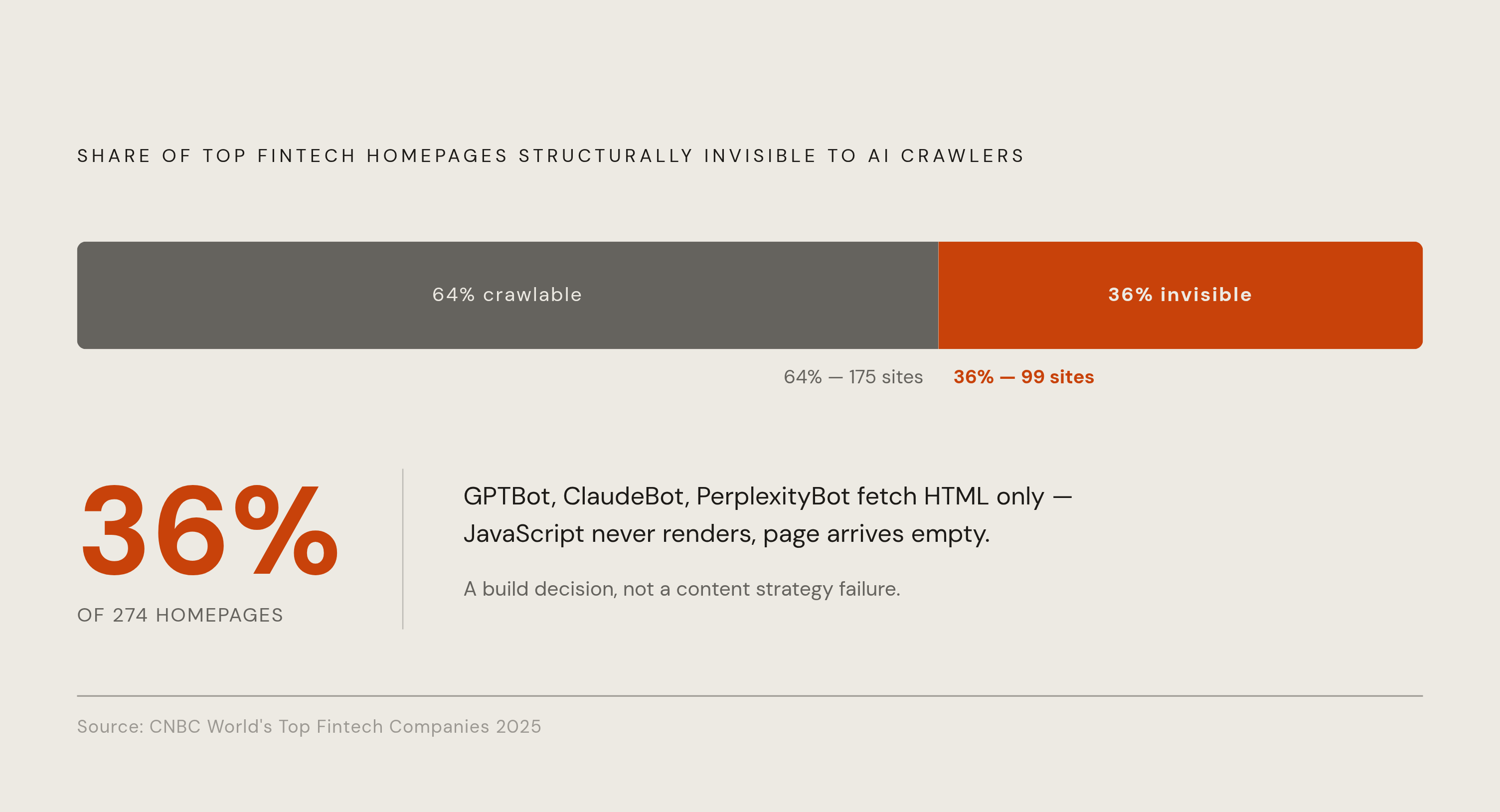
Much of the invisibility problem in financial services traces back not to weak content strategy but to a front-end architecture decision made years ago for human visitors, one that AI crawlers are simply unable to navigate. A study done in May 2026 looked at 274 fintech homepages drawn from the CNBC World's Top Fintech Companies 2025 list, and it found that 36 percent of these platforms are invisible to AI crawlers at the most basic technical level. The crawlers in question, GPTBot, ClaudeBot, and PerplexityBot among them, do not render JavaScript the way a human browser does. Each makes a simple HTTP fetch and retrieves whatever exists in the raw HTML returned, nothing more.
When a fintech homepage depends on JavaScript to populate its actual content, as a large share of modern web applications do, the crawler retrieves what amounts to an empty page. At that point, schema markup, carefully built brand authority signals, and any deliberate citation strategy no longer matter, because the AI agent never saw the content in the first place. The consequence is blunt: one in three of the world's most prominent fintech brands is structurally excluded from AI-generated answers about its own product category, and the cause has nothing to do with strategy or messaging. It is a build decision made on the front end.
Financial services carries a second layer of difficulty on top of the technical one. Financial content has long carried Google's Your Money or Your Life designation, and AI systems hold it to a similar trust threshold when they decide what to cite. Content that cannot demonstrate experience, expertise, authoritativeness, and trustworthiness, the signals known collectively as E-E-A-T, faces a steeper bar for citation than equivalent content in less regulated categories. It applies to AI retrieval the same way it has always applied to organic rankings. Regulated verticals are fighting a harder version of a problem that less-regulated industries barely notice.
Entity consistency compounds both problems at once. AI models function, in effect, as consensus engines: when a brand's hours, products, or regulatory details differ from one directory or data source to the next, the model loses confidence in the accuracy of what it knows and may simply exclude the brand rather than risk surfacing something wrong. In financial services, where regulatory standing, fee structures, and licensing details carry real stakes for the consumer reading the answer, that kind of inconsistency is especially costly. None of this is fixable through content alone, which raises the next question: since each AI engine retrieves and verifies content differently, a fix that restores visibility on one platform may do nothing at all for the others.
How ChatGPT, Perplexity, Gemini, and Claude source their financial answers
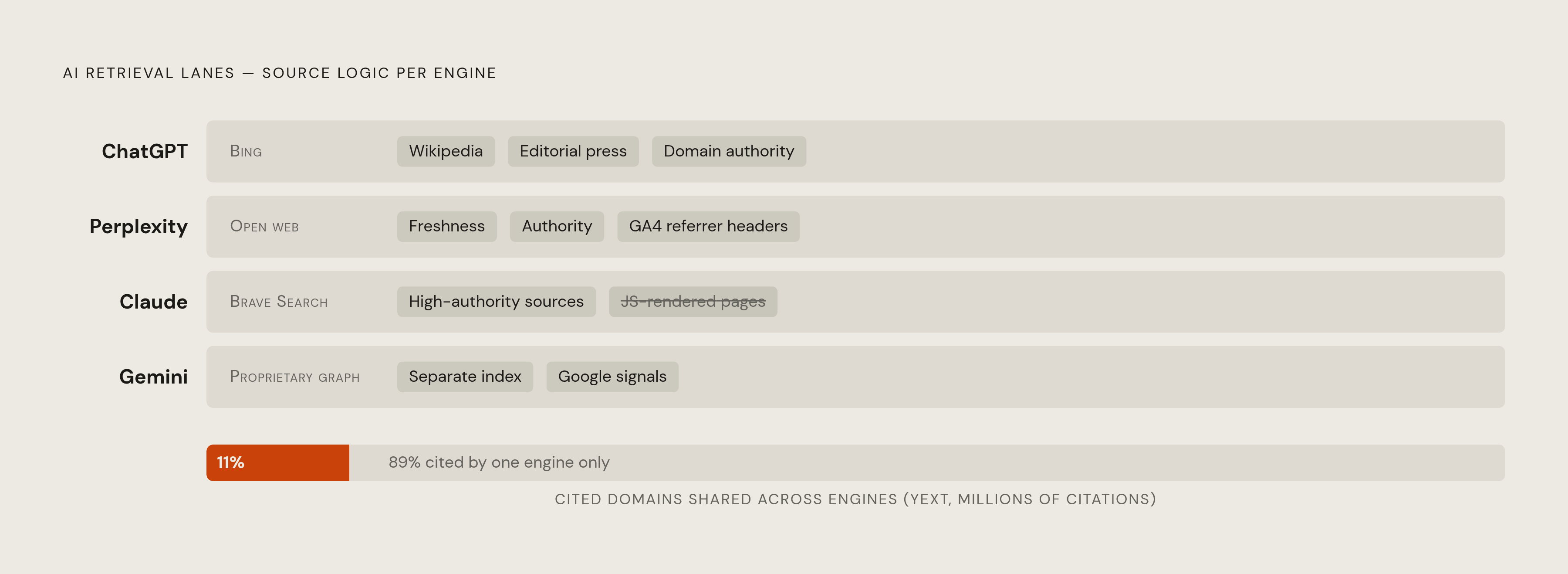
Each major AI engine retrieves content through its own mechanism and rewards its own set of signals, so visibility on one platform cannot be assumed to carry over to another. Only 11 percent of cited domains appear across multiple platforms for identical queries, according to a Yext analysis covering millions of AI citations, meaning the citation graphs for these engines barely overlap at all.
ChatGPT pulls its retrieval layer from Bing, and it rewards Wikipedia presence, broad web authority, and editorial press coverage. It represents the largest citation surface of any engine measured, but it tends to paraphrase answers without naming sources unless SearchGPT mode is explicitly activated, which makes tracking actual brand mentions on the platform considerably harder than it looks. Perplexity was built from the outset as a response engine with explicit citations baked into the product, and every response displays its sources with clickable links. Other engines surface citations more selectively or require a web-search mode to be switched on, which makes Perplexity one of the most consistently trackable major AI engines for referral traffic inside GA4, since it reliably passes referrer headers on every citation click; it also rewards freshness and authority in what it chooses to cite. Claude retrieves through Brave Search and rewards high-authority, well-sourced content, but ClaudeBot must be able to reach that content, and JavaScript rendering limits what Claude can cite.
The practical consequence for a bank, insurer, fintech, or advisory firm is that a fix built for one engine's retrieval logic will not automatically register on the others. Winning visibility across ChatGPT, Perplexity, Claude, and Gemini simultaneously requires understanding each engine's source preferences and citation mechanics as separate problems rather than one unified search strategy. That is the structural reason financial brands now need cross-platform visibility tracking rather than single-engine optimization: prospects complete their research inside whichever AI system they happen to be using, and a brand has no way of knowing in advance which one that will be. Platforms like AthenaHQ, an AEO and GEO platform that quantifies AI citation presence across eight or more models, track citation presence across large language models in real time, so financial brands can see exactly where they appear, and where they don't, across the engines that are actually shaping buyer decisions. Few financial services marketing teams are measuring any of this with the rigor it demands.
The wrong signals financial brands measure and the AI revenue gap they miss
The AI revenue gap in financial services does not appear in most marketing dashboards, and the reason is not that the gap fails to exist. It is that the metrics most teams still track were never built to detect it, so the loss accumulates quietly while traditional reporting continues to look stable. McKinsey finds that only 16 percent of brands systematically track AI search performance at all, which leaves the overwhelming majority operating with no visibility into whether they appear in AI-generated answers in any given category. A standard organic traffic report can look healthy in the same quarter a brand loses substantial ground inside AI answers, because McKinsey finds GEO performance at industry-leading brands can already lag traditional SEO performance by a wide margin. Four signals actually define AI search visibility, and standard dashboards are not built to capture any of them. Mention frequency measures how often a brand surfaces across a sample of relevant queries. Citation rate measures how often an AI engine cites a specific page when it builds its answer. Sentiment captures whether the AI characterizes the brand positively, neutrally, or negatively on the occasions it does appear. Share of voice compares a brand's relative presence against its competitors on identical queries, measured simultaneously across ChatGPT, Perplexity, Gemini, and Claude rather than on any single platform in isolation.
Sources
- The AI Search Reckoning in Financial Services
- mckinsey.com
- The Fintech Brands Winning in AI Search Have One Thing Their Competitors Do Not - Impact Wealth Fintech AI Search Visibility: Why Some Brands Win in 2026
- AI Search Visibility: The 2026 Optimization Guide
- AI Visibility Index: Financial Services Q2 2026 Insights