Tracking Brand Mention Sentiment Shifts in LLMs After a Campaign Launch
How to measure brand sentiment shifts inside AI models after your campaign launches.

A campaign launch today produces two distinct reputational outcomes: one in the places marketers have always measured, and another inside AI model responses that most teams have no process for tracking at all. That second outcome behaves nothing like social sentiment or search rank, so it needs its own methodology, and this article lays that out, from pre-campaign baseline through post-launch measurement.
LLM responses as a distinct layer of brand reputation
When a prospective customer asks ChatGPT or Perplexity for a recommendation in a given category, the model collapses what used to be several separate research steps, a search query, a few open tabs, a comparison review, into a single conversational answer, and the path to purchase now runs inside that answer rather than toward it, as impact.com's Dave Yovanno described to Forbes. That compression matters because it means a brand's fate in that moment is decided entirely by how the model chooses to represent it, with no intervening click for the brand to win or lose on its own terms.
A brand can carry strong social sentiment and healthy review scores, but still be missing from AI answers, or show up only in a negatively framed mention, because what produces social reputation and what produces LLM reputation are structurally independent of one another. Social listening tools and review aggregators were never built to see this layer, and they still cannot. Sight AI's 2026 tracking guide frames the difference bluntly: a brand can respond to a negative tweet, correct it, escalate it, apologize for it, but LLM sentiment forms inside a black box that most marketing teams have not yet learned how to open, and there is no reply button for a model's assessment.
Absence inside that black box is not a neutral outcome. When a brand fails to appear in response to the core prompts that define its category, while competitors are surfaced with detailed, favorable recommendations, that silence reaches the model's users with the same force as an explicit negative mention. The same brand, asked about on the same topic, will also produce meaningfully different sentiment profiles depending on whether the question goes to ChatGPT, Claude, Gemini, or Perplexity, because each model trained on different data, built different retrieval systems on top of that training, and applies different logic when generating a response. Meltwater's research into LLM brand mentions points to the practical consequence: tracking coverage across multiple models exposes blind spots that a single-platform view would never reveal, places where a competitor dominates the conversation entirely or where the brand simply never comes up. A 2026 analysis of hundreds of millions of citations found that only a small fraction of the domains ChatGPT cites overlap with the domains Perplexity cites, which confirms that no brand can treat these platforms as one undifferentiated audience. Measurement, like the optimization work that precedes it, has to be built platform by platform.
How LLMs form and update brand sentiment: static and dynamic layers
LLM brand sentiment is generated fresh at query time from two different layers of model behavior, baked-in training associations and real-time retrieval, and because those two layers move at different speeds, sentiment can shift measurably after a campaign goes live. If you understand the two layers separately, the data you collect during a campaign reads as interpretable instead of confusing.
Static sentiment is the set of associations encoded into a model's weights during training, the product of how a brand appeared in aggregate across news coverage, reviews, documentation, and forum discussion at the time the model was trained. It changes slowly and does not respond to any single campaign, no matter how well executed. Dynamic sentiment is the layer a model builds at the moment of the query, when it retrieves current web sources to supplement what it already knows, pulling in recent articles, reviews, or citations that can color the answer within a much shorter window. Sight AI's brand sentiment analysis guide offers a useful comparison: static sentiment behaves like a general impression formed over a long relationship, while dynamic sentiment behaves like a recent experience or a fresh news story that temporarily overrides that impression, and a model processes both of these simultaneously when it answers a question. If a campaign earns strong coverage in authoritative, independent publications, it can move within weeks, but the static layer needs a sustained content presence over a much longer stretch first.
The probabilistic nature of how these models generate text adds another layer of complexity: brand sentiment is not a binary toggle, and the same prompt can produce subtly different responses across sessions. A reliable sentiment read requires repeated querying rather than a single data point. That variance is a design feature of the technology, not noise to be eliminated, and any measurement framework has to be built to tolerate it.
The deeper reason a campaign can move this needle at all comes down to where these models get their information. Third-party sources, not content the brand publishes itself, dominate what LLMs surface in response to a query, and that fact is the structural reason a campaign's reach into independent, authoritative publications is the primary lever for changing AI sentiment. Writer's research into generative engine optimization puts a number on this: roughly 85% of brand mentions inside AI search responses originate from third-party pages rather than brand-owned sites, and a brand is far more likely to be cited because an independent publisher or community wrote about it than because its own website said so. impact.com's 2026 guide frames the underlying logic as a form of authority aggregation: these models surface what credible creators, publishers, and communities are already saying about a brand, and owned content alone cannot manufacture that consensus. So when a post-campaign sentiment shift appears in AI answers, you know the campaign's third-party content has already gained enough authority and reach to enter the model's retrieval pool, and that makes the shift a lagging but trustworthy signal of how far the campaign actually traveled.
Establishing the pre-campaign baseline across multiple LLMs
You need a reference point captured before launch, or you can't measure any of this. A pre-campaign baseline is the fixed anchor you interpret every later reading against, and without it, you can't tell a genuine shift in sentiment from the ordinary variance built into how these models generate responses. Campaign-specific tracking should begin before the launch date and run for at least 30 days afterward, with the pre-launch snapshot serving as the anchor for that entire measurement window.
The baseline needs to be captured across a minimum platform set: ChatGPT, Claude, Perplexity, and Gemini. Sight AI's tracking guide identifies these as the major models consumers actually use to research and get recommendations, and each one brings different training data, a different retrieval method, and a different knowledge cutoff to the same question, so a baseline built on only one platform tells an incomplete story. The prompt set you use to generate that baseline has to mirror how a real prospective customer actually searches, using the customer's own language rather than the terms the brand uses internally to describe itself. That means building out direct queries such as "Tell me about [Brand]" and "What are the pros and cons of [Product]?", alongside category-level queries that ask the model for the best tools or providers in a given space, problem-solution queries framed around the need the product addresses rather than the product's name, and head-to-head comparison queries that pit the brand directly against a named competitor.
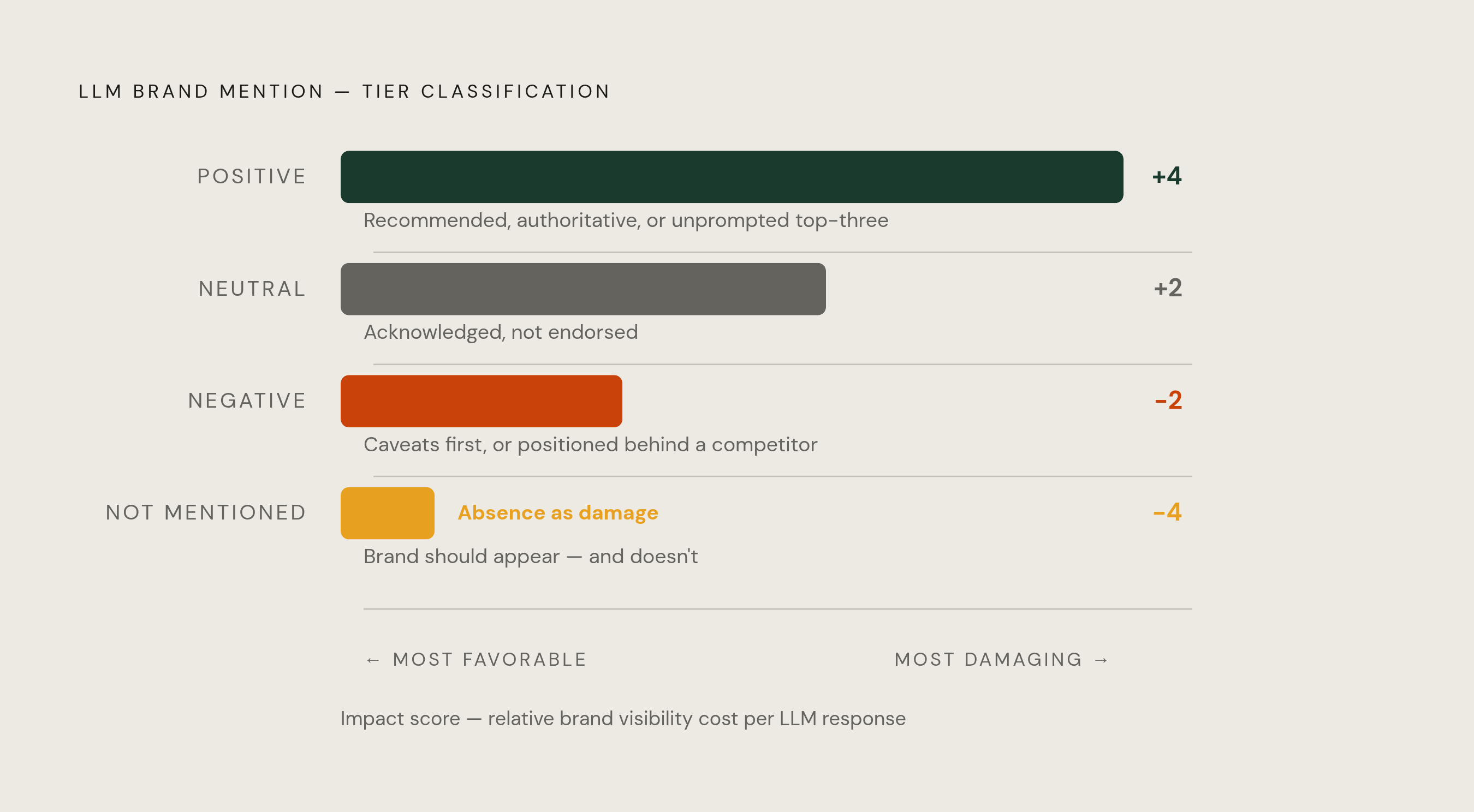
Every response gathered against that prompt set then needs to be scored using a four-tier classification system built to capture the full range of outcomes. A positive classification applies when the brand is recommended with favorable context, when the language used positions it as an authority in its space, or when it is included unprompted in a top-three list. A neutral classification covers responses where the brand is acknowledged but not meaningfully endorsed one way or the other. A negative classification applies when the brand appears with caveats attached, when its limitations are surfaced before any benefit, or when it is positioned as secondary to a named competitor. The fourth tier, not mentioned, covers prompts where the brand should plausibly appear but does not, and Sight AI identifies this as sometimes the most damaging outcome of all, since it means the brand sits entirely outside the model's consideration set for that query.
Every one of these responses needs to be logged with real documentation discipline: which model produced it, the exact prompt text used, whether the brand was mentioned at all, the sentiment tier it earned, the specific phrases the model used (language like "industry-leading," "reliable choice," or "limited features" carries real weight), which competitors appeared in the same response, and where in the answer the brand landed, first, third, or last, since position shapes how a user reads the recommendation regardless of the words used. When responses carry unusually strong positive or negative framing, you should capture them as screenshots the moment they appear, because these systems are probabilistic, and the same prompt may not reproduce that exact language later.
The metric stack for tracking sentiment during and after a campaign
Sentiment polarity alone, positive, neutral, or negative, is too blunt an instrument to carry a campaign's measurement load on its own. A usable metric stack needs to track how often the brand shows up, how it's positioned against competitors when it does, the quality of what's driving those mentions, and whether the overall picture is trending in the intended direction.
Share of Model is the top of that stack: it tracks how often the brand appears specifically as the recommended answer, not merely mentioned in passing, across the full set of AI-generated responses being tracked. impact.com's 2026 guide treats Share of Model as the metric replacing share of voice as the primary measure of visibility in this environment. This is the number that answers the central question a campaign is meant to move: is the brand actually being recommended more often than it was before launch.
Everything else in the stack exists so you can explain why Share of Model moved, or failed to. Position in the answer, whether the brand lands first, third, or last among the options a model names, is one such diagnostic: LLM Lab's research shows that brands recommended first convert at significantly higher rates than those mentioned as an afterthought, and a shift in position after a campaign is a meaningful signal even in weeks when raw mention frequency stays flat. An AI Visibility Score, a composite that combines mention frequency, sentiment, and coverage across the prompt set and competitive landscape, gives teams a single benchmark to track across multiple measurement periods, which Sight AI's monitoring guide positions as the mechanism for watching progress over time. Sentiment accuracy asks whether the model's description of the brand reflects its current offerings, correct specifications, and intended positioning, since a factually wrong positive mention creates its own kind of problem distinct from polarity. Prompt coverage is the share of the brand's target prompt set on which it appears at all, and when it's low, it flags categories the brand actually competes in but isn't associated with; LLM Lab's guide treats that as a direct signal to build more authoritative third-party content in those specific topical areas. Citation source quality rounds out the diagnostic layer: tracking which third-party domains a model draws on when it mentions the brand shows whether a campaign's placements in authoritative publications have actually entered that model's retrieval pool, and their absence from citations suggests the content hasn't yet been indexed and surfaced by the system.
Calibrating what counts as a meaningful shift requires some sense of where the category stands overall. LLM Pulse's GEO research puts median visibility across measured brands, in their own core category, somewhere in the single to low double-digit percentage range of prompt responses, with category leaders reaching 40 percent or above. If a team knows where its baseline sits relative to those bands, it can judge whether a five-point move after launch is a real gain or just ordinary noise.
Monitoring frequency and the timing window for detecting post-campaign shifts
The window during which a campaign's effects become visible in LLM outputs is set by how quickly third-party content clears the path into a model's retrieval system, and a monitoring schedule has to be built around that lag rather than around the campaign's own launch calendar.
Static sentiment, the layer encoded into model weights, can't move during a typical campaign window at all, because retraining cycles run on their own infrequent schedule. What a campaign can realistically influence is the dynamic layer, because it's built through real-time retrieval and moves on a faster cycle when new, authoritative content gets published. Sight AI's monitoring guide tells you to step up monitoring frequency for brands in fast-moving sectors like technology and finance, where models may pull in recent news or updates quickly, and to increase monitoring cadence during the launch period for any brand running a major campaign, so you can catch how the model integrates new information as it arrives.
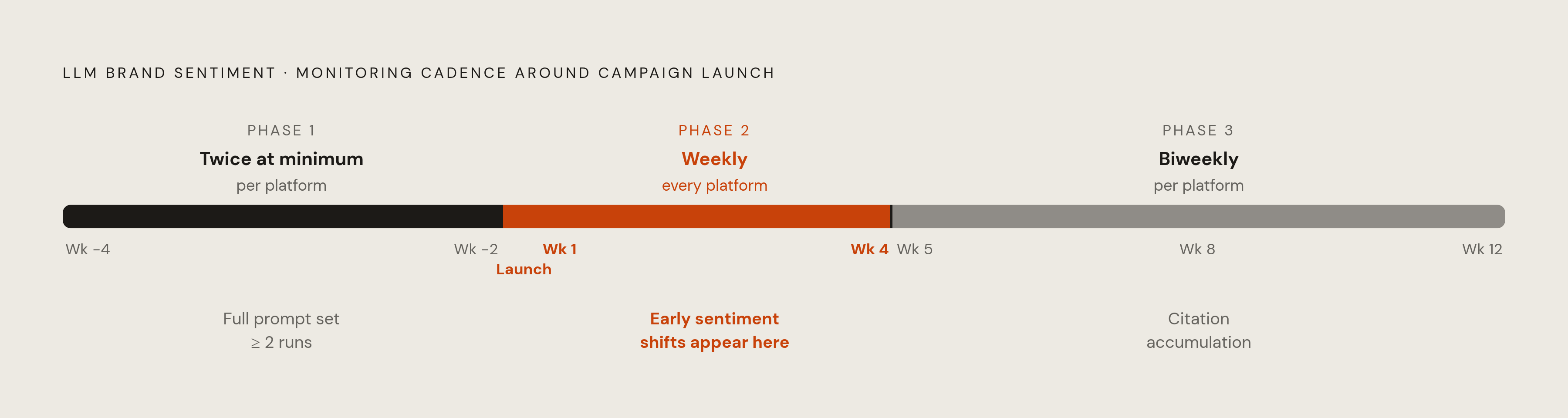
A workable cadence breaks into three phases. In the two to four weeks before launch, the full baseline prompt set should run at least twice per platform, establishing a stable reference point rather than a single noisy snapshot. From launch week through the fourth week after, you should run the prompt set weekly across every platform you track, because this stretch carries the highest probability of early dynamic sentiment movement. From week five through week twelve, the cadence can drop to biweekly; campaign-specific tracking guidance calls for a 30-day window at minimum, but if you run the full quarter you catch slower citation accumulation that a 30-day window would miss entirely.
At each of those checkpoints, you have to manage variance deliberately rather than assume it away. Because LLM outputs are probabilistic, you should run each prompt multiple times per session and average the results, since a single query response is not a reliable data point on its own. Sight AI's sentiment analysis guide notes that the same prompt can return subtly different answers depending on context, phrasing, and the random sampling process the model uses during generation. Timing also varies by platform: different models retrieve and weight new content at different speeds, so a sentiment shift that appears quickly in Perplexity, which leans heavily on real-time retrieval, may not reach ChatGPT for several more weeks. Tracking every platform on the same schedule, rather than checking one and assuming the rest will follow, lets a team tell a campaign that moved the needle apart from a single model that happened to notice first.
Sources
- GEO, AEO, and SEO in 2026: The enterprise guide to AI visibility - WRITER
- Generative Engine Optimization (GEO): The Complete Guide for 2026 - LLM Pulse
- How to track brand mentions in AI search 2026 | impact.com
- Track Brand Sentiment In Llms: Complete 2026 Guide - Sight AI
- Monitor LLM Brand Sentiment: Complete Guide 2026 Tips
- Brand Sentiment Analysis In Llms: Complete Guide 2026
- Brand Sentiment Analysis for AI Visibility in 2026 - BrandMentions.link
- LLM Brand Mentions: Tracking, Metrics & More