AI Search Lift Measurement for E-Commerce Brands
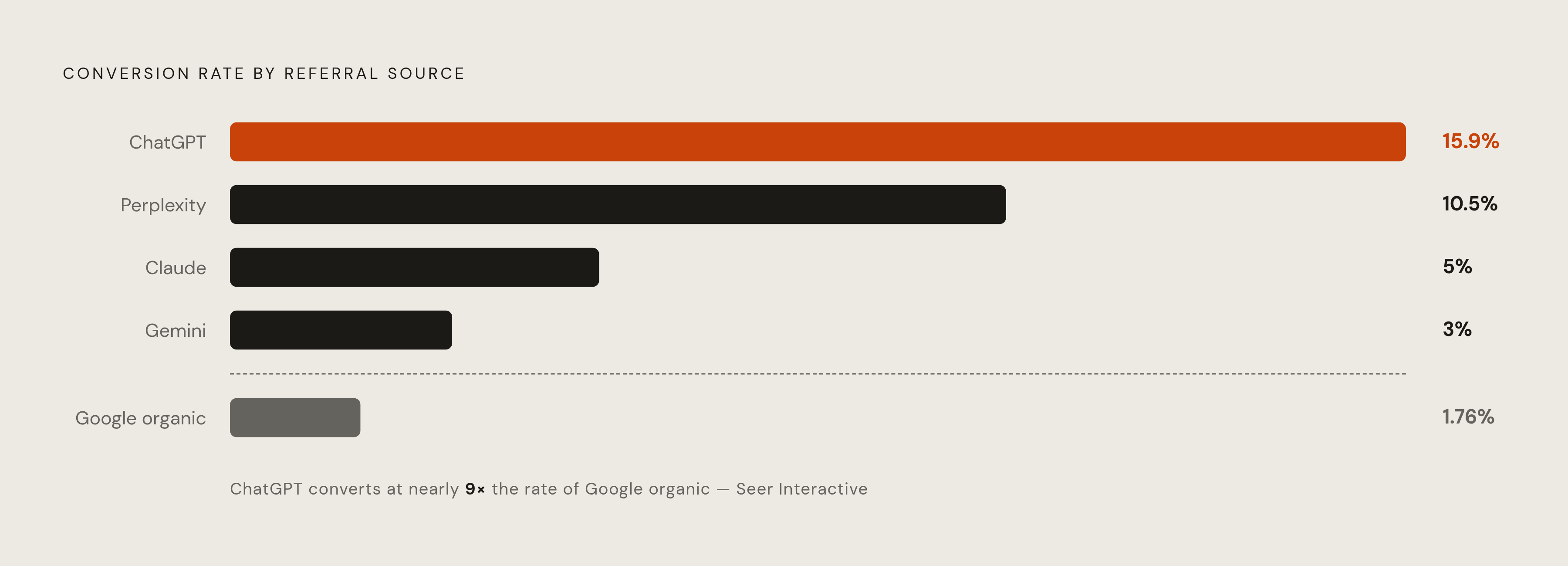
AI referrals convert nine times better than Google organic search.

Consumer adoption of AI shopping tools crossed a real threshold in 2025: Stord's State of AI 2026 report found 51% of consumers used generative AI for online shopping that year, up from 38% in 2024. Brands still reporting acquisition through SEO and paid metrics alone are measuring a channel that's shrinking while ignoring the one replacing it, and that habit costs money in a way most finance teams haven't noticed yet.
Why AI-referred shoppers convert so much better than organic or paid visitors
A shopper who lands on a site after Googling "running shoes" is still shopping around. One who lands after asking ChatGPT which running shoe to buy has already been filtered, because the AI matched intent to a specific product before the click happened at all. That pre-qualification shows up directly in the numbers, and the effect is not small.
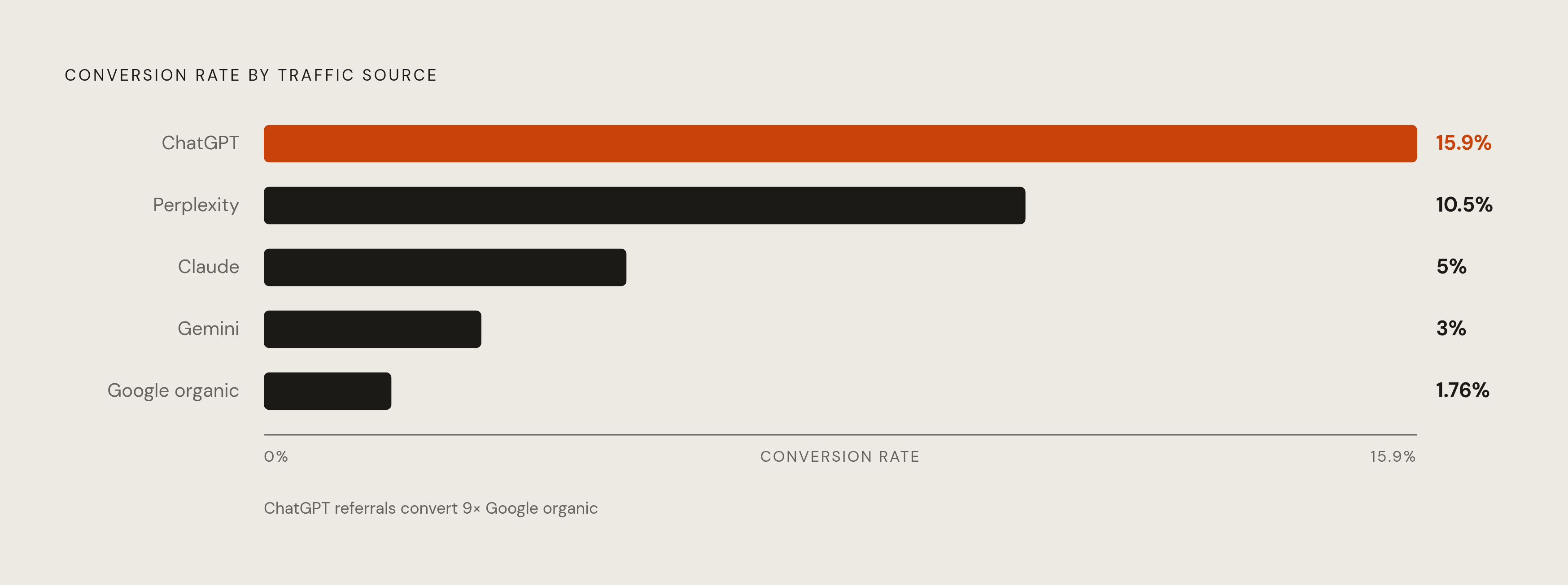
Seer Interactive's benchmark puts ChatGPT-referred visitors at a 15.9% conversion rate against 1.76% for Google organic traffic. Perplexity referrals convert at 10.5%, Claude at 5%, Gemini at 3%. Order value tells its own story: Perplexity referrals carry a notably higher average order value despite modest volume, so the platform someone consults while researching a purchase shapes not just whether they buy, but how much they spend once they do.
AI referral traffic is the best acquisition source most brands aren't tracking with any rigor, a gap made plain by the distance between 15.9% and 1.76%. The real question is why so few teams have a clear read on it, and the answer has nothing to do with laziness.
The core measurement problem: most AI-influenced orders leave no clickstream trace
The answer is structural. SparkToro's 2026 zero-click study found 69.5% of UK searches and 68% of U.S. searches now end without a click at all, and LLMs pass fewer than 1% of prompts through to an external website as a referral link. Most of what's happening never generates anything to follow in the first place.
Triple Whale's order data shows the scale of what's shifting underneath that: merchants logged more than 424,000 orders from LLM referrals in the fourth quarter of 2025 alone, against just 7,152 across all of 2024. Triple Whale's own post-purchase survey data suggests the true count of AI-influenced orders runs 2.5 to 3 times higher than what referral logs capture. That gap is the whole story here, and it's worth walking through exactly how it happens.
A shopper asks ChatGPT which running shoe to buy, gets an answer, opens a new tab, types the brand name into the address bar, and buys. That session lands in analytics as direct traffic. No referral tag exists anywhere in the chain, because UTM parameters and last-click attribution were built for a web where people click links to get where they're going. The recommendation happens in one window and the purchase happens in another, and that pattern breaks the old model rather than just straining it.
Most brands, as of late 2025, had no systematic tracking of AI search performance in place. Referral-based tooling was never built to see this kind of handoff, and no amount of tuning it closes the gap by itself.
Layer one — what referral data can actually tell you right now
Referral data is worth collecting, though it covers only part of the picture. GA4 and most analytics platforms let a team segment sessions by referral domain; filtering for chat.openai.com, perplexity.ai, claude.ai, gemini.google.com, and copilot.microsoft.com isolates the AI traffic that does leave a trace.
That traffic doesn't belong to one platform anymore, either. ChatGPT's share of measurable B2B AI referrals has dropped from 89% to 63% as Claude, Gemini, and Perplexity pick up volume, so a setup that watches only ChatGPT already misses a growing slice of the picture. Segment by platform instead of lumping everything into one "AI traffic" bucket: the conversion gap between ChatGPT (15.9%) and Gemini (3%) is too wide for a blended average to mean anything useful. Track sessions, conversion rate, revenue per session, average order value, and pages per session separately for each platform, since that pattern shows which audience is close to buying and which is still just browsing.
One more wrinkle. OpenAI's rollout of in-platform checkout through Shopify in September 2025 created a new order category entirely, one that starts and finishes inside ChatGPT and shows up in merchant dashboards through an API feed rather than a browser referral. Pull that data separately, or it disappears from the picture altogether.
Referral analytics, done well, still shows only the part of the iceberg above the water.
Layer two — post-purchase surveys as the ground truth for dark AI influence
The fix for the dark-funnel problem is low-tech: ask the customer. One question at the post-purchase confirmation stage, something like "How did you first hear about us?" with named AI tools listed as options, catches influence that never left a clickstream trace. Triple Whale's merchant data backs this directly, since the survey method consistently surfaces 2.5 to 3 times more AI-influenced orders than referral logs alone, exactly the undercount the clickstream problem predicts.
A few design choices decide whether this data is useful or just noise. List specific tools, ChatGPT, Perplexity, Google AI, Claude, rather than a generic "AI assistant" option, because people remember brand names, not categories. Ask about influence broadly rather than last touch alone; a question like "what first made you aware of this product" catches mid-funnel AI mentions that a last-click framing misses entirely. Keep it to one or two questions asked right at order confirmation. A short survey at the moment of purchase beats a longer one sent by email days later, when most people won't bother answering.
Treat the survey number as a multiplier on the referral number. If referral data shows a given volume of orders from LLM traffic and the survey shows two-and-a-half to three times that figure, apply the ratio to estimate total AI-influenced revenue. It won't be exact, but it holds up when someone in a board meeting asks where the number came from.
Survey answers also reveal something referral logs can't: which platform actually did the influencing. A brand might see strong ChatGPT referral numbers in GA4, then discover through survey responses that Perplexity is the real first-touch source for its highest-spending customers. The limitation is that surveys are self-reported and skew toward shoppers who remember their own research path clearly, which is exactly why a third layer is needed.
Layer three — brand visibility signals across LLMs as a leading indicator
AI share of voice measures how often a brand gets mentioned, recommended, or cited by an LLM compared to its competitors, in response to the kinds of questions shoppers actually ask. The logic mirrors traditional media: share of voice tends to lead market share, not follow it. A brand winning mentions in AI answers today is shaping the consideration set for purchases that close weeks or months out.
Across ChatGPT, Perplexity, Claude, and Google AI Overviews, the large majority of e-commerce brands are essentially invisible. That's rarely a product-quality problem. It's a gap in how the brand shows up in the data these systems were trained and grounded on, and unlike product quality, it's fixable on a reasonable timeline.
Four things are worth tracking here: citation rate (how often the brand shows up in answers to category questions at all), sentiment (whether the mention is positive, neutral, or hedged with caveats), competitive share (the brand's mentions as a percentage of every brand mentioned in that category), and platform distribution, since a brand can be strong on ChatGPT and nearly absent on Perplexity. Each platform draws on different sources when deciding what to cite: Each platform draws on different source types when deciding what to cite, and the mix varies meaningfully across ChatGPT, Perplexity, and Google AI Overviews. Averaging visibility across platforms hides all of this. Share of voice only means something when it's tracked per platform.
Share of voice serves as the leading indicator in this stack; referral data and survey data provide the lagging confirmation. Both halves matter, and neither one alone tells the full story.
How the three layers connect into a reportable measurement stack
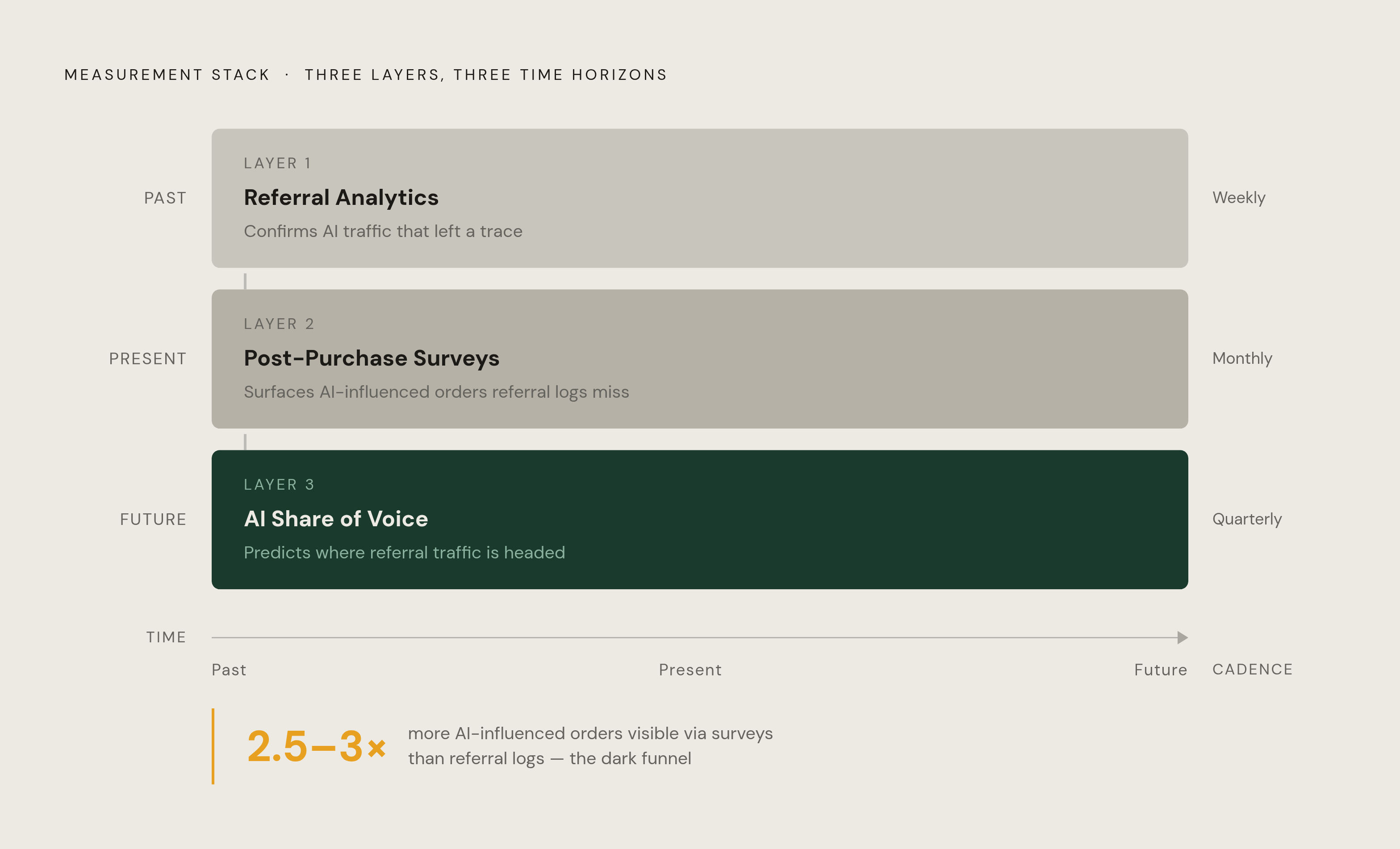
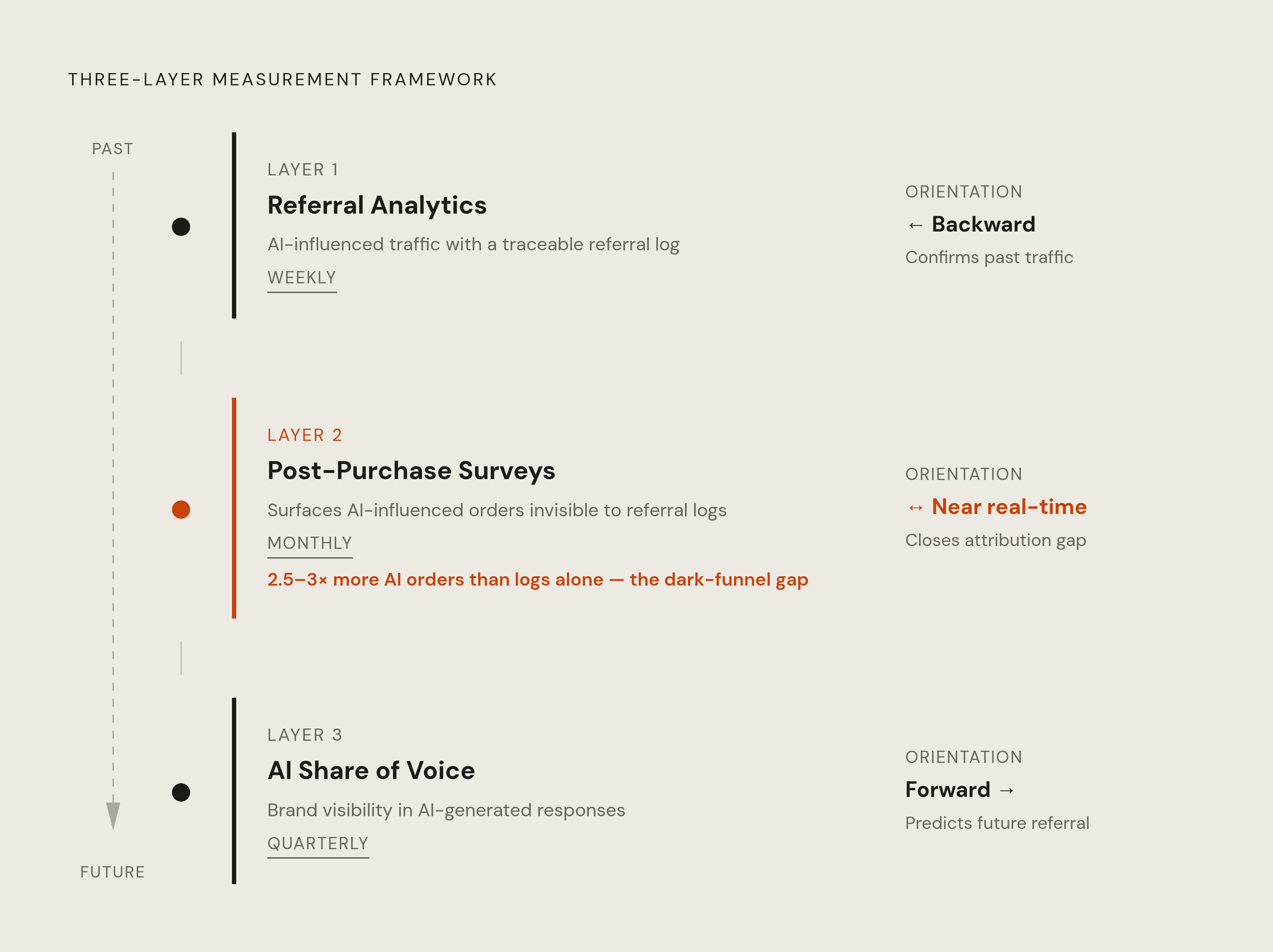
Each layer answers a different question about time. AI share of voice looks forward; it predicts where referral traffic and influenced revenue are headed next. Post-purchase surveys sit close to real time; they capture influence in orders that just closed. Referral analytics look backward; they confirm the slice of AI-influenced traffic that happened to leave a trace.
A working model for total AI-influenced revenue starts with confirmed referral revenue from GA4 or whatever analytics platform is in place, then applies the survey-derived multiplier, the 2.5 to 3x range Triple Whale's data points to, to estimate the revenue sitting in the dark funnel. Share-of-voice trend data explains the direction from there: whether that AI-influenced number is likely to grow, hold steady, or shrink over the coming quarter.
Cadence matters too, and running everything on the same schedule wastes effort. Referral data can be checked weekly since it's cheap to pull, while survey data needs a month to build a sample size worth trusting. Share-of-voice audits work best quarterly, since visibility shifts more slowly than traffic does.
The output of all this is one reportable number: estimated AI-influenced revenue and its trend line, paired with the share-of-voice data that explains why the trend is moving. Call it a defensible, directional model rather than a clean attribution one, since pretending otherwise would be dishonest. For most e-commerce teams right now, directional still beats nothing.
What determines whether a brand appears in AI answers at all
Peer-reviewed research has begun laying out frameworks for what's now called generative engine optimization. The finding that matters most for e-commerce: adding citations, quotations, and statistics to existing content tends to increase how often that content gets surfaced in AI-generated answers.
Entity clarity plays a role too. AI systems cite brands they can classify without ambiguity, so consistent naming, category description, and product signals across a website, its help docs, its social profiles, and third-party mentions make a brand easier for a model to understand, and therefore easier to recommend.
Earned media works as a credibility signal that brand-owned content can't replicate. LLMs weight third-party coverage, analyst mentions, and expert commentary heavily, since those sources function as outside validation rather than self-promotion. Recency counts for more than most brands assume, too: LLMs favor content that's recently published or updated, and content that goes stale can drop out of consideration even after months of reliable citation. Content recency appears to matter across platforms, with older material at risk of dropping out of consideration over time.
Where that content needs to live depends on the platform. Reddit and other community discussion carry meaningful weight for certain platforms, while earned media and long-form editorial coverage matter more to ChatGPT and Claude. Content distribution across multiple platforms and formats shapes which brands surface in AI answers. Put together, this points to a conclusion most e-commerce teams haven't internalized yet: visibility in AI answers is fundamentally a PR and content distribution problem, and treating it as an SEO checklist item is the surest way to stay invisible.
Building the measurement habit before the channel matures further
AI search's share of the market moved from somewhere around 5 to 6% at the start of 2025 to 12 to 15% by the middle of 2026. That's a channel maturing fast, and the window to build measurement infrastructure ahead of competitors is closing.
Brands that put the three-layer stack in place now, referral trend lines by platform, survey-derived multipliers, share-of-voice movement, will have months of baseline data before the channel gets crowded enough that gaining ground turns expensive. That data does something else too: it surfaces competitive intelligence no traditional analytics setup can produce, showing which AI platforms recommend competitors, what language they use to describe the category, and which content formats actually earn citations.
A reasonable starting point doesn't require much. Week one: segment GA4 by the known LLM referral domains and pull conversion and revenue per session for each. Week two: add a post-purchase survey question that names specific AI tools rather than a generic category. Within the first month, run a manual share-of-voice audit: ten category prompts, run across ChatGPT, Perplexity, Gemini, and Claude, with every brand mention logged by hand. By the end of the first quarter, move that tracking onto a platform built to monitor visibility across LLMs continuously.
The real payoff goes beyond better dashboards. A team that can show, with numbers, how much revenue AI search already drives and where it's headed next has the case it needs to get AI search its own budget line, its own optimization roadmap, and its own place in the executive reporting cycle. Measurement is the starting point, the thing that turns AI search from a variable nobody can see into a channel somebody is actually running.